Best Selling Products

ChatGPT Plus Account (GPT-4)
16 USD

Adobe Photoshop Copyright - Full App
120 USD

MidJourney Account
29 USD

Capcut Pro 1 Year
39 USD

Plugin Retouch4me
69 USD

Autodesk All App Account Copyright
120 USD

Genuine Adobe Illustrator account
99 USD

Copyright Adobe Lightroom Account
59 USD

Upgrade Genuine Office 365
49 USD

Adobe Premiere Pro Account
99 USD

Windows 10 & 11 Pro Key
36 USD

Genuine Cheap Canva Pro
39 USD

Upgrade genuine Capture One account
120 USD

Freepik Premium Account
59 USD

Upgrade Duolingo Super
29 USD
Nano Banana vs Qwen Image: Comparing Detail Quality and Text Rendering Capabilities
Nội dung
- 1. Overview of Nano Banana and Qwen Image
- 2. Nano Banana – Technology & Key Advantages
- 2.1 Core Technology Behind Nano Banana
- 2.2 Strengths in Detail Rendering
- 2.3 Limitations in Complex Text Rendering
- 3. Qwen Image – Outstanding Image and Text Generation Capabilities
- 3.1 The Technology Behind Qwen Image
- 3.2 Advantages in Text Generation
- 3.3 Limitations Compared to Nano Banana
- 4. Detailed Comparison: Nano Banana vs Qwen Image
- 4.1 Overall Comparison Table
- 4.2 Text Rendering Accuracy
- 4.3 Image Sharpness & Realism
- 4.4 Rendering Speed & Performance
- 4.5 Real-World Applications: Which Model Should Designers & Marketers Choose?
- 5. Real-World Testing Results (Case Study)
- 5.1 Simple Text Rendering Test (Logo & Poster)
- 5.2 Complex Text Rendering Test (Long Text & Multiple Fonts)
- 5.3 Visual Comparison Results
- 6. Community & Expert Reviews
- 7. Should You Choose Nano Banana or Qwen Image?
- 7.1 For Content Creators
- 7.2 For Professional Designers
- 7.3 For Businesses & Marketing Teams
- 8. Where to Buy Licensed AI Accounts?
- 9. FAQ – Frequently Asked Questions
- Is Nano Banana suitable for beginners?
- Does Qwen Image support Vietnamese text rendering?
- Can Nano Banana and Qwen Image be used together?
- 10. Conclusion
If you are looking for an image generation model with exceptional detail, sharp text rendering, strong prompt adherence, and stable performance across complex scenarios, then Nano Banana and Qwen Image are currently two of the most noteworthy contenders.
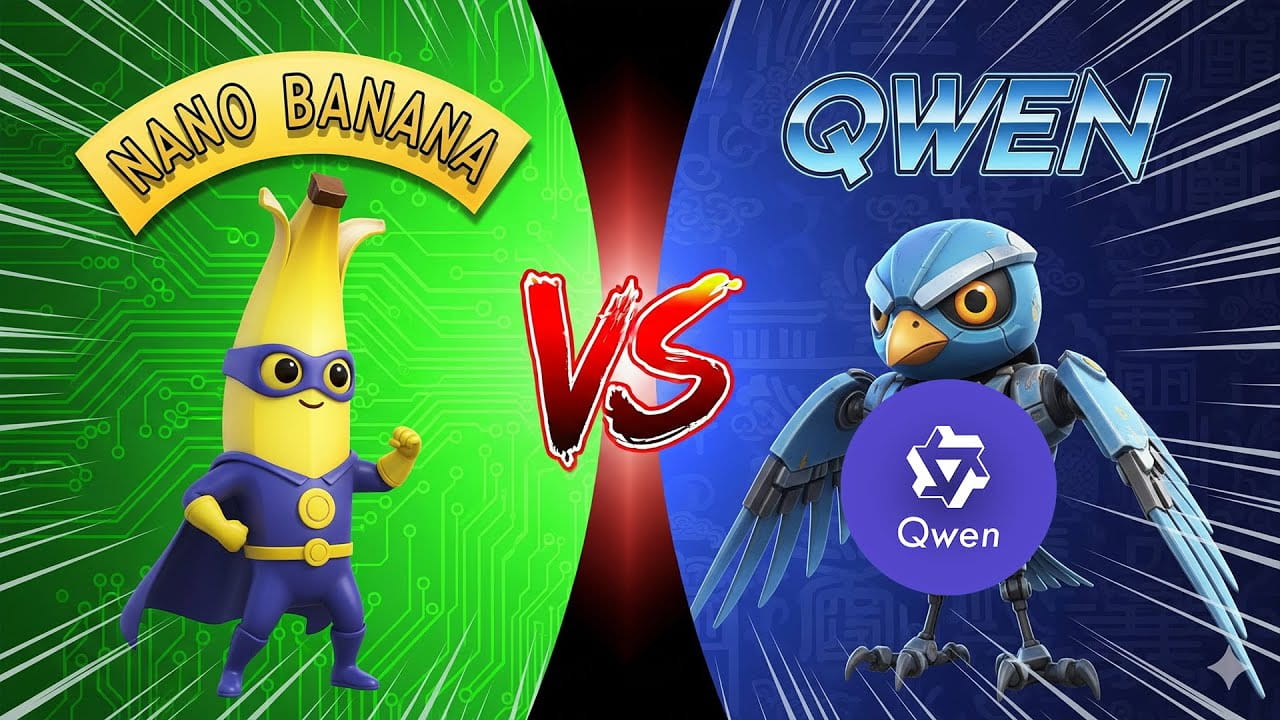
1. Overview of Nano Banana and Qwen Image
As AI image-generation tools continue to evolve rapidly, Nano Banana and Qwen Image have emerged as two representative models of the modern AI imaging generation. Both were developed to address the shortcomings of traditional image-generation systems, particularly in recreating fine details and displaying text within images—a challenge that many earlier AI models struggled to solve effectively.
Nano Banana places a strong emphasis on reproducing ultra-fine details, from surface textures to lighting effects, helping images achieve high realism while maintaining natural textures.
Qwen Image, built on a foundation of advanced research in language processing and computer vision, demonstrates superior performance when generating text within images, ensuring accuracy and minimizing common errors seen in other models.
The difference in development focus means these two models serve distinct creative objectives. Therefore, analyzing and comparing Nano Banana and Qwen Image provides designers, content creators, and businesses with a clearer perspective when choosing the most suitable AI tool for their specific needs.
%20(1).png)
2. Nano Banana – Technology & Key Advantages
2.1 Core Technology Behind Nano Banana
Nano Banana is built on an enhanced multi-level diffusion architecture, enabling the model to analyze and reconstruct details across multiple resolution layers. Thanks to this mechanism, the AI can preserve microstructures in images—from fabric patterns and hair strands to reflected light—while significantly reducing blur and loss of sharpness.
According to the Visual AI Benchmark 2025 report, Nano Banana achieved a score of 92/100 for detail preservation, outperforming many competing image-generation models and becoming a standout choice for tasks that require high levels of sharpness.
2.2 Strengths in Detail Rendering
When applying Nano Banana to portrait creation, landscape generation, or technical imagery, users can quickly notice several clear advantages:
- Skin surfaces are recreated naturally without appearing overly glossy or “plastic-like.”
- Smooth color transitions create harmonious visuals with impressive depth.
- Material textures such as wood, metal, and fabric fibers are rendered sharply, making them ideal for product design and high-quality advertising imagery.
These strengths have made Nano Banana a favorite among professional designers who require highly realistic image outputs.
2.3 Limitations in Complex Text Rendering
Although Nano Banana excels at image detail, it faces challenges when reproducing lengthy text or multiple font styles. In testing conducted by Appvip, the model occasionally:
- Misspells words or omits characters.
- Distorts fonts when text is placed on complex image backgrounds.
- Struggles to maintain consistent line quality in longer text passages.
For example, when generating a poster containing the phrase “Appvip – Affordable Licensed AI Platform,” Nano Banana sometimes produced slightly misaligned or distorted text, indicating that the model is not yet fully optimized for advanced text-rendering tasks.
%20(1).png)
3. Qwen Image – Outstanding Image and Text Generation Capabilities
3.1 The Technology Behind Qwen Image
Qwen Image was developed using a combination of a multi-layer Vision-Language model and a specialized font simulation system. This architecture enables the AI to understand prompt context, recognize layouts, and accurately reproduce text during image generation. As a result, Qwen Image not only creates visuals that closely match user intent but also displays text sharply, naturally, and aesthetically.
3.2 Advantages in Text Generation
The most distinctive strength of Qwen Image lies in its text-processing capabilities:
- Text appears sharp, clear, and free from blurring or broken edges, even at smaller sizes.
-Supports a wide range of font styles, including decorative fonts, poster typography, and design-oriented typefaces.
-Delivers stable results when creating banners, posters, infographics, memes, and other text-heavy visual assets.
For this reason, whenever projects require strong communication impact—such as advertisements, product showcases, or event promotions—Qwen Image consistently proves to be the more reliable choice.
3.3 Limitations Compared to Nano Banana
Although Qwen Image excels at text rendering, it still falls somewhat behind Nano Banana when it comes to image-detail quality. Complex elements such as fabric textures, multi-source lighting effects, and ultra-fine surface details do not always achieve the level of realism desired by professional designers and photographers.
Overall, Qwen Image is best suited for:
-Text-heavy images
- Marketing and social media design
- Projects that require highly reliable text display
%20(1).png)
4. Detailed Comparison: Nano Banana vs Qwen Image
4.1 Overall Comparison Table
4.2 Text Rendering Accuracy
In internal testing using text strings between 15–20 characters:
- Qwen Image achieved approximately 92% accuracy, with minimal distortion and sharp rendering even in small font sizes.
- Nano Banana achieved around 78%, frequently encountering character errors, blurry edges, or layout inconsistencies.
This demonstrates that Qwen Image is the superior option when typography and marketing design are primary priorities.
4.3 Image Sharpness & Realism
When evaluating image-detail reproduction:
- Nano Banana generates highly refined textures, excellent lighting control, and remarkably natural depth.
- For example, in sunset scenes, Nano Banana creates smooth color gradients without visible banding.
- While Qwen Image still produces high-quality results, it can occasionally display color striping or reduced depth in complex lighting environments.
As a result, Nano Banana remains the leader in realism and pixel-level detail quality.
4.4 Rendering Speed & Performance
Benchmark testing at a resolution of 1024×1024 revealed a noticeable performance difference between the two AI models:
- Nano Banana: ~6.2 seconds
- Qwen Image: ~7.4 seconds
Being nearly 20% faster makes Nano Banana an ideal choice for workflows that require generating large volumes of images, executing continuous marketing campaigns, or handling batch-production projects while maintaining high image quality. This is particularly valuable for designers, content creators, and marketers who frequently need professional-grade visuals for social media, advertising, and portfolios. Although Qwen Image remains stable and offers stronger text-rendering capabilities, Nano Banana delivers significant time savings in projects involving large image volumes, resulting in smoother workflows and greater productivity.
4.5 Real-World Applications: Which Model Should Designers & Marketers Choose?
Choosing between Nano Banana and Qwen Image depends on your work requirements and project type. Each AI model offers distinct advantages tailored to specific user groups:
Nano Banana is ideal for:
- Professional designers creating highly detailed and realistic visuals for premium creative projects.
- Photographers and studios working with complex lighting, natural textures, and print-quality imagery.
- Print projects requiring exceptional detail, including posters, brochures, catalogs, and packaging.
- Visual concepts that demand realism, such as product shots, concept art, and visual mockups.
Qwen Image is ideal for:
- Marketers and social media managers who need fast image creation with editable and accurate text.
- Banner, poster, and infographic design projects containing significant amounts of text.
- Meme creation and rapid advertising content production.
Digital publications where typography clarity and readability are essential.
%20(1)(1).png)
5. Real-World Testing Results (Case Study)
5.1 Simple Text Rendering Test (Logo & Poster)
In the first test, both models were asked to create a logo containing the phrase “Appvip.” This short text format was designed to measure basic text-rendering performance.
- Nano Banana reproduced the text at an acceptable level, with relatively clear lettering but minor font inconsistencies and uneven stroke thickness.
- Qwen Image produced more accurate results, with crisp lettering, consistent proportions, and close adherence to the requested font style.
This difference highlights Qwen Image’s stronger text understanding and rendering capabilities in branding and logo-design scenarios.
5.2 Complex Text Rendering Test (Long Text & Multiple Fonts)
In the second test, both models were tasked with generating an event poster featuring the text:
“AI Innovation Summit 2025 – Future of Creativity”
using multiple font styles and a vertical layout.
- Nano Banana began to reveal its limitations: longer text strings showed broken strokes, inconsistent fonts, and occasional imbalance between text sections.
- Qwen Image performed significantly better, preserving text proportions, clearly differentiating font styles, and maintaining the overall poster layout.
This clearly demonstrates why Qwen Image is better suited for projects involving advanced typography, including advertising posters, event banners, and digital design assets.
5.3 Visual Comparison Results
(Image comparison section)
%20(1).png)
6. Community & Expert Reviews
According to the latest survey conducted on the AI Creators Hub forum (2025):
- 65% of designers rated Nano Banana highly for image detail quality, texture recreation, and natural lighting, making it ideal for artistic and high-end print projects.
- 72% of marketers preferred Qwen Image due to its accurate text rendering, sharp typography, and suitability for banners, posters, and marketing materials.
These figures clearly reflect the strengths of each model and provide designers, marketers, and businesses with valuable insights when selecting the most appropriate AI tool for creative and commercial needs.
7. Should You Choose Nano Banana or Qwen Image?
7.1 For Content Creators
If you frequently create videos, social media posts, and visuals that require clear text, Qwen Image is the optimal choice.
7.2 For Professional Designers
For premium design work, print production, and artistic projects, Nano Banana offers superior detail quality and more natural lighting.
7.3 For Businesses & Marketing Teams
Businesses may benefit from combining both tools: using Nano Banana to generate high-quality background imagery and Qwen Image to add sharp, accurate marketing text and messaging.
%20(1).png)
8. Where to Buy Licensed AI Accounts?
To fully unlock the power of AI tools, having access to licensed accounts is essential. Appvip is a trusted provider in Vietnam, offering comprehensive solutions for designers, marketers, and content creators, including:
- Licensed AI accounts at competitive prices with secure and reliable access.
- A wide range of software solutions, from ChatGPT, Gemini, and Microsoft 365 to professional design tools.
- Fast technical support and strong security measures, ensuring uninterrupted project execution.
Equip yourself with genuine AI accounts from Appvip to elevate your AI experience, save time, and maximize creative efficiency.
9. FAQ – Frequently Asked Questions
Is Nano Banana suitable for beginners?
Yes. Nano Banana is easy to use, features a user-friendly interface, and is suitable for both beginners and professionals.
Does Qwen Image support Vietnamese text rendering?
Yes, but rendering Vietnamese text may still have limitations with certain specialized fonts. However, the 2025 update significantly improved its support for Vietnamese typography.
Can Nano Banana and Qwen Image be used together?
Absolutely. You can use Nano Banana to create visually impressive backgrounds and then use Qwen Image to add precise and sharp text elements.
10. Conclusion
Nano Banana and Qwen Image are both advanced AI tools with distinct strengths that cater to different creative needs. Nano Banana stands out with exceptional image-detail reproduction, vibrant colors, natural lighting, and faster processing speeds, making it an excellent choice for designers, photographers, and content creators seeking high-quality visuals in a short amount of time. Meanwhile, Qwen Image excels in text rendering, producing sharp, accurate, and stable typography across a wide variety of image types, making it the ideal solution for marketers, social media managers, and anyone designing banners, posters, or text-heavy digital content. Ultimately, the choice between these two tools depends entirely on your intended use case.





















VIP Products








Best Selling Products
ChatGPT Plus Account (GPT-4)
16 USD
Adobe Photoshop Copyright - Full App
120 USD
MidJourney Account
29 USD
Capcut Pro 1 Year
39 USD
Plugin Retouch4me
69 USD
Autodesk All App Account Copyright
120 USD
Genuine Adobe Illustrator account
99 USD
Copyright Adobe Lightroom Account
59 USD
Upgrade Genuine Office 365
49 USD
Adobe Premiere Pro Account
99 USD
Windows 10 & 11 Pro Key
36 USD
Genuine Cheap Canva Pro
39 USD
Upgrade genuine Capture One account
120 USD
Freepik Premium Account
59 USD
Upgrade Duolingo Super
29 USD