Best Selling Products

Windows 10 & 11 Pro Key
36 USD

Upgrade genuine Capture One account
120 USD

ChatGPT Plus Account (GPT-4)
16 USD

Copyright Adobe Lightroom Account
59 USD

Genuine Cheap Canva Pro
39 USD

Genuine Adobe Illustrator account
99 USD

Adobe Premiere Pro Account
99 USD

Upgrade Duolingo Super
29 USD

Capcut Pro 1 Year
39 USD

Upgrade Genuine Office 365
49 USD

Plugin Retouch4me
69 USD

Freepik Premium Account
59 USD

MidJourney Account
29 USD

Adobe Photoshop Copyright - Full App
120 USD

Autodesk All App Account Copyright
120 USD
What Is Nano Banana Pro and Why Is It Getting So Much Attention?
Nội dung
- 1. The Technology Behind Its Smartphone-Like Image Recreation
- 2. Why Do Users Easily Mistake Nano Banana Pro AI Images for Real Photos?
- 3. The Characteristics That Make Nano Banana Pro Images Feel Familiar
- 4. The “Intentional Imperfections” That Make AI Images Look More Real
- 5. Practical Applications of Smartphone-Style Images
- 6. What Benefits Does Nano Banana Pro Offer Content Creators?
- 7. How Nano Banana Pro Differs from Traditional Image Generation Models
- 8. Why Do People Easily Confuse Nano Banana Pro Images with Real Photos?
- 9. Industries That Will Directly Benefit from Smartphone-Style AI Images
- 9.1 Advertising – Marketing
- 9.2 E-commerce
- 9.3 Independent Content Creators
- 9.4 Journalism and Informational Media
- 10. The Future of Everyday Photography in the New AI Era
- 10.1 Expanding Opportunities for Content Creators
- 10.2 But Major Challenges Will Follow
- 10.3 A New Era Is Taking Shape
- 11. Nano Banana Pro Learns from Millions of Everyday Photos
- 12. Smartphone Image Processing Simulation Preserves the “Real Capture Feeling”
- 13. Why Does the Human Eye Get Easily Fooled by Nano Banana Pro?
- 14. Conclusion
Nano Banana Pro is Google’s latest image generation model, emerging as a phenomenon thanks to its ability to recreate visuals that look “just like real life” in a surprisingly convincing way.
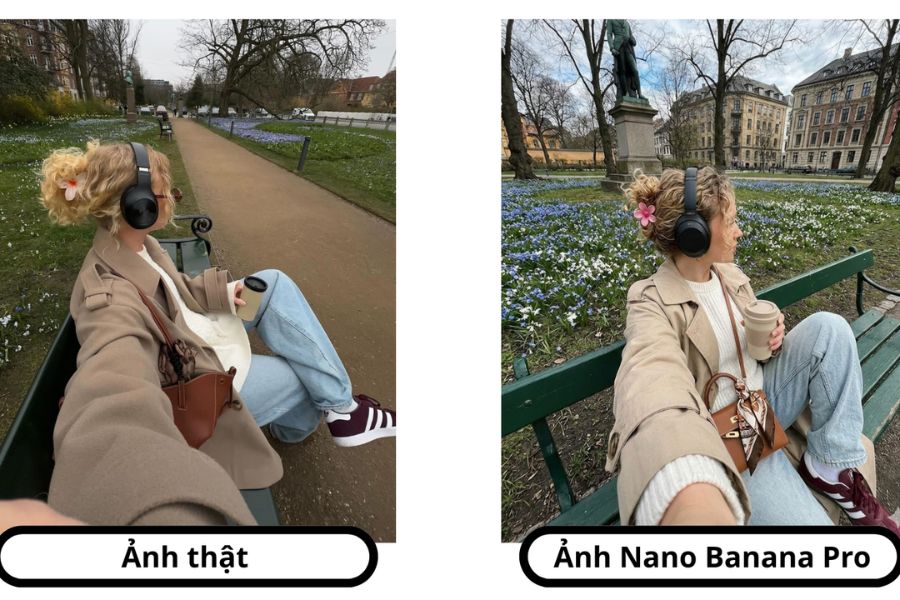
1. The Technology Behind Its Smartphone-Like Image Recreation
To create “true smartphone-style” images, Nano Banana Pro is trained based on how smartphones process images in real-world conditions. Instead of generating overly perfect visuals, it simulates the entire image-processing pipeline of a smartphone camera:
Key technological elements include:
Recreating smartphone HDR algorithms: Flat lighting while preserving details in both bright and dark areas.
Maintaining familiar sharpness: Clear details without excessive smoothing like older AI image styles.
“Everyday” white balance: Neutral tones without studio-like color shifting.
Reproducing light noise and grain: Similar to photos captured under average smartphone lighting conditions.
Wide depth of field: Both subject and background remain sharp, matching smartphone camera characteristics.
2. Why Do Users Easily Mistake Nano Banana Pro AI Images for Real Photos?
One reason Nano Banana Pro has exploded in popularity is because its generated images feel so “real” that viewers struggle to tell whether they are actual photographs or AI-generated.
This comes down to three major factors:
The images are not overly perfect, preserving random imperfections found in real smartphone photography.
The colors and lighting feel familiar, giving viewers the sense of “I’ve seen photos like this before.”
There are no distorted AI errors, which used to make AI-generated images easy to detect.
This visual familiarity makes the human brain automatically classify them as real photographs rather than AI creations.
.jpg)
3. The Characteristics That Make Nano Banana Pro Images Feel Familiar
What makes Nano Banana Pro different is its ability to reproduce the exact “visual language” of smartphones — something almost everyone interacts with daily.
The features that create this familiar feeling include:
Soft, neutral tones without oversaturation.
Flat lighting without unrealistic cinematic effects.
Clear details without excessive sharpness.
Backgrounds are not heavily blurred like professional camera shots.
Objects, lines, and textures are processed naturally.
This naturalness makes the images feel less like “AI-generated art” and more like authentic captured moments.
4. The “Intentional Imperfections” That Make AI Images Look More Real
Instead of avoiding flaws, Nano Banana Pro deliberately simulates the imperfections commonly found in smartphone photography — and this is exactly what makes the images feel authentic.
Some intentionally recreated imperfections include:
Light noise in darker areas.
Slightly uneven or imperfectly balanced lighting.
Subtle motion blur in smaller details.
Occasionally cluttered backgrounds, just like real-life snapshots.
Details that are not as razor-sharp as professional camera shots.
These factors make the images feel alive and believable instead of “hyper-perfect,” which often appears fake to viewers.
5. Practical Applications of Smartphone-Style Images
Smartphone-style visuals are becoming a major trend due to their accessibility and realism. This is why Nano Banana Pro is widely used for:
Social media content creation (TikTok, Facebook, Instagram)
Simulated product review photos that look genuinely photographed*
Lifestyle, travel, and fashion imagery
Journalistic illustrations and professional blog visuals
Natural-looking video thumbnails
Advertising visuals in the “real people – real moments” style
.jpg)
6. What Benefits Does Nano Banana Pro Offer Content Creators?
For the creative community, Nano Banana Pro has become an optimized tool, especially as authentic and relatable content continues to dominate.
Key benefits for creators, marketers, and brands:
Generate natural-looking images quickly without real lighting setups or locations.
Save photography costs without renting equipment or hiring photographers.
Higher trustworthiness: images that look real are easier for audiences to accept.
Compatible across all platforms, from social media to e-commerce.
Easy large-scale image production for ad campaigns or ongoing content creation.
At AI Software World, this tool is currently rated as one of the most practical AI image generators available for creators today.
7. How Nano Banana Pro Differs from Traditional Image Generation Models
Nano Banana Pro stands out among countless image generation models not because it creates “perfectly beautiful” visuals, but because it dares to move in a direction that seems less glamorous: recreating the exact feel of ordinary daily-life photography that people see every day on their phones. This is something previous models rarely prioritized.
Midjourney always produces highly cinematic images, with glowing lighting and visually dramatic composition. Stable Diffusion often leans more toward artistic expression than realism. These models are impressive, but they create distance from real life, making it obvious that they are AI-generated.
Nano Banana Pro reverses this standard. Instead of adding “perfection,” it adds the flaws people are used to seeing: flat HDR-like lighting, slight edge roughness, evenly distributed sharpness from near to far, and slightly faded colors like rushed smartphone photos. This “against-the-crowd” strategy makes Nano Banana Pro a new trend in approachable, familiar AI imagery that blends naturally into real photos on social media.
.jpg)
8. Why Do People Easily Confuse Nano Banana Pro Images with Real Photos?
There are many reasons why Nano Banana Pro tricks the human eye so effectively, but the biggest factor is visual habit. For over a decade, users have become deeply familiar with smartphone photo aesthetics: soft lighting, muted tones, moderate contrast, and images that are sharp but not aggressively crisp.
When Nano Banana Pro reproduces these exact characteristics, the brain automatically interprets them as real because they resemble thousands of photos users have already seen in their own galleries.
Additionally:
Minor AI imperfections resemble real smartphone camera flaws (lens distortion, grain, slight blur).
The brightness and colors feel like quick snapshots in natural conditions, without heavy editing.
The compositions feel spontaneous rather than artificially staged.
When viewed quickly on smaller screens like TikTok, Facebook, or Instagram, users have even less time to notice subtle inconsistencies. This is why many Nano Banana Pro images are mistaken for real photos even when zoomed in.
9. Industries That Will Directly Benefit from Smartphone-Style AI Images
Nano Banana Pro’s “real-life realism” offers practical applications across multiple industries.
9.1 Advertising – Marketing
Modern campaigns increasingly prefer relatable authenticity over polished studio photography. Nano Banana Pro helps marketers generate hundreds of “real-feeling” visuals quickly for social ads, UGC campaigns, and simulated reviews.
9.2 E-commerce
Sellers can generate product visuals in realistic everyday settings without hiring photographers or building studio environments. Products can be shown in homes, cafes, or outdoor spaces, making them easier for customers to imagine using.
9.3 Independent Content Creators
KOLs, TikTokers, and bloggers no longer need complex setups. A simple prompt can generate perfect visual storytelling elements — from daily-life narratives to clean smartphone-style thumbnails.
9.4 Journalism and Informational Media
For analytical articles, event reconstructions, or difficult-to-access situations, Nano Banana Pro can create highly convincing “ordinary-life” visuals without the artificial appearance typical of older AI-generated images.
.jpg)
10. The Future of Everyday Photography in the New AI Era
As visual AI continues evolving, Nano Banana Pro is opening an entirely new direction for everyday imagery. Instead of chasing unrealistic perfection, the future lies in emotionally rich realism that feels naturally captured.
Next-generation AI models will increasingly recreate “real-life signals,” including:
Natural environmental lighting: from dim bulbs to angled afternoon sunlight and uneven room lighting.
Characteristic motion blur of quick snapshots.
Natural optical flaws: light flares, fine grain, edge glow.
Realistic human skin textures: natural roughness, pores, and shine without excessive smoothing.
The spontaneous messiness of life: stray hairs, off-center objects, imperfect backgrounds.
This combination will create a future where AI images and real photographs become nearly indistinguishable.
10.1 Expanding Opportunities for Content Creators
Models like Nano Banana Pro allow anyone to build a “massive image library” that once required professional studios.
Creators can:
Generate realistic illustrations from simple text prompts.
Build emotional characters, settings, and stories.
Produce social-ready visuals without expensive shoots.
Create 4K smartphone-style visuals with flagship-level lighting and color.
10.2 But Major Challenges Will Follow
Truth and fiction will blur more than ever. Key concerns include:
Difficulty distinguishing real photos from AI-generated ones.
Potential misuse through deepfakes and misinformation.
Questions of responsibility: creator, platform, or AI tool?
The urgent need for transparency through watermarking and verification systems.
10.3 A New Era Is Taking Shape
Nano Banana Pro is only the beginning. In the coming years:
AI will recreate emotions, environments, lighting, and materials with increasing precision.
AI-generated visuals may become the new standard for advertising, creativity, and filmmaking.
The line between reality and fabrication will continue fading, requiring new ethical and detection standards.
The future of everyday imagery is opening a new chapter: more beautiful, more realistic, and full of opportunity — but also demanding thoughtful caution.
(1).jpg)
11. Nano Banana Pro Learns from Millions of Everyday Photos
Nano Banana Pro’s core strength comes from its massive training dataset. Instead of focusing on polished artwork, it was trained on:
Quick everyday snapshots
Low-light noisy photos
Street scenes and ordinary surroundings
Selfies and natural portraits
Images from multiple smartphone brands
This diversity helps the model deeply understand how smartphone cameras reproduce reality: uneven lighting, wide depth of field, rougher details, and manufacturer-specific color rendering.
This is why many viewers cannot distinguish Nano Banana Pro images from real photos at first glance.
12. Smartphone Image Processing Simulation Preserves the “Real Capture Feeling”
Smartphones have highly distinctive image processing pipelines: small sensors, powerful algorithms, and layered post-processing. Nano Banana Pro not only understands this data but replicates the process itself.
Accurately recreated elements include:
Even HDR-style brightness across the frame.
Sharp foreground and background matching smartphone lens behavior.
Slight edge contrast enhancement for screen clarity.
Slightly vibrant default smartphone camera colors.
Because it reproduces these smartphone “signatures,” Nano Banana Pro images feel like they were taken with the same phones users carry every day.
13. Why Does the Human Eye Get Easily Fooled by Nano Banana Pro?
The human brain recognizes images through overall feeling rather than detailed analysis. When viewing an image for only a few seconds, we judge it based on familiar lighting, sharpness, and angles.
Three reasons people get confused:
The model reproduces characteristic “minor flaws” like wide-angle distortion, grain, and subtle blur.
Everyday photos are naturally imperfect — slight roughness feels more believable.
Fast social media scrolling leaves no time for deeper inspection.
This blend of realism, natural flaws, and familiar processing style makes Nano Banana Pro one of today’s most visually convincing AI models.
14. Conclusion
Nano Banana Pro is proving that the future of imagery is no longer about perfection, but about realism convincing enough to fool the senses. By accurately simulating smartphone camera processing styles, it creates images that feel as natural as daily-life snapshots. This opens a new creative era where anyone can produce vivid content from only a few lines of text.
However, alongside these opportunities come growing concerns around authenticity. AI Software World believes that proper understanding and reliable verification technologies will be the key to helping users, businesses, and digital platforms safely enter the era of unbelievably realistic AI-generated imagery.





















VIP Products








Best Selling Products
Windows 10 & 11 Pro Key
36 USD
Upgrade genuine Capture One account
120 USD
ChatGPT Plus Account (GPT-4)
16 USD
Copyright Adobe Lightroom Account
59 USD
Genuine Cheap Canva Pro
39 USD
Genuine Adobe Illustrator account
99 USD
Adobe Premiere Pro Account
99 USD
Upgrade Duolingo Super
29 USD
Capcut Pro 1 Year
39 USD
Upgrade Genuine Office 365
49 USD
Plugin Retouch4me
69 USD
Freepik Premium Account
59 USD
MidJourney Account
29 USD
Adobe Photoshop Copyright - Full App
120 USD
Autodesk All App Account Copyright
120 USD