
Best Selling Products

Copyright Adobe Lightroom Account
59 USD

ChatGPT Plus Account (GPT-4)
16 USD

MidJourney Account
29 USD

Genuine Cheap Canva Pro
39 USD
Upgrade genuine Capture One account
120 USD
Plugin Retouch4me
69 USD
Upgrade Genuine Office 365
49 USD

Freepik Premium Account
59 USD
Adobe Premiere Pro Account
99 USD
Adobe Photoshop Copyright - Full App
120 USD

Upgrade Duolingo Super
29 USD
Genuine Adobe Illustrator account
99 USD
Windows 10 & 11 Pro Key
36 USD
Autodesk All App Account Copyright
120 USD

Capcut Pro 1 Year
39 USD
The Difference Between Integrated Graphics Cards And Dedicated Graphics Cards
Nội dung
- 1. Overview of graphics cards
- 1.1. What is an integrated graphics card?
- 1.2. What is a dedicated graphics card?
- 2. Advantages and Disadvantages of Integrated Graphics Cards and Dedicated Graphics Cards
- 2.1. Advantages of Integrated Graphics Cards
- 2.2. Disadvantages of Integrated Graphics Cards
- 2.3. Advantages of Dedicated Graphics Cards
- 2.4. Disadvantages of Dedicated Graphics Cards
- 3. Performance Comparison Between Integrated Graphics Cards and Dedicated Graphics Cards
- 4. Should You Choose an Integrated Graphics Card or a Dedicated Graphics Card?
- 5. Conclusion
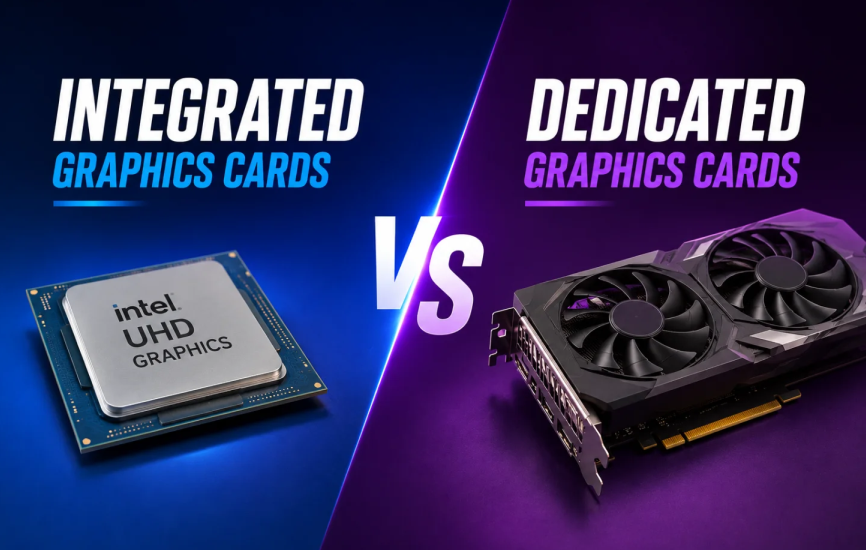
When choosing to buy a laptop or PC, you have probably often heard about integrated graphics cards and dedicated graphics cards. These are two familiar concepts, but not everyone clearly understands the difference and role of each type.
1. Overview of graphics cards
1.1. What is an integrated graphics card?
An integrated graphics card (Integrated GPU) is a graphics processor attached directly inside the CPU or on the motherboard of a computer. Unlike a dedicated card, this type of card does not have its own memory but shares system resources, specifically RAM and the processing power of the CPU, to display images. Because of that, the performance of an integrated card depends largely on the overall configuration of the machine. Thanks to its compact design, power saving, and low heat generation, integrated cards are often equipped on most office laptops, study computers, or mobile devices that need to optimize battery life.
With the ability to meet basic needs well such as watching Full HD movies, light photo editing, online learning, or web browsing, integrated graphics cards become an ideal choice for general users. Today, manufacturers such as Intel (with the Iris Xe line) or AMD (with Radeon Vega) have continuously improved the performance of integrated GPUs, helping the visual experience become increasingly smoother while still ensuring compactness and energy saving. It can be said that an integrated graphics card is a solution that balances performance and cost, suitable for the vast majority of users who do not have intensive graphics needs.
.jpg)
1.2. What is a dedicated graphics card?
A dedicated graphics card (Discrete GPU) is an independent graphics processor, specially designed to optimize computing power for complex visual tasks. Unlike an integrated card, a dedicated card has its own VRAM memory, helping process and store image data at high speed without affecting system RAM. Thanks to its powerful and stable operation, a dedicated card is the “heart” of gaming computers, graphics laptops, and professional PCs. This is an indispensable choice for gamers, designers, engineers, video editors, or people working in the field of content creation.
The strength of a dedicated graphics card lies not only in its outstanding performance but also in its flexible upgrade capability. Users can easily replace or upgrade a dedicated GPU to improve processing power without needing to replace the entire machine. Famous brands such as NVIDIA and AMD always lead the market with many outstanding product lines such as GeForce RTX or Radeon RX, meeting diverse needs from general to high-end. However, greater power also means higher power consumption and more heat generation, so dedicated cards are often suitable for those who truly need superior graphics performance for work or top-level entertainment.
.jpg)
2. Advantages and Disadvantages of Integrated Graphics Cards and Dedicated Graphics Cards
2.1. Advantages of Integrated Graphics Cards
Integrated graphics cards stand out thanks to their compact design, space-saving nature, and compatibility with most mainstream laptops and PCs today. Since they are integrated directly into the CPU or motherboard, users do not need to spend extra money purchasing a separate graphics card, helping significantly reduce the initial investment cost. Another major advantage is their extremely low power consumption, allowing the computer to operate cooler, more stably, and with longer battery life, especially beneficial for laptops that are frequently carried around.
In addition, today's integrated graphics cards have been greatly improved compared to the past. Integrated GPUs such as Intel Iris Xe or AMD Radeon Vega can effectively handle studying, office work, high-quality video playback, and even many lightweight games. Their convenience, affordability, and sufficient performance make integrated graphics cards the perfect choice for general users who do not require intensive graphics processing power.
2.2. Disadvantages of Integrated Graphics Cards
Although they offer many advantages, integrated graphics cards still have certain limitations. Since they must share system RAM, their graphics processing performance is generally much weaker than that of dedicated graphics cards. As a result, computers are more likely to experience lag or slowdowns when handling demanding tasks such as playing 3D games, rendering videos, or creating complex graphic designs.
Furthermore, integrated graphics cards do not support advanced graphics technologies such as Ray Tracing or DLSS, which are only available on high-end GPUs. Another drawback is that integrated graphics are permanently built into the CPU or motherboard, making upgrades or replacements impossible when users want to improve performance. Therefore, if you are a creative professional or frequently work with images and videos, an integrated graphics card may not provide the optimal experience.
.jpg)
2.3. Advantages of Dedicated Graphics Cards
Dedicated graphics cards are considered the “heart” of powerful machines designed for gamers, designers, and content creators. Equipped with dedicated VRAM, they can process images, videos, and complex visual effects quickly, smoothly, and consistently. Thanks to their outstanding computing power, dedicated graphics cards can easily handle demanding tasks such as 4K gaming, video production, video rendering, and 3D graphics processing.
Not only are they powerful, but dedicated graphics cards also support numerous advanced technologies such as NVIDIA's Ray Tracing and DLSS, as well as AMD's FSR, making visuals more vivid, realistic, and detailed than ever before. In addition, for PC users, dedicated graphics cards can be easily upgraded or replaced, offering great flexibility when customizing a computer's configuration. This is why dedicated graphics cards are the ideal choice for users who prioritize performance and image quality.
2.4. Disadvantages of Dedicated Graphics Cards
Besides their outstanding performance, dedicated graphics cards also have several drawbacks that should be considered. First, they are significantly larger than integrated graphics cards, requiring more installation space and a specialized cooling system. Especially with high-performance models, they generate a considerable amount of heat, meaning users often need to invest in additional cooling fans, advanced heatsinks, or even liquid cooling systems to maintain stable operation.
Cost is another important consideration. Dedicated graphics cards are generally expensive, particularly high-end models such as NVIDIA RTX or AMD Radeon RX. In addition, dedicated GPUs consume much more power, requiring a higher-capacity PSU, which often results in a noisier system and greater energy consumption. Therefore, dedicated graphics cards are best suited for users with demanding performance requirements who are willing to invest in achieving the best possible graphics experience.
.jpg)
3. Performance Comparison Between Integrated Graphics Cards and Dedicated Graphics Cards
4. Should You Choose an Integrated Graphics Card or a Dedicated Graphics Card?
Choosing between an integrated graphics card and a dedicated graphics card does not have one absolutely correct answer. The best choice depends on your budget, the type of device you use (PC or laptop), and, most importantly, your work or entertainment needs. Each type has its own advantages, and understanding your personal requirements will help you choose the most suitable computer while balancing cost and performance.
Here are some recommendations to help you make the right decision:
Choose an integrated graphics card if:
- You have a limited budget and need a computer for studying, office work, and basic entertainment.
- Your primary needs are watching movies, browsing the web, online learning, or light photo and video editing.
- You prioritize long battery life, cooler operation, quiet performance, and portability, especially if you frequently carry your laptop.
- You do not play demanding games or use professional graphics software.
Choose a dedicated graphics card if:
- You are a gamer, designer, video editor, or content creator who requires powerful graphics processing performance.
- You frequently use video editing software, 3D design applications, video rendering tools, or AI applications that demand high computing power.
- You want a smooth and realistic visual experience with technologies such as Ray Tracing, DLSS, or FSR.
- You are willing to invest more in a high-performance computer with an advanced cooling system and a reliable power supply.
(1).jpg)
5. Conclusion
Whether you choose an integrated graphics card or a dedicated graphics card, each type has its own advantages and disadvantages and is suitable for different groups of users. If you only need to handle office tasks, online learning, watching movies, or web browsing, an integrated graphics card is more than capable of delivering a smooth experience while saving energy. On the other hand, if you are passionate about gaming, video editing, 3D design, or professional graphics work, investing in a computer equipped with a dedicated graphics card will be a worthwhile decision.
Ultimately, there is no universally "best" graphics card—only the one that best matches your needs. Before making a purchase, carefully evaluate the software you use most frequently, your budget, and your future upgrade plans. A well-informed decision will not only help you optimize your investment but also ensure the best experience throughout the lifespan of your computer.
Hopefully, through this comparison, you now have a clearer understanding of the differences between integrated and dedicated graphics cards, making it easier to select the right device for your work, studies, entertainment, or creative projects. If you're still unsure which option best suits your needs, don't hesitate to explore more technology guides and product reviews from Appvip to make the smartest choice.















VIP Products




Best Selling Products
Copyright Adobe Lightroom Account
59 USD
ChatGPT Plus Account (GPT-4)
16 USD
MidJourney Account
29 USD
Genuine Cheap Canva Pro
39 USD
Upgrade genuine Capture One account
120 USD
Plugin Retouch4me
69 USD
Upgrade Genuine Office 365
49 USD
Freepik Premium Account
59 USD
Adobe Premiere Pro Account
99 USD
Adobe Photoshop Copyright - Full App
120 USD
Upgrade Duolingo Super
29 USD
Genuine Adobe Illustrator account
99 USD
Windows 10 & 11 Pro Key
36 USD
Autodesk All App Account Copyright
120 USD
Capcut Pro 1 Year
39 USD