Best Selling Products

MidJourney Account
29 USD

Upgrade Genuine Office 365
49 USD

Genuine Adobe Illustrator account
99 USD

Adobe Photoshop Copyright - Full App
120 USD

Genuine Cheap Canva Pro
39 USD

ChatGPT Plus Account (GPT-4)
16 USD

Upgrade Duolingo Super
29 USD

Copyright Adobe Lightroom Account
59 USD

Freepik Premium Account
59 USD

Autodesk All App Account Copyright
120 USD

Plugin Retouch4me
69 USD

Upgrade genuine Capture One account
120 USD

Windows 10 & 11 Pro Key
36 USD

Adobe Premiere Pro Account
99 USD

Capcut Pro 1 Year
39 USD
A Compilation of Common Bokeh Photography Mistakes Beginners Make
Nội dung
- 1. Overusing an excessively large aperture causes the image to lose detail.
- 2. Incorrect focus makes the subject not stand out.
- 3. The distance between the subject and the background is inappropriate.
- 4. The background is cluttered or contains distracting details.
- 5. Inappropriate lighting results in unattractive bokeh.
- 6. Using a Lens Unsuitable for Bokeh Effect
- 7. Poor composition prevents bokeh from supporting the subject.
- 8. Overuse of Post-Production Creates Fake and Unnatural Bokeh
- 9. Not understanding the nature of Bokeh, shooting based on intuition.
Many failed bokeh photos aren't due to a lack of equipment, but rather a misunderstanding of its fundamental nature. This content provides a detailed analysis of common but easily overlooked mistakes. Suitable for photography beginners.
A Compilation of Common Bokeh Photography Mistakes Beginners Make
Many failed bokeh photos aren't due to a lack of equipment, but rather a misunderstanding of its fundamental nature. This content provides a detailed analysis of common but easily overlooked mistakes. Suitable for photography beginners.
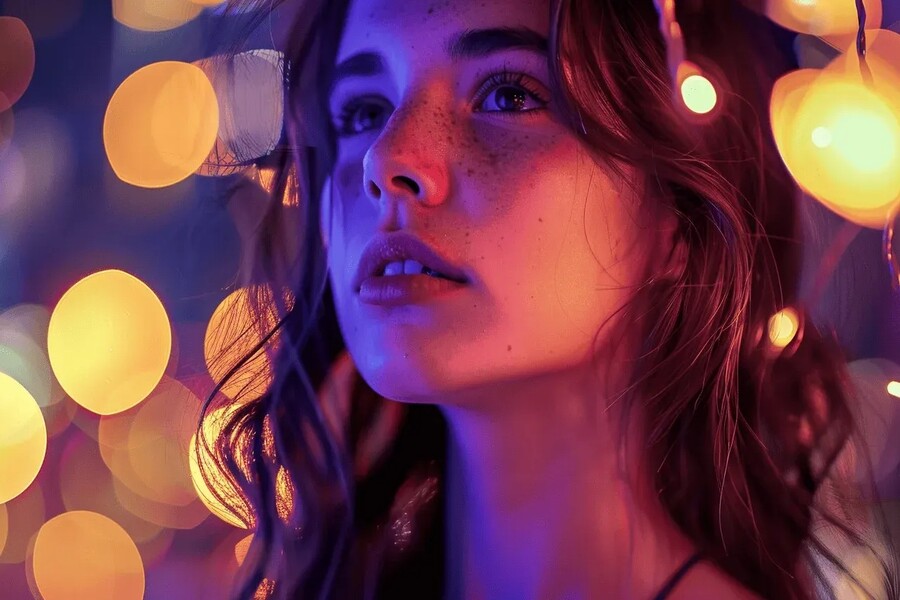
Bokeh has long been one of the most beloved effects, especially in portrait, lifestyle, and product photography. A smooth, blurred background, a prominent subject, and a sense of depth and emotion are what viewers often associate with bokeh. However, beautiful bokeh doesn't necessarily mean excessive background blurring . In fact, many bokeh photos fail not because of a lack of equipment or advanced techniques, but because photographers make very basic yet repeated mistakes . These mistakes make bokeh counterproductive: the image loses detail, the subject doesn't stand out, the composition is cluttered, or it feels artificial and unnatural. This article will summarize the most common bokeh photography mistakes , analyze the causes and impact of each mistake on image quality. This will help you gain a better understanding of bokeh and avoid errors that make your photos aesthetically unappealing, despite your hard work.
1. Overusing an excessively large aperture causes the image to lose detail.
One of the most common mistakes when shooting bokeh is the habit of always setting the aperture to the largest setting the lens allows, such as f/1.8, f/1.4, or even f/1.2, regardless of the context or purpose of the shot. Many people assume that the larger the aperture, the better the bokeh, and the more blurred the background, the "better" the photo. In reality, this is a rather one-sided notion.
When the aperture is opened too wide, the depth of field becomes extremely shallow. This means that only a very small portion of the image is in focus, while the rest quickly falls into the out-of-focus area. In portrait photography, especially close-up portraits, the common consequence is that the eyes may be in focus, but the nose, ears, or hair in the background are noticeably blurred. This creates a visual imbalance in the image, causing discomfort when viewed for extended periods, especially for viewers with refined aesthetic tastes.
.jpg)
Furthermore, even at the widest aperture, many lenses still fail to achieve optimal sharpness. Contrast reduction, chromatic aberration, chromatic aberration, or slight softness are often more noticeable when shooting wide open. As a result, while bokeh is abundant, the overall image lacks visual appeal and sharpness, failing to create a professional feel.
Beautiful bokeh isn't about opening the aperture wide, but about striking a balance between the sharpness of the subject and the blur of the background. In many cases, slightly closing the aperture to f/2.2, f/2.8, or even f/4 helps to achieve just the right amount of background blur while retaining the necessary detail and sharpness for the subject.
2. Incorrect focus makes the subject not stand out.
If we had to choose one biggest "enemy" of bokeh photography, it would be focus errors. When the background is heavily blurred, the role of the focus point becomes extremely important. Just a slight misalignment of the focus can make the entire image look bland, lacking emphasis, and giving the impression of being "completely blurred."
A common cause of this error often stems from using autofocus mode without controlling the AF point. The camera may automatically focus on the area with the highest contrast, but that area may not necessarily be where you want the viewer to focus. In low light conditions, the AF system is less accurate, increasing the likelihood of misfocusing.
.jpg)
With the shallow depth of field when shooting bokeh, even a very small change can cause the focus point to shift. A slight tilt of the model's head, the photographer moving forward or backward a few centimeters, or simply pressing the shutter button a beat slower—all can cause the focus point to fall out of the desired position.
This error is especially easy to occur when shooting close-up portraits or small products with strong bokeh. When the subject is not sharp enough, the blurred background no longer enhances the subject; on the contrary, it reveals the inaccuracies in the shooting technique. A bokeh photograph is only truly beautiful when the point of focus is placed correctly and is sharp enough to compensate for the entire blurred background.
3. The distance between the subject and the background is inappropriate.
Many people, when shooting bokeh, focus only on camera and lens specifications, forgetting a crucial element: the distance between the subject and the background. In reality, beautiful bokeh doesn't just depend on a large aperture or long focal length, but also heavily on how you arrange the space within the frame.
A common mistake is placing the subject too close to the background. In this case, no matter how wide you open the aperture, the background will retain a lot of detail and won't be as blurry as desired. The result is weak bokeh, the subject isn't clearly separated, and the photo lacks depth.
.jpg)
Conversely, there are cases where the background is placed too far away but lacks structure or suitable lighting. In such cases, the bokeh produced is very faint, without a clear shape, rendering the blurring effect meaningless. The image looks blurry but not beautiful, lacking a sense of space and failing to create a visual impact.
Failing to actively control the distance behind the subject results in many bokeh photos appearing almost nonexistent. Photographers need to understand that bokeh is the result of the relationship between the subject, background, and camera position, not just a single parameter.
4. The background is cluttered or contains distracting details.
One of the most common misconceptions is that bokeh can "hide" any unattractive background. The reality is quite the opposite. If the background has too much complex detail, strong contrast, or chaotic colors, the resulting bokeh can become visually jarring and distracting.
Harsh light spots, colorful signs, overlapping lines, or objects with distinct shapes in the background, when blurred, create chaotic bokeh effects, distracting the viewer from the main subject. This often occurs when shooting outdoors in crowded areas, brightly lit streets, or spaces with complex lighting.
.jpg)
Beautiful bokeh requires a background that is simple enough so that when it fades, it becomes a soft backdrop, supporting the subject rather than competing for attention. If the background is already cluttered from the start, blurring it will only make that clutter more unpleasant, and will not "save" the composition.
5. Inappropriate lighting results in unattractive bokeh.
Lighting is a crucial factor determining bokeh quality, yet it's often overlooked. A common mistake is shooting bokeh in overly flat lighting conditions, lacking any focal points. When the light is too even and lacks highlights, the bokeh, though blurry, looks lifeless, lacking the necessary sparkle and depth.
Conversely, excessively harsh or direct light hitting the lens can easily cause overexposure, uncontrolled flare, and loss of detail. This not only reduces bokeh quality but also ruins the entire composition of the photograph.
Additionally, placing the light source behind the subject without controlling the direction and intensity can cause bokeh to be distorted, uneven, or have harsh bright edges. These details make the bokeh unpleasant and less refined, especially when viewed at a large size.
6. Using a Lens Unsuitable for Bokeh Effect
Not all lenses are designed to create beautiful bokeh. A common mistake is using a kit lens with a small aperture and then trying to create bokeh by zooming all the way in or doing heavy post-processing. The result is often a stiff, blurry background lacking smooth transitions and looking very artificial.
The quality of bokeh depends heavily on the lens's optical design, including the maximum aperture, the number and shape of the aperture blades, the focal length, and how aberrations are handled. Some lenses produce round, soft, and smooth bokeh; but others create distorted, hard-edged, or very distinct polygonal bokeh.
.jpg)
Without a thorough understanding of the bokeh characteristics of their lens, photographers can easily become disappointed with the results, even after applying the correct basic settings. Understanding your equipment is just as important as owning good equipment.
7. Poor composition prevents bokeh from supporting the subject.
Bokeh only truly shines when it serves the overall composition. A common mistake is focusing too much on blurring the background while neglecting the proper placement of the subject within the frame. When the composition is weak, even a lot of bokeh can't save the photo.
Placing the subject in an unbalanced position, allowing bokeh to take up too much space, or shifting the visual focus can make it difficult for the viewer to concentrate. In some cases, bokeh can even "swallow" the important details of the subject, making the image look bland and lacking in emphasis.
Beautiful bokeh is bokeh that knows how to "stay in the right place," supporting the subject instead of competing for attention.
8. Overuse of Post-Production Creates Fake and Unnatural Bokeh
With the development of photo editing software, creating fake bokeh has become too easy. A common mistake is over-blurring the background, causing the edges of the subject to become blurry and the blurred areas to transition unnaturally.
.jpg)
Fake bokeh is typically characterized by a uniformly blurred background that appears mechanical, lacking any gradual transition in space. In portraits, hair and small details are easily erased or crudely cropped, creating a distinctly "app-edited" look.
Post-processing should be a supporting tool, not a substitute for mastering proper bokeh techniques from the start.
9. Not understanding the nature of Bokeh, shooting based on intuition.
The most fundamental, yet common, mistake is misunderstanding the nature of bokeh. Many people view bokeh simply as a background blur effect, shooting based on intuition or imitation without understanding why such photos are beautiful.
Bokeh is the result of a combination of aperture, focal length, distance, light, and composition. Without understanding these elements, photographers easily fall into a cycle of trial and error. Sometimes the photos are beautiful, sometimes not, inconsistent, and it's very difficult to repeat the desired result.
This is especially disadvantageous for those who shoot commercial photos, service portraits, or want to build a lasting personal style.
Bokeh is a powerful tool in photography, but it only proves valuable when used correctly. Common bokeh photography mistakes don't stem from a lack of expensive equipment, but mainly from misunderstanding its nature and overusing the background blur effect.




















VIP Products








Best Selling Products
MidJourney Account
29 USD
Upgrade Genuine Office 365
49 USD
Genuine Adobe Illustrator account
99 USD
Adobe Photoshop Copyright - Full App
120 USD
Genuine Cheap Canva Pro
39 USD
ChatGPT Plus Account (GPT-4)
16 USD
Upgrade Duolingo Super
29 USD
Copyright Adobe Lightroom Account
59 USD
Freepik Premium Account
59 USD
Autodesk All App Account Copyright
120 USD
Plugin Retouch4me
69 USD
Upgrade genuine Capture One account
120 USD
Windows 10 & 11 Pro Key
36 USD
Adobe Premiere Pro Account
99 USD
Capcut Pro 1 Year
39 USD