Best Selling Products

ChatGPT Plus Account (GPT-4)
16 USD

Freepik Premium Account
59 USD

Windows 10 & 11 Pro Key
36 USD

Genuine Cheap Canva Pro
39 USD

Adobe Premiere Pro Account
99 USD

Plugin Retouch4me
69 USD

MidJourney Account
29 USD

Upgrade Duolingo Super
29 USD

Capcut Pro 1 Year
39 USD

Genuine Adobe Illustrator account
99 USD

Upgrade genuine Capture One account
120 USD

Adobe Photoshop Copyright - Full App
120 USD

Copyright Adobe Lightroom Account
59 USD

Autodesk All App Account Copyright
120 USD

Upgrade Genuine Office 365
49 USD
Field Curvature: Understanding the Causes and Mitigation Methods in Photography
Nội dung
- 1. Definition of Field Curvature
- 2. Wavy line curvature
- 3. How to determine if a lens has field distortion.
- 3.1. MTF Chart
- 3.2. Practical testing
- 4. Ways to reduce field curvature
- 4.1. Reducing the aperture
- 4.2. Appropriate focus compensation
- 4.3. Choosing the best focusing distance
- 4.4. Use the right lens for the purpose.
- 4.5. Avoid using an excessively large aperture when unnecessary.
- 5. Lens performance evaluation
This section explains the principle of field curvature and how it affects sharpness. It also provides detailed instructions on adjusting aperture and composition to achieve sharper images from the center to the corners.
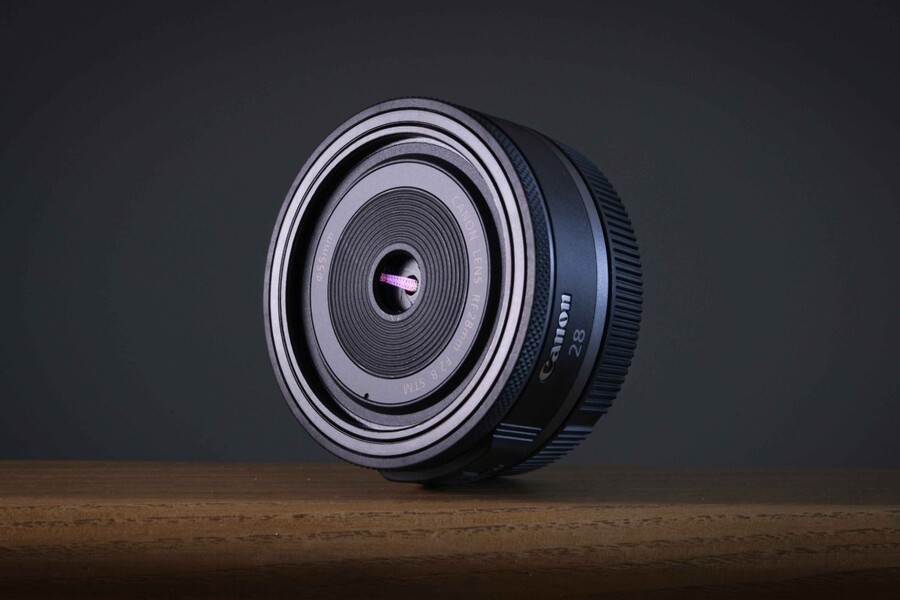
In the modern world of photography, users increasingly expect images to be sharp from center to edge. However, even expensive, high-quality, or professional-grade lenses cannot always perfectly meet this expectation. One of the most common causes of sharpness discrepancies between different areas of the frame is field curvature , also known as the curvature of the image field .
This phenomenon occurs in all types of lenses, from phone lenses and inexpensive kit lenses to professional lenses. Many users often confuse field curvature with out-of-focus or poor lens quality, but they are different. This is a natural optical characteristic, stemming from the design and the way the lenses bend light as it enters the sensor.
Today, with digital sensors capable of capturing incredibly sharp detail even at the pixel level, field curvature is far more noticeable than it was in the film era. This leaves many photographers frustrated when images don't look as expected, even when the shooting technique is perfectly correct.
1. Definition of Field Curvature
Field curvature is a phenomenon where the focal plane of a lens does not lie on a perfect plane but is curved in a spherical or other curved shape. This causes the sensor to only focus on a specific area. When you focus on the center, the corners may be blurry; conversely, if you focus on the corners, the center may lose sharpness.
To understand this better, we need to consider the optical nature. Camera lenses are made up of many curved lenses. Each lens bends light in a different way and directs the light rays to a focal point. However, in reality, the light rays from the edges and the center do not converge on the same flat plane, but rather on a curved surface. This curved surface is called the Petzval field curvature .
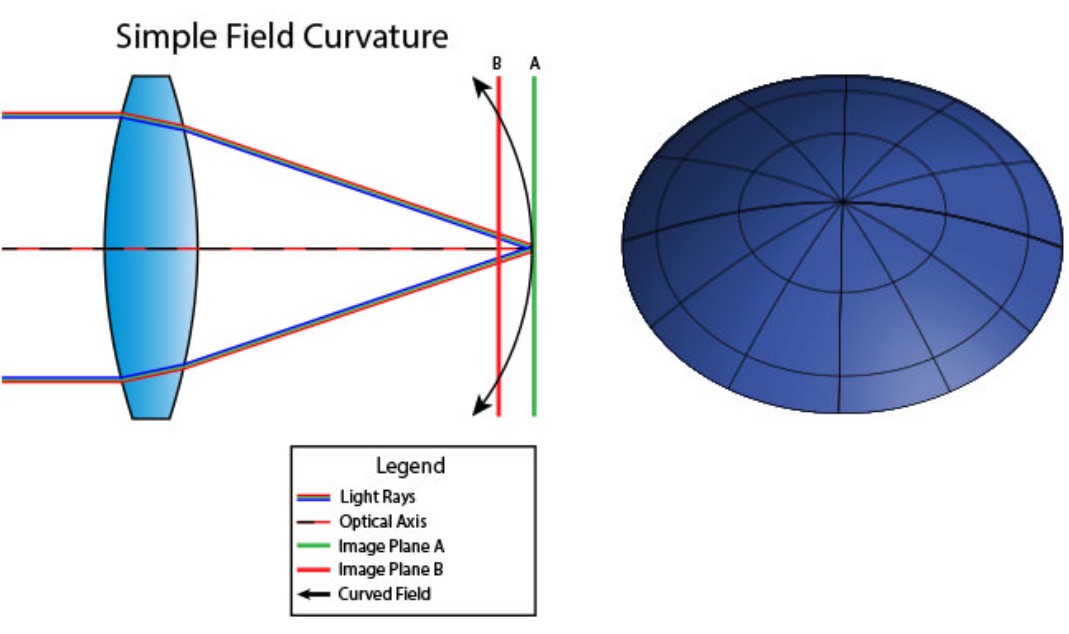
Several factors make this phenomenon easier to recognize:
Modern camera sensors are large and high-resolution, making them susceptible to optical flaws.
Large aperture lenses , especially f/1.4 – f/1.8, result in a wider focus transition area and more noticeable focus deviation.
Closer focusing distances result in a more pronounced focal-field curve compared to shooting at infinity.
Vintage lenses often lack aspherical lens elements or corrective lens groups.
In the film era, the film surface had a slight curvature, which helped reduce the effects of field curvature because the film conformed to the curved focal length. This explains why the same vintage lens, when mounted on a DSLR or mirrorless camera, feels softer at the edges compared to when using film.
When understood correctly, Field Curvature is not a bad design flaw but rather a physical challenge in optics that manufacturers must balance between cost, size, weight, and performance.
2. Wavy line curvature
In reality, the field curvature isn't always a smooth curve. Many lenses have a "wavy" focal length curve, resulting in an unusual distribution of sharpness: sharp in the center, soft in the middle, sharp at the corners, and then blurry at the extreme edges.
This phenomenon is called wavy field curvature .
The main reasons stem from:
• Complex optical design with multiple compensating lenses.
• A combination of aspherical lenses, ED lenses, and low-dispersion lenses.
• Optimize performance in other areas such as reducing image distortion, minimizing aberration, and increasing brightness at different angles.
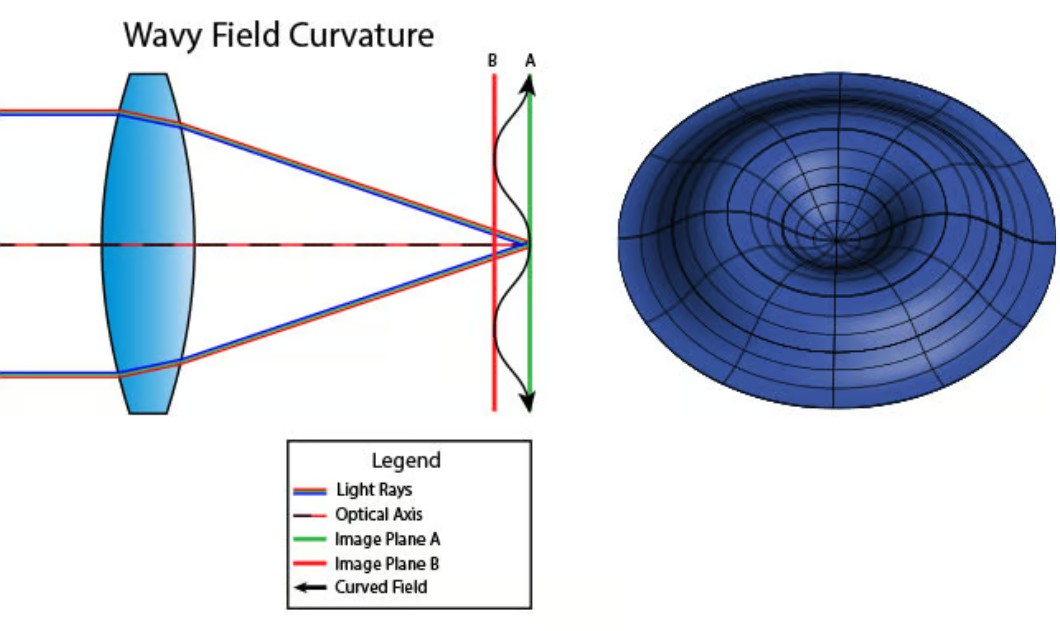
Lens manufacturers always have to make trade-offs when designing lenses. For example, a wide-angle lens that wants to significantly reduce distortion must accept an increase in field curvature. A telephoto lens that wants to be thin and light must accept a focal length curve that isn't perfectly flat.
Interestingly, wavy curvature is often most noticeable in lenses that are "very good" in other aspects, for example:
· Nikon 28mm f/1.8G
· Nikon 24-70mm f/2.8G
· Canon EF 35mm f/1.4L I
Sigma Art 35mm f/1.4 (some versions)
Wavy curvature makes focusing difficult because whether you focus on the center or the middle, some part of the frame will not be in peak sharpness. This is especially disadvantageous when shooting landscapes or architecture.
3. How to determine if a lens has field distortion.
There are two common approaches: reading MTF charts and conducting practical tests.
3.1. MTF Chart
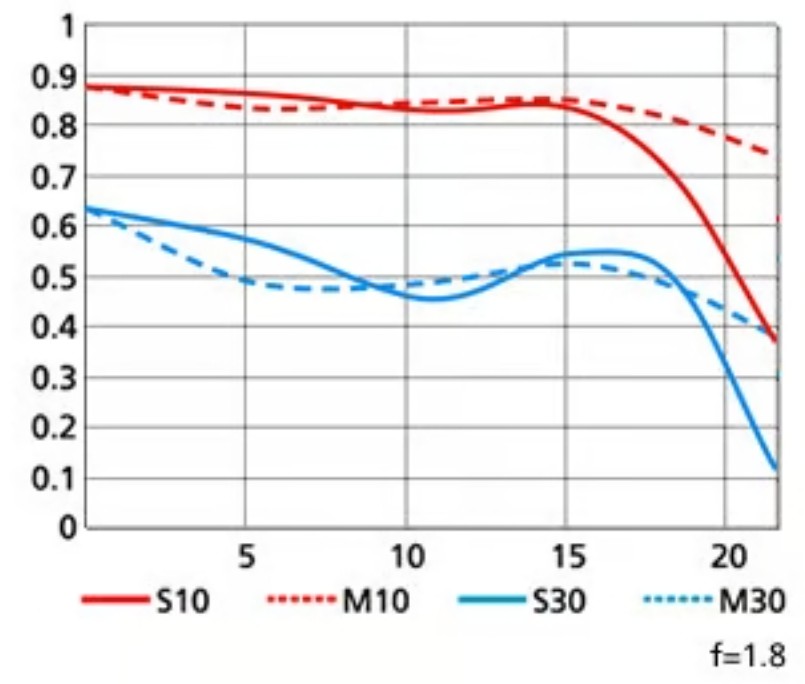
MTF indicates the lens's ability to reproduce contrast and sharpness from the center to the edges. A lens with a pronounced field curvature will have an MTF line:
• Reduce sharply from the center outwards to about 1/3 of the frame.
• Rebound at the edges
• Sudden decrease at the extreme end
For the Nikon 28mm f/1.8G, MTF shows the curve starting high, dropping in the mid-frame region, and then rising again near the corners.
3.2. Practical testing
Place the camera on a tripod and photograph a flat surface such as a brick wall or test board. Focus precisely on the center, using the widest aperture. If you notice:
• The center is sharp, the mids are soft, and the corners are sharp: this is a wavy field of view.
The center is sharp but becomes softer towards the edges: uniformly curved.
Sharp corners but soft center: focusing is off or the lens has a serious problem.
Visually inspecting the field curvature of a lens on a computer screen at 100% brightness is a simple way to determine its field curvature.
Many people are surprised to find that expensive lenses still don't provide the desired sharpness at large apertures, but this is perfectly normal with wide-angle or large-aperture lenses.
4. Ways to reduce field curvature
Field curvature cannot disappear completely, but you can significantly reduce it using the following techniques:
4.1. Reducing the aperture
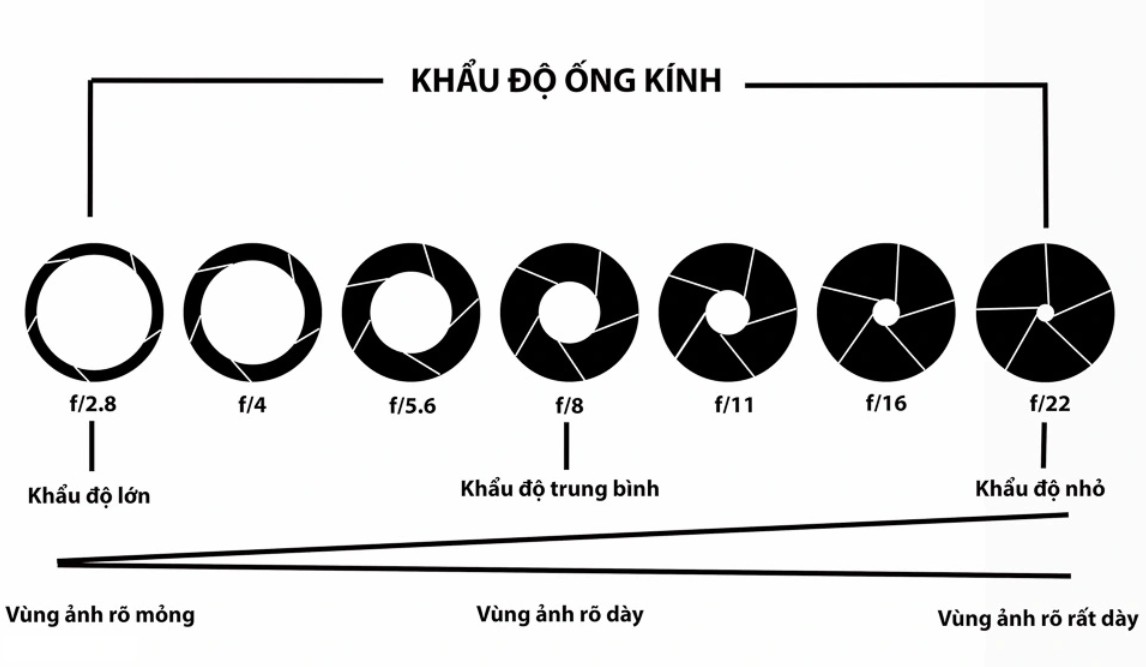
This is the most effective method. When the aperture is reduced, the depth of field increases, helping to "mask" the differences between regions located on the curved focal plane.
For slight field of view curvature: f/4 – f/5.6 is sufficient.
With medium field curvature, f/8 is ideal.
With heavy field curvature: f/11 or lower.
The drawback of closing the aperture too much is that it increases diffraction, so you need to find the optimal aperture setting.
4.2. Appropriate focus compensation
Instead of focusing perfectly in the center, try focusing slightly back or forward so that both the center and mid-range achieve a more balanced level of sharpness. This technique is called focus shift compensation .
4.3. Choosing the best focusing distance
With some lenses, field curvature decreases when you shoot at:
long distance
infinity
or specific near distance
Therefore, test it out before shooting.
4.4. Use the right lens for the purpose.
Lenses with strong field curvature are not suitable for shooting:
· architecture
· scenery
product images
· macro
But it's very suitable for:
• Portrait with beautiful bokeh
· street photography
everyday photos
4.5. Avoid using an excessively large aperture when unnecessary.
Many people are used to shooting at f/1.4 or f/1.8 to test lenses, but a larger aperture doesn't always yield the best results in terms of sharpness.
5. Lens performance evaluation
To accurately assess a lens's performance, you need to analyze it based on real-world usage, not just test charts or MTF data.
In practice, you don't always need absolute sharpness. Field Curvature only becomes important when you require uniformly sharp images. If you mainly shoot portraits or street photography, the softness at the edges can sometimes be helpful, creating a sense of focus on the subject.
Conversely, for landscape photographers, sharpness across the entire frame is the absolute priority. Therefore, field curvature is a crucial factor to consider when buying a lens.
It's important to note that Field Curvature can vary depending on:
aperture
Focusing distance
Focal length (with zoom lens)
lighting conditions
• Sensor type (full-frame vs crop)
A lens with a heavy field of curvature when shooting at f/1.8 can become extremely sharp when stopped down to f/8. Therefore, evaluating a lens requires a holistic view rather than relying on just one situation.
Additionally, newer lenses with complex optical structures also exhibit field curvature characteristics at different focal lengths. For example:
Sony 16-35mm GM: slight field curvature at 16mm, almost flat at 24–28mm.
Canon 15-35mm RF: Less field curvature compared to the EF version.
Sigma Art 14-24mm: small field of view, ideal for astrophotography.
This diversity means users need to actively experiment with each focal length instead of relying solely on theoretical specifications.
Field curvature is a natural optical phenomenon that occurs in almost all lenses. However, instead of viewing it as a flaw, consider it a characteristic you need to understand to optimize your equipment. Knowing how to identify it, how to test for it, and methods to mitigate it, such as closing the aperture, choosing the right focus distance, or adjusting composition, will significantly improve image quality.


















VIP Products








Best Selling Products
ChatGPT Plus Account (GPT-4)
16 USD
Freepik Premium Account
59 USD
Windows 10 & 11 Pro Key
36 USD
Genuine Cheap Canva Pro
39 USD
Adobe Premiere Pro Account
99 USD
Plugin Retouch4me
69 USD
MidJourney Account
29 USD
Upgrade Duolingo Super
29 USD
Capcut Pro 1 Year
39 USD
Genuine Adobe Illustrator account
99 USD
Upgrade genuine Capture One account
120 USD
Adobe Photoshop Copyright - Full App
120 USD
Copyright Adobe Lightroom Account
59 USD
Autodesk All App Account Copyright
120 USD
Upgrade Genuine Office 365
49 USD