Best Selling Products
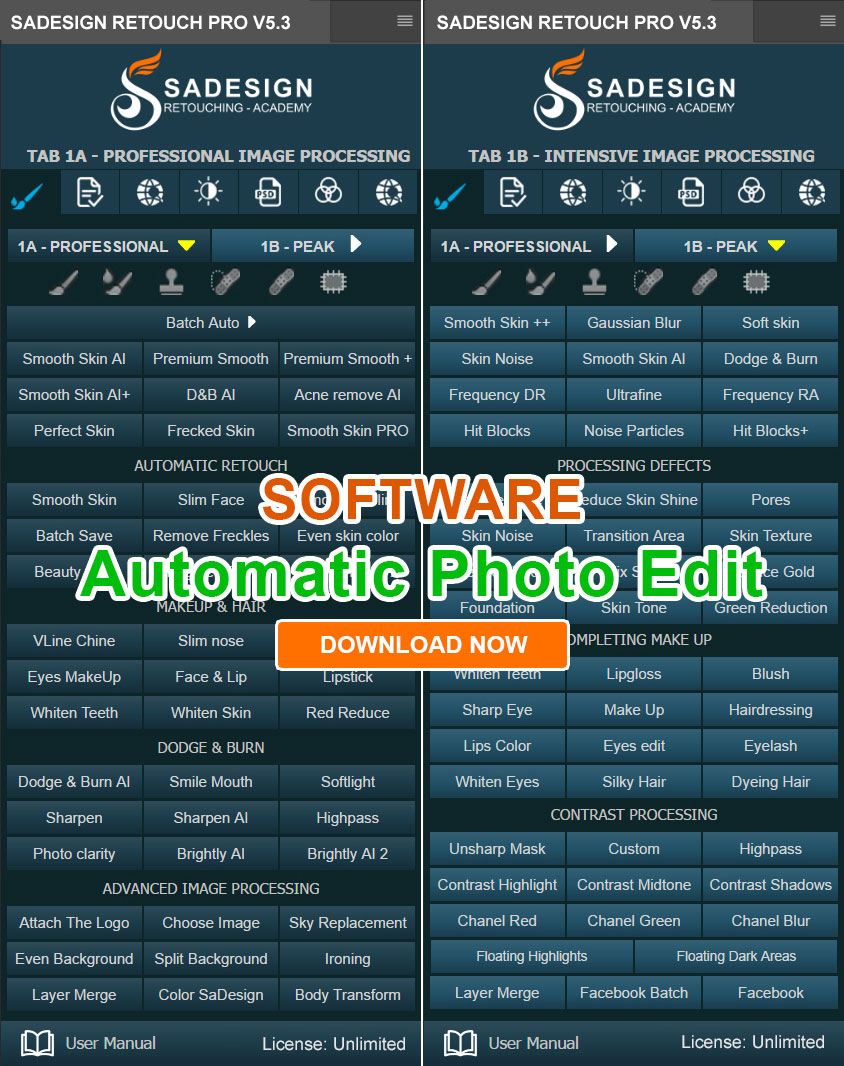
Plugin Retouch4me
69 USD

MidJourney Account
29 USD
Upgrade Duolingo Super
29 USD
Copyright Adobe Lightroom Account
59 USD
Autodesk All App Account Copyright
120 USD
Windows 10 & 11 Pro Key
36 USD
Upgrade genuine Capture One account
120 USD
Upgrade Genuine Office 365
49 USD
Adobe Photoshop Copyright - Full App
120 USD

Capcut Pro 1 Year
39 USD
Genuine Adobe Illustrator account
99 USD
Adobe Premiere Pro Account
99 USD
Genuine Cheap Canva Pro
39 USD

Freepik Premium Account
59 USD

ChatGPT Plus Account (GPT-4)
16 USD
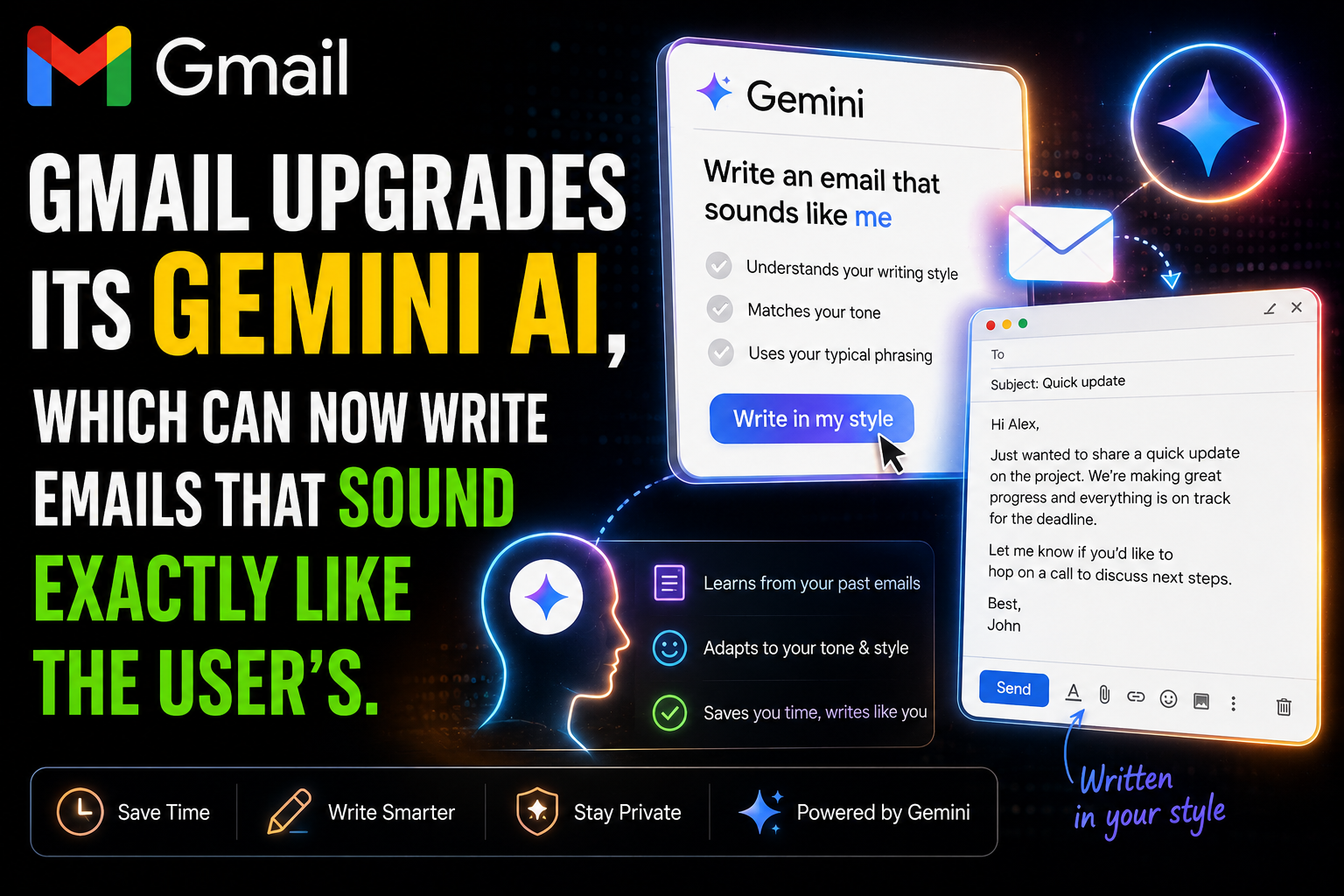
Gmail upgrades its Gemini AI, which can now write emails that sound exactly like the user's.
Nội dung
- 1. Gemini is no longer just an email writing tool.
- 2. How does the ability to "role-play" as a user work?
- 3. AI understands both the task and the context.
- 4. Google wants AI emails to be "so perfect that they send instantly."
- 5. Positive aspect: Work productivity can be completely transformed.
- 6. But AI "role-playing" also raises many concerns.
Google has just added powerful personalization capabilities to Gemini in Gmail. The AI can now learn each person's word choice, tone of voice, and communication style to create more natural-sounding emails.
1. Gemini is no longer just an email writing tool.
When Google first integrated Google Gemini into Gmail, the initial goal was primarily to help users compose emails faster. The AI could suggest email content, edit sentences, or create drafts from a few short lines of description.
While convenient, in the early stages, AI-generated emails often feel "too perfect" or lack personalization. Recipients can sometimes easily recognize that it's machine-written content because the writing style is too neutral and lacks emotion.
Gemini now understands not only the content of emails but also how users think and communicate. The system analyzes previously sent emails to identify wording, sentence structure, formality, and even the conversational attitude of the account holder.
If the user typically writes concise, to-the-point emails, the AI will accurately replicate that style. Conversely, if the account holder has a habit of writing in a friendly, emotional style or prefers using polite opening sentences, Gemini will also closely mimic that.
This means AI no longer acts as a "ghostwriter," but rather as an assistant capable of embodying and communicating.
In the near future, many people may be able to send emails daily with virtually no need to manually compose each sentence. AI will understand how they speak and handle much of the repetitive communication in their work for them.
2. How does the ability to "role-play" as a user work?
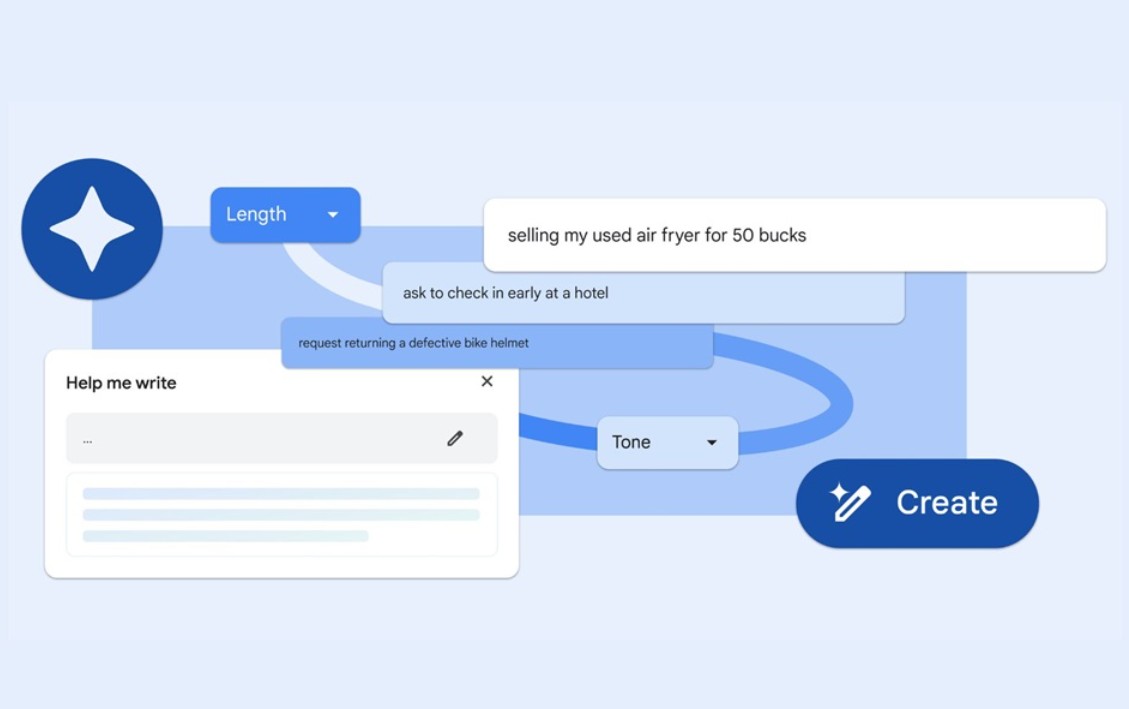
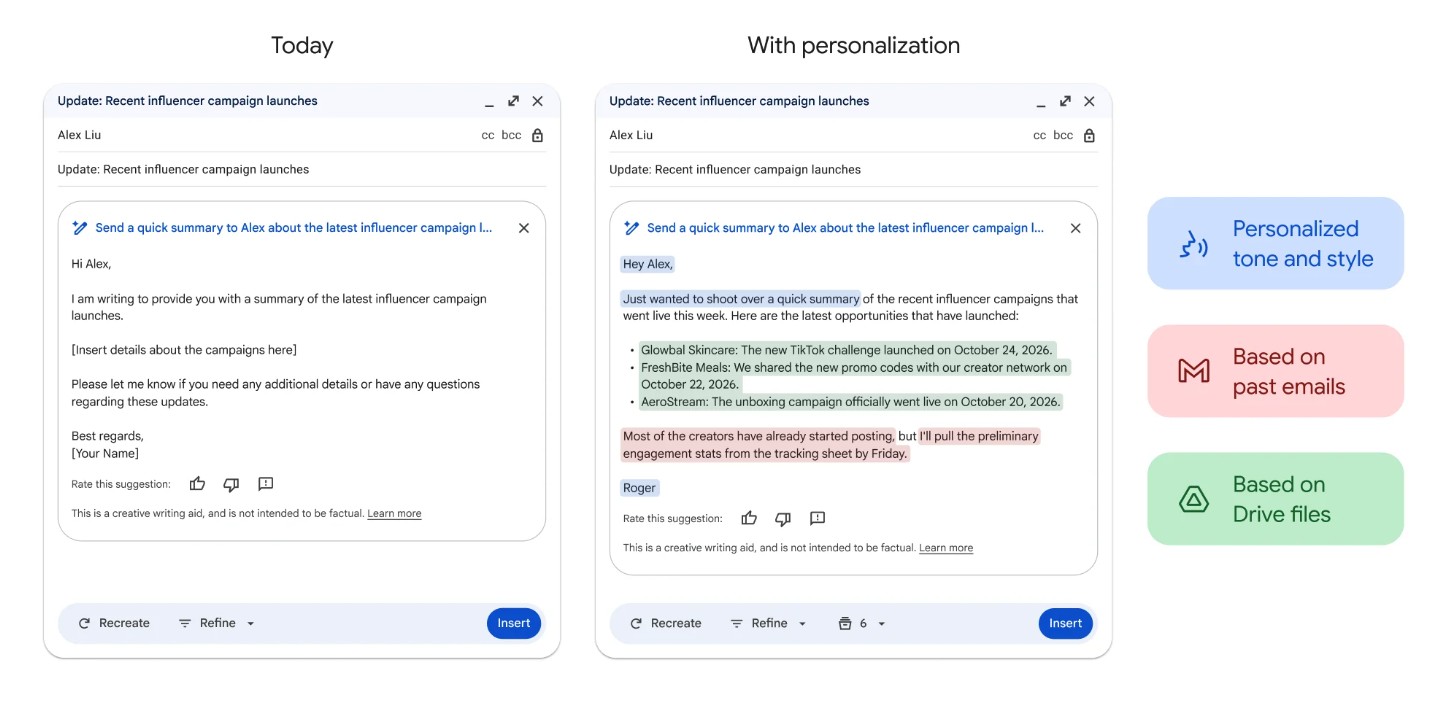
The core of the upgrade lies in a feature called "Tone and style personalization," which allows you to personalize your tone and writing style.
Essentially, Gemini scans and analyzes the user's previously sent email history. The AI system uses linguistic models to recognize various elements in individual communication styles.
For example, AI can learn whether users typically use formal or informal language, whether they tend to write long or short pieces, and whether they prefer to begin with a polite greeting or get straight to the main point.
Beyond just language, Geminis can also understand the "rhythm of communication." Some prefer short, decisive sentences to project professionalism, while others favor a softer tone to create a friendly atmosphere with partners and clients.
After learning enough data, the AI will apply that style when creating new emails. The result is content that feels like it's being written by the account owner themselves.
3. AI understands both the task and the context.
Besides its ability to simulate writing styles, Gemini has also been significantly upgraded in its "Topic contextualization" feature, which is its ability to understand the user's real-world work context.
Previously, when writing work-related emails, users often had to open multiple tabs to find information in Google Drive, Docs, or Sheets and then manually copy it into the email. This process was quite time-consuming and prone to errors, especially for those who handle a large volume of emails daily.
Gemini can now connect directly to the Google Workspace ecosystem to automatically retrieve necessary data. The AI can read documents in Google Drive, analyze key information, and then deliver it to emails in a way that suits each specific work situation.
For example, if a user needs to send a project progress report to a client, Gemini can automatically read the relevant documents, identify key metrics, and generate a complete summary email without requiring manual copying.
Notably, AI not only "copies data" but also adjusts its presentation to suit the context of the communication. If the email is sent to a superior or client, the writing style can be more concise and formal. Conversely, if sent to a close colleague, the content will be more natural and informal.
4. Google wants AI emails to be "so perfect that they send instantly."
According to Google, the biggest goal of this update is to create emails that are of good enough quality that users will need almost no editing before sending them.
Previously, AI email writing primarily assisted in creating content outlines or suggesting phrases. Users still had to make significant edits to suit the actual context and personal style. But with its ability to learn user tone and access work data, Gemini is getting closer to replacing much of the manual email writing process.
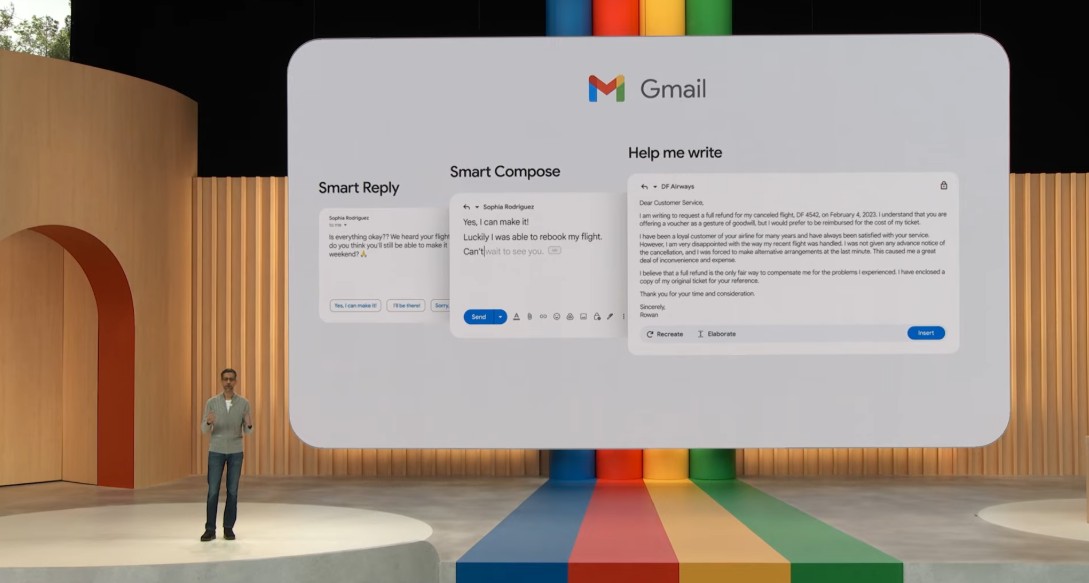
Google believes this will significantly save office workers time each day. Instead of spending hours responding to client emails, confirming meeting schedules, or sending recurring reports, users can let AI handle most repetitive tasks.
In the modern workplace, email remains one of the most time-consuming tasks. Many people spend a significant portion of their workday reading and responding to emails. This increases work pressure and directly impacts productivity.
If AI can accurately handle everyday communication tasks, humans will have more time for more creative, strategic, or high-value work.
Google is clearly aiming to turn Gemini into an "AI middle layer" between users and the ever-increasing volume of digital workloads. In the near future, many work emails could be generated and responded to almost entirely automatically by AI, with the human role shifting to final review and approval before sending.
5. Positive aspect: Work productivity can be completely transformed.
For office workers, Gemini's new capabilities promise to bring about a significant change in the way they work every day.
Many employees now spend most of their time on repetitive tasks such as answering emails, confirming information, submitting reports, or updating work progress.
These are time-consuming tasks that don't require highly creative thinking.
When AI can automate these tasks while maintaining a personalized communication style, productivity can increase significantly.
For example, a customer service representative can handle a larger volume of emails while maintaining a friendly and professional demeanor. A project manager can quickly respond to partners without having to write each email individually.
For businesses, this means reducing the time spent on administrative tasks and optimizing employee productivity.
Furthermore, AI can help reduce mental stress for users. Many people feel stressed from constantly responding to emails in the modern work environment.
6. But AI "role-playing" also raises many concerns.
Despite offering many benefits, the ability of AI to mimic personal style has also sparked considerable controversy.
To learn communication styles, Gemini needs to analyze large volumes of users' personal emails. This means the AI must access data containing sensitive information such as work-related, financial, or private conversations.
Google claims the system is designed with high security standards. However, the increasing understanding of personality and communication behavior by AI still makes many people uncomfortable.
If AI can replace users in writing emails so perfectly that no one notices, the line between real communication and machine-generated communication will become increasingly blurred.
In the future, it's highly likely that many work-related conversations will take place between AIs instead of real humans directly writing emails.
This raises serious questions about the authenticity of digital communication. Does an email carrying personal emotion still have meaning if it's entirely generated by a machine?
In addition, the risk of misuse also exists. Personal style simulation technology could be used for impersonation or fraud if it falls into the wrong hands.
The latest update to Gmail shows that AI is advancing much faster than many people imagined. Just a few years ago, the idea of a system being able to mimic an individual's writing style seemed like science fiction. Now, it's starting to appear in the daily work tools of millions of people.










VIP Products


Best Selling Products
Plugin Retouch4me
69 USD
MidJourney Account
29 USD
Upgrade Duolingo Super
29 USD
Copyright Adobe Lightroom Account
59 USD
Autodesk All App Account Copyright
120 USD
Windows 10 & 11 Pro Key
36 USD
Upgrade genuine Capture One account
120 USD
Upgrade Genuine Office 365
49 USD
Adobe Photoshop Copyright - Full App
120 USD
Capcut Pro 1 Year
39 USD
Genuine Adobe Illustrator account
99 USD
Adobe Premiere Pro Account
99 USD
Genuine Cheap Canva Pro
39 USD
Freepik Premium Account
59 USD
ChatGPT Plus Account (GPT-4)
16 USD