Best Selling Products

Genuine Adobe Illustrator account
99 USD

Adobe Premiere Pro Account
99 USD

Capcut Pro 1 Year
39 USD

Upgrade Genuine Office 365
49 USD

Copyright Adobe Lightroom Account
59 USD

MidJourney Account
29 USD

Freepik Premium Account
59 USD

ChatGPT Plus Account (GPT-4)
16 USD

Upgrade Duolingo Super
29 USD

Plugin Retouch4me
69 USD

Adobe Photoshop Copyright - Full App
120 USD

Windows 10 & 11 Pro Key
36 USD

Genuine Cheap Canva Pro
39 USD

Autodesk All App Account Copyright
120 USD

Upgrade genuine Capture One account
120 USD
How to Take Blurry Photos in the Rain: 8 Tips to Keep Your Photos Sharp
This detailed guide explains how to increase shutter speed, utilize image stabilization, protect your lens, and achieve precise focusing to help you create sharp, professional-looking photos even in bad weather.

1. Why Is It Necessary to Set Up Camera Settings Before Photographing Fireworks?
Many people have a habit of using Auto mode when taking photos because of its convenience. However, when it comes to fireworks, automatic mode often does not deliver good results.
The reason lies in the unique lighting characteristics of fireworks. Within a single frame, there are two opposing areas of light and darkness. The night sky is almost completely dark, while fireworks are an extremely powerful light source that appears only for an instant.
When operating in Auto mode, the camera attempts to balance the exposure for the entire frame. This leads to several issues.
In some cases, the camera increases the ISO too much to brighten the sky. As a result, the image contains significant noise and loses its clean appearance.
In other situations, the camera chooses a shutter speed that is too fast, causing the fireworks trails to appear only briefly instead of forming soft and impressive streaks of light.
.jpg)
The biggest challenge is the autofocus system. The night sky often lacks enough contrast for the camera to lock focus accurately. If the device continuously searches for a focus point while fireworks are exploding, the most beautiful moment may pass before the camera captures it.
For this reason, Manual Mode is considered the ideal choice for photographing fireworks. Having complete control over ISO, aperture, shutter speed, and focus allows photographers to create images with far more consistent quality.
2. Prepare Your Equipment Before Setting Up the Camera
Settings only become effective when you are properly prepared.
One of the most common mistakes is focusing solely on camera settings while overlooking other supporting factors.
2.1. Choosing the Right Camera
Mirrorless and DSLR cameras are the most ideal choices for photographing fireworks.
The biggest advantages of these camera systems are the ability to manually adjust all settings, support RAW image capture, and provide a wide dynamic range.
However, that does not mean smartphones cannot capture beautiful fireworks photos.
Modern smartphones equipped with Pro Mode are fully capable of producing impressive images if you know how to configure the settings and stabilize the device properly.
2.2. The Importance of a Tripod
If you could choose only one accessory for photographing fireworks, it would definitely be a tripod.
Most beautiful fireworks photos are created using long-exposure techniques ranging from a few seconds to several tens of seconds.
During that period, even a slight hand movement can make the image blurry.
A tripod keeps the camera perfectly stable and enables the use of long shutter speeds while maintaining maximum sharpness.
.jpg)
2.3. Remote Shutter Release and Self-Timer
Even when the camera is mounted on a tripod, pressing the shutter button can still create small vibrations.
To minimize this issue, you should use a remote shutter release or a cable release.
If you do not have these accessories, the 2-second self-timer is a simple but highly effective solution.
2.4. Lens Selection
Wide-angle lenses are the preferred choice for many photographers when shooting fireworks.
Focal lengths between 16mm and 35mm allow you to capture the entire sky along with the surrounding cityscape, water surface, or structures below.
If you are positioned farther away from the fireworks launch area, lenses in the 24–70mm range provide greater flexibility for adjusting composition.
.jpg)
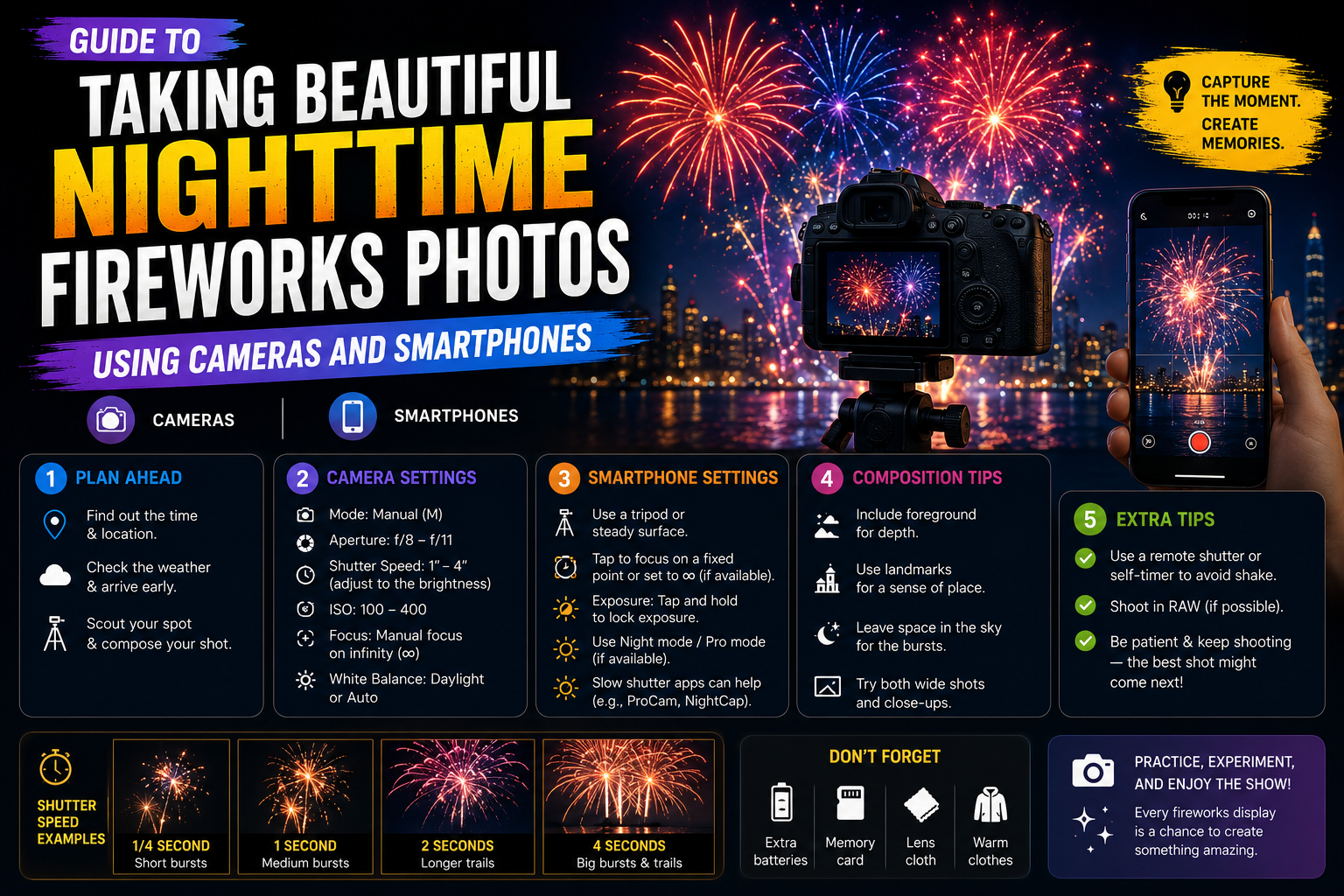
3. Standard Fireworks Photography Settings for Beginners
There is no single set of camera settings that works for every fireworks display.
However, there is a fundamental formula that makes it easier for beginners to get started.
The general principle is low ISO, medium aperture, and slow shutter speed.
3.1. ISO Settings
ISO should be set as low as possible.
Typically, ISO 100 or ISO 200 is the ideal choice.
This ISO range helps produce clean images with minimal noise and preserves details in the dark areas of the sky.
Many people mistakenly assume that nighttime environments require high ISO values. In reality, fireworks are an extremely bright light source, so excessively increasing ISO is usually unnecessary.
When ISO is raised to 800 or 1600, the sky becomes more susceptible to visible noise, reducing the overall image quality.
3.2. Aperture Settings
Aperture directly affects image sharpness and the amount of light entering the sensor.
An aperture range between f/8 and f/11 is considered the ideal working zone for photographing fireworks.
This aperture range helps maintain excellent sharpness throughout the frame, from foreground elements to distant light trails.
If the aperture is opened too wide, such as f/2.8 or f/4, the fireworks may become overexposed and lose detail.
Conversely, stopping down too far to f/16 or f/22 can reduce sharpness because of diffraction.
3.3. Shutter Speed Settings
This is the most important setting.
Shutter speed determines the length of the light trails and the sense of movement within the image.
For beginners, a shutter speed between 3 and 5 seconds is a safe starting point.
This duration is sufficient to capture the entire process of fireworks bursting and spreading across the sky.
If you want to create denser layers of light, you can increase the exposure time to 6 or 8 seconds.
However, you must monitor the results carefully to avoid overexposure or an overly cluttered frame.
.jpg)
4. Easy-to-Use Fireworks Photography Settings Chart
When starting out, you can use the following basic setup:
Shooting Mode: Manual Mode
ISO: 100–200
Aperture: f/8–f/11
Shutter Speed: 3–5 seconds
White Balance: Daylight or Auto
Focus: Manual Focus
Image Format: RAW
This setup is suitable for most outdoor fireworks displays.
After taking your first few shots, review the images and make adjustments based on actual conditions.
If the fireworks appear too bright, reduce the exposure time or stop down the aperture slightly.
If the image appears too dark, extend the exposure time before considering increasing the ISO.
.jpg)
5. How to Focus When Photographing Fireworks
Many people use the correct settings but still end up with blurry photos.
The reason is incorrect focusing.
5.1. Why Does Autofocus Often Struggle?
The night sky contains very few clearly defined details.
Autofocus systems require contrast to operate effectively. When they cannot find a reference point, the camera continuously hunts for focus or locks onto the wrong location.
This often causes photographers to miss the best moments.
5.2. Switch to Manual Focus
Manual Focus is the solution most commonly used by photographers when shooting fireworks.
Before the show begins, find a distant structure, a bright light source, or a building near the launch area.
Then zoom in using Live View and adjust the focus ring until the image appears as sharp as possible.
Once focus is locked successfully, keep that focus position unchanged throughout the session.
5.3. Notes About Infinity Focus
Many people have a habit of turning the focus ring all the way to the infinity mark.
However, this is not always accurate.
On many modern lenses, the true infinity point is not located at the very end of the focus ring's rotation.
Therefore, always verify focus using Live View rather than relying entirely on the markings on the lens.
.jpg)
6. Adjust Shutter Speed According to the Type of Fireworks
Each display has a different rhythm and intensity.
Therefore, shutter speed should be adjusted flexibly.
Sparse and Slow-Exploding Fireworks
When individual bursts appear separately, shutter speeds between 2 and 3 seconds often work best.
The frame remains clean and preserves separation between light clusters.
Multi-Layered Fireworks
This style is common at major festivals.
Shutter speeds between 4 and 6 seconds help capture multiple layers of light overlapping beautifully.
The light trails become longer and create a more spectacular impression.
Extremely Dense Fireworks
Some displays feature a very high concentration of fireworks.
If exposure times remain too long, the central area may become completely blown out and lose all detail.
In this case, reduce the shutter speed to around 3 or 4 seconds.
.jpg)
7. Photographing Fireworks with a Smartphone
Not everyone owns a professional camera.
The good news is that modern smartphones can produce stunning fireworks photos.
Use Pro Mode
Switch to Pro Mode or Manual Mode.
Set the ISO to the lowest possible value.
Keep the shutter speed between 1 and 4 seconds depending on your device’s capabilities.
Stabilize the Phone
A tripod remains the most important factor.
If you do not have a tripod, take advantage of railings, stone ledges, or any stable surface.
Avoid Digital Zoom
Digital zoom significantly reduces image quality.
Instead of zooming, try moving closer or crop the image during post-processing.
8. Composition Helps Fireworks Photos Gain Depth
Correct settings only help make the image sharp.
Composition is what ultimately creates emotion.
Include Foreground Elements
A photo showing only fireworks against the sky often lacks a strong focal point.
Take advantage of elements such as bridges, buildings, water surfaces, or crowds to add depth.
Use Reflections
If you are shooting near a river or lake, include the water surface in the frame.
Colorful reflections can make the image far more vibrant.
Leave Space for the Fireworks to Expand
Do not position the fireworks too close to the top edge of the frame.
Leave enough space so the bursts have room to expand and create a balanced composition.
9. Common Mistakes When Photographing Fireworks
One of the most common mistakes is setting the ISO too high.
Many people assume that darkness automatically requires higher ISO values. As a result, the images contain excessive noise.
The second mistake is using a shutter speed that is too short.
This causes the fireworks to lose their natural softness and appear only as scattered points of light.
The third mistake is leaving the camera in continuous autofocus mode.
In dark environments, autofocus is often unstable and can easily miss focus.
Additionally, many people forget to check their composition before the fireworks begin. Once the display starts, everything changes so quickly that adjusting the framing becomes difficult.
10. Conclusion
For most situations, the combination of ISO 100–200, aperture f/8–f/11, shutter speed 3–5 seconds, manual focus, and RAW shooting serves as an ideal starting point. In addition, using a tripod, locking focus before the fireworks explode, and building a composition with depth will make your images stand out significantly more.
After a few practice sessions, you will understand how to adjust the settings to suit each specific performance. At that point, the dazzling moments of fireworks lighting up the night sky can be preserved perfectly through sharp, emotional, and highly artistic photographs.





















VIP Products








Best Selling Products
Genuine Adobe Illustrator account
99 USD
Adobe Premiere Pro Account
99 USD
Capcut Pro 1 Year
39 USD
Upgrade Genuine Office 365
49 USD
Copyright Adobe Lightroom Account
59 USD
MidJourney Account
29 USD
Freepik Premium Account
59 USD
ChatGPT Plus Account (GPT-4)
16 USD
Upgrade Duolingo Super
29 USD
Plugin Retouch4me
69 USD
Adobe Photoshop Copyright - Full App
120 USD
Windows 10 & 11 Pro Key
36 USD
Genuine Cheap Canva Pro
39 USD
Autodesk All App Account Copyright
120 USD
Upgrade genuine Capture One account
120 USD