Best Selling Products

Copyright Adobe Lightroom Account
59 USD

Adobe Premiere Pro Account
99 USD

Genuine Cheap Canva Pro
39 USD

Upgrade Genuine Office 365
49 USD

Upgrade genuine Capture One account
120 USD

MidJourney Account
29 USD

ChatGPT Plus Account (GPT-4)
16 USD

Plugin Retouch4me
69 USD

Windows 10 & 11 Pro Key
36 USD

Freepik Premium Account
59 USD

Autodesk All App Account Copyright
120 USD

Capcut Pro 1 Year
39 USD

Upgrade Duolingo Super
29 USD

Adobe Photoshop Copyright - Full App
120 USD

Genuine Adobe Illustrator account
99 USD
No more machines: warmer than ever with ChatGPT-5.1
Nội dung
ChatGPT has been significantly upgraded in terms of empathy and understanding of context. GPT-5.1 makes conversations smoother, more pleasant, and friendlier.
Conversational artificial intelligence has become an indispensable part of work and life. Despite their powerful language processing capabilities, previous AI models were often criticized for being dry, robotic, and sometimes lacking the necessary subtlety in communication. The emergence of GPT-5 was expected to be a major milestone in overcoming these limitations. However, contrary to expectations, GPT-5 has become one of OpenAI's most disappointing versions.
The introduction of GPT-5.1 aims to address existing problems while setting a new standard for the "human" aspect of AI communication. Not only is it smarter and faster, but GPT-5.1 is also considered warmer, more nuanced, and more tactful in conversation. Improvements in personality, tone, response speed, and the ability to handle complex tasks have propelled ChatGPT into a new phase: friendlier, more flexible, and more useful than ever before.
1. OpenAI's double leap forward
GPT-5.1 is a direct upgrade to GPT-5, but instead of simply improving one model, OpenAI introduced two variants that operate in parallel: GPT-5.1 Instant and GPT-5.1 Thinking . Each model is built to serve different user needs.
GPT-5.1 Instant is described as “warmer, smarter, and more compliant with instructions” than GPT-5. The phrase “warmer” isn’t just advertising hype. Early user feedback suggests Instant offers a more natural, less stiff conversational feel, providing responses that are more emotionally sensitive to the listener. This model is suitable for everyday conversations, tasks requiring instant response times, or simple tasks like basic email writing, quick Q&A, content creation, or instant suggestions.
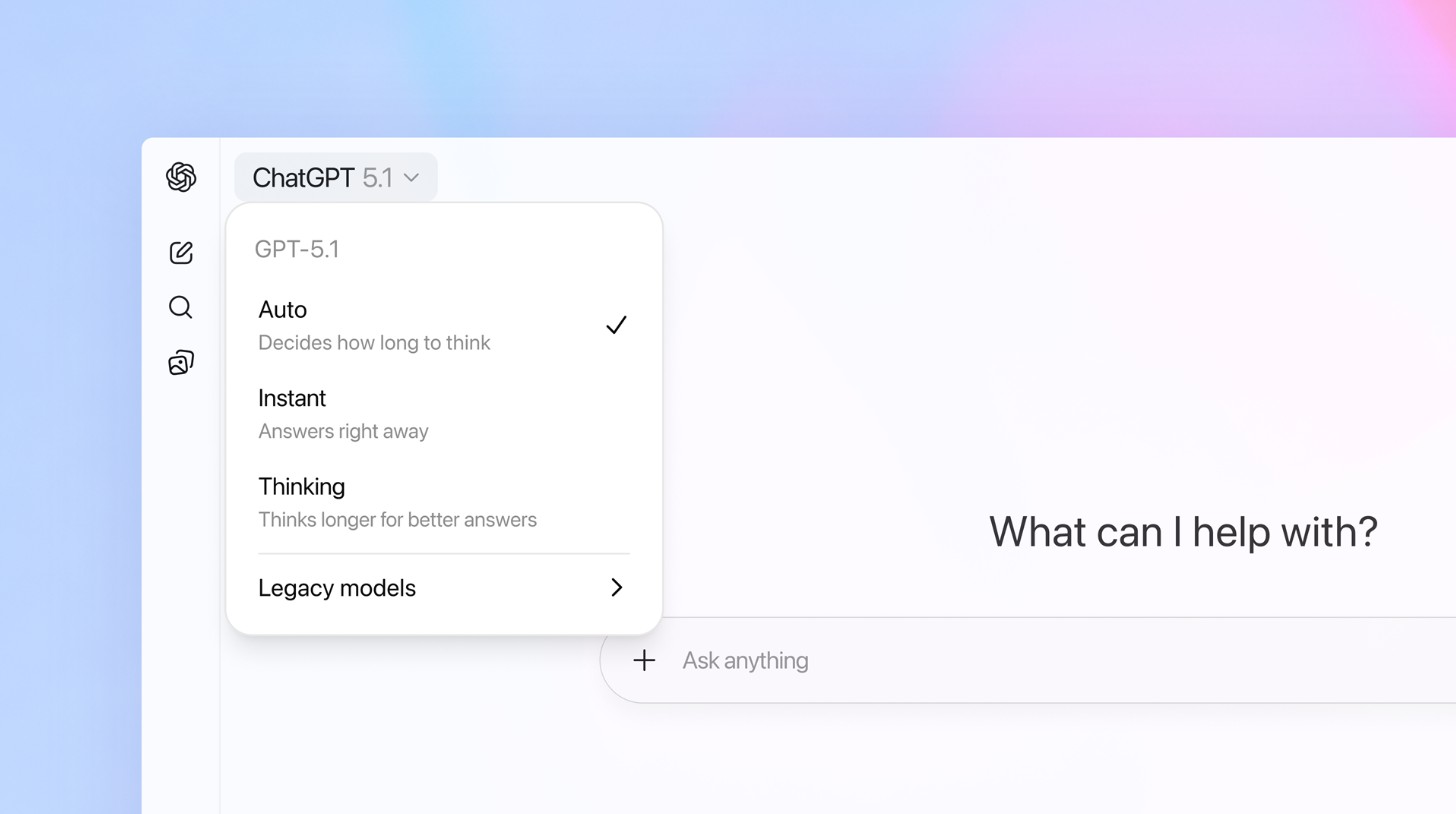
Meanwhile, GPT-5.1 Thinking is built on the core principle of continuous and sustained thinking. This model can handle complex tasks that GPT-5 previously struggled with, such as detailed multi-step planning, in-depth analysis of multidisciplinary problems, solution modeling, or processing highly logical requirements. Not only is it smarter, but Thinking is also optimized to avoid logical fallacies, minimize "illusions," and maintain coherence in lengthy conversations.
Another notable change is that in most situations, ChatGPT will automatically select the most appropriate model based on the query type. This eliminates the need for users to decide whether to use Instant or Thinking; instead, they simply enter the question and the system handles the rest.
From the end-user's perspective, the experience is almost more seamless and natural than before, with each task handled according to the optimal capabilities of each model.
Both GPT-5.1 models will be deployed to ChatGPT users in the week of their launch. However, to ensure a smooth transition, OpenAI is allowing older GPT-5 models to remain in use for approximately three months before being officially phased out. For enterprise users or developers, this timeframe is sufficient to test the new integration and fine-tune the system before fully transitioning to the next generation.
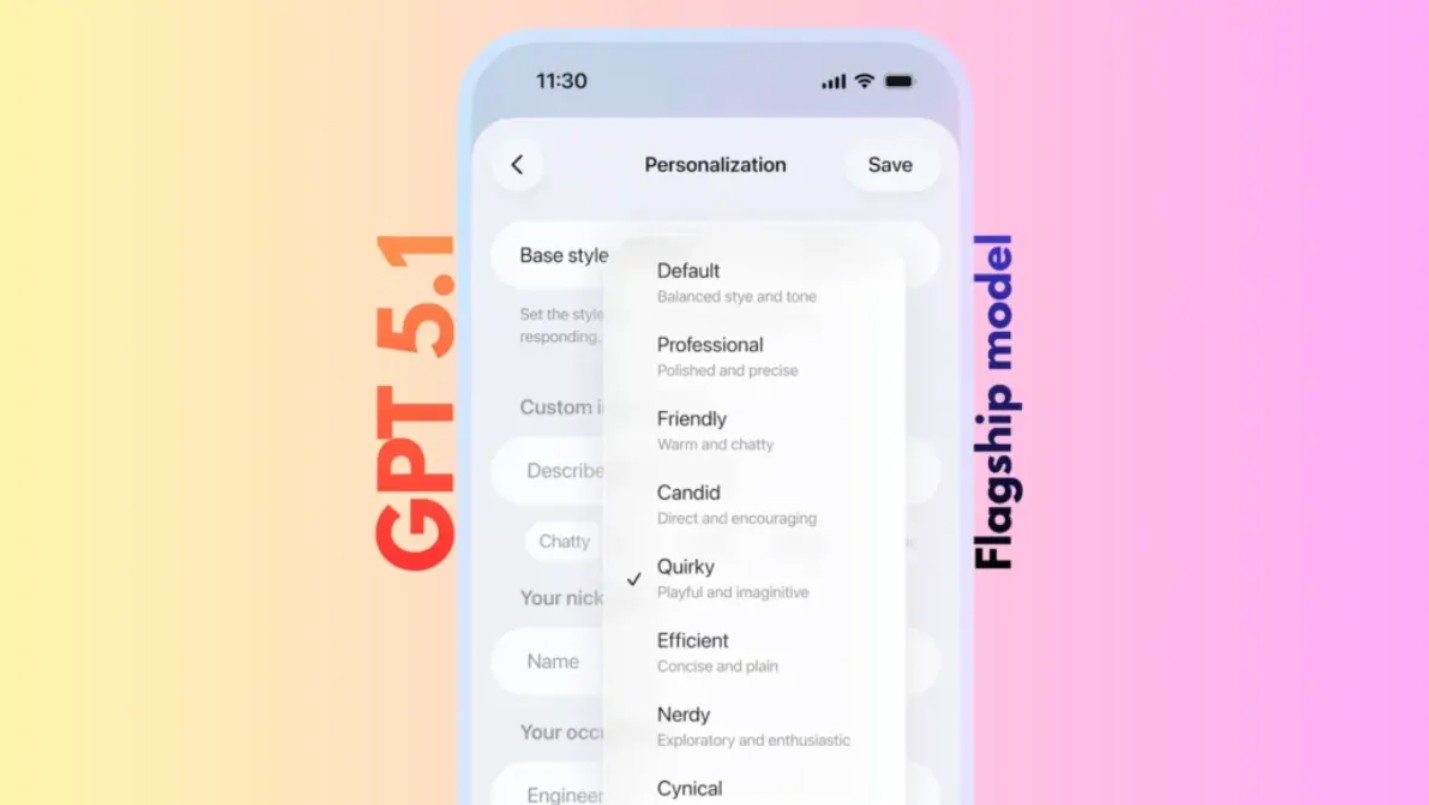
Alongside technical upgrades, OpenAI also introduced a "personality" change. The company expanded the voice customization system (persona) for ChatGPT, including options such as Default, Professional, Friendly, Frank, Quirky, Efficient, Bookish, and Skeptical. This voice refinement allows the AI to adapt more flexibly to different contexts: from everyday conversations and academic discussions to character simulations and office work support.
Furthermore, OpenAI announced it will be testing a new method that allows users to change ChatGPT's personality directly in the settings, instead of relying solely on pre-defined templates.
2. GPT-5.1 addresses the shortcomings of GPT-5.
Since its announcement, GPT-5 has been met with high expectations that it would create a breakthrough similar to GPT-4 before it. CEO Sam Altman also mentioned this expectation at several events, further increasing public attention to the launch of GPT-5. However, the reality has not lived up to expectations.
The GPT-5 version received complaints for its unstable processing speed, poor and inconsistent response quality in some intensive tasks, and limited ability to simulate emotions. Many users commented that GPT-5 was "more difficult to use" and "less emotional" than GPT-4o. Just one day after GPT-5's launch, pressure from the community was so great that OpenAI had to bring GPT-4o back as a parallel option for users to continue using.
This is a rare instance where OpenAI had to "withdraw" an AI version after its official launch, highlighting the seriousness of the problem.
Following the disappointment left by GPT-5, OpenAI's biggest strategic partner, Microsoft, has begun paying more attention to competing models from Anthropic. Microsoft uses AI in many of its flagship products such as Copilot Researcher, GitHub Copilot, Copilot Studio, and Office Agent. In particular, Office Agent can create Word and PowerPoint documents directly from the chat interface. These are features that Microsoft wants to ensure absolute accuracy for; therefore, if OpenAI's model doesn't meet expectations, Microsoft will be forced to consider other options.
The announcement of GPT-5.1 comes just weeks after OpenAI introduced its new AI browser called ChatGPT Atlas. Atlas is currently exclusive to ChatGPT Plus and Pro users and functions similarly to its predecessor, Operator, as a “browser assistant.” The launch of Atlas shows OpenAI's desire to expand ChatGPT's reach beyond traditional chat interfaces and integrate it into users' real-world work environments.
3. Changes in OpenAI's development direction through GPT-5.1
Instead of creating a single, most powerful model, OpenAI splits into two branches: one optimized for speed, and the other for depth of thought. This approach is strategic because it expands the range of applications: from everyday conversations to academic, professional, or advanced analytical tasks. The automatic selection of the appropriate model also shows OpenAI's desire to reduce the "technical burden" on the average user.
Improvements in tone and personality are based on real-world demands from the user community. As AI becomes increasingly integrated into daily life, users want it to resemble a partner, colleague, or even a friend, rather than a machine that only knows how to give right or wrong answers. GPT-5.1 ushers in a new era where AI can flexibly become a serious teacher, a computational expert, or a fun friend depending on the situation.
OpenAI's deployment of GPT-5.1 just weeks after Atlas also shows that the company is accelerating its pace to maintain a competitive advantage in the AI race. With rivals like Google, Anthropic, and xAI constantly releasing improvements, OpenAI is forced to maintain a rapid development pace to retain its leading position.
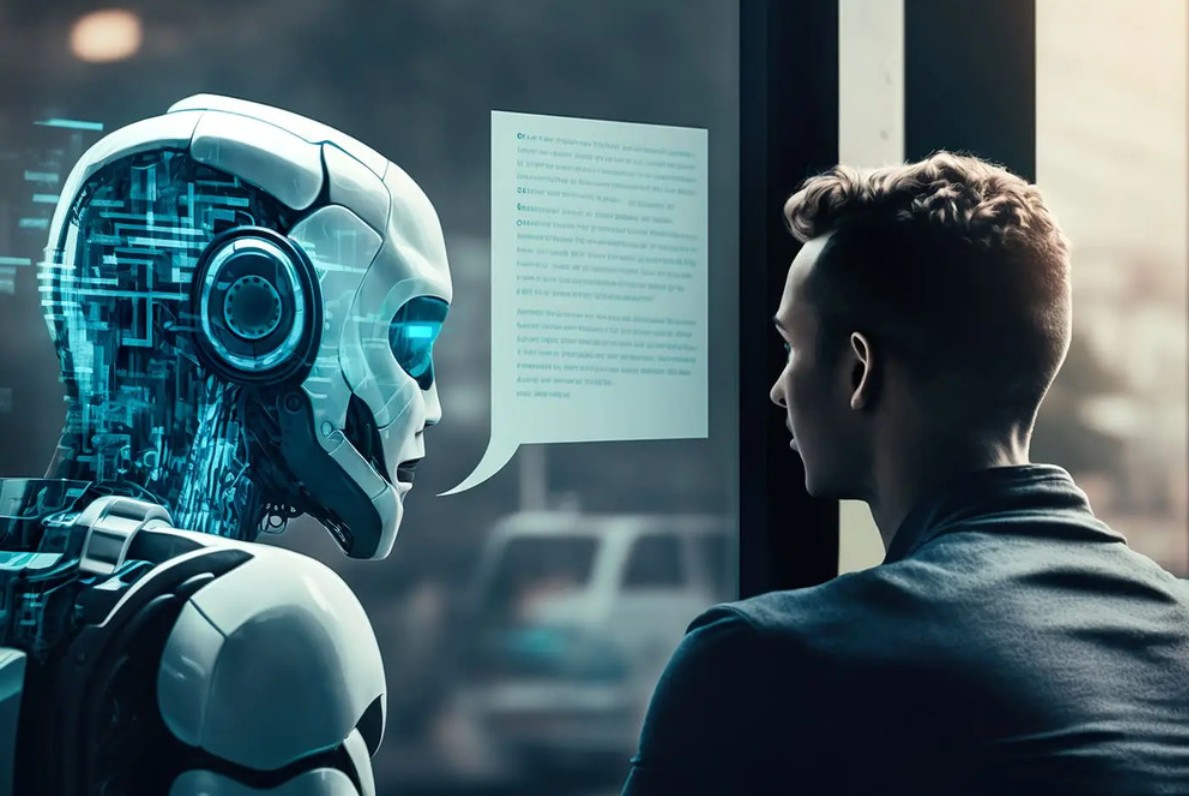
4. What does it mean for ChatGPT to be "less cold"?
One of the most notable aspects of GPT-5.1 is the promise that ChatGPT will be less "cold" and more tactful. This isn't simply about improving the tone for a more pleasant listening experience; it's a combination of three key elements.
Firstly, it offers better contextual understanding. GPT-5.1 more subtly analyzes the user's attitude and intentions, resulting in more flexible responses. If the user is stressed, ChatGPT will be gentler; if they need technical information, ChatGPT will be more focused; if they are looking for creative ideas, ChatGPT can become more enthusiastic and inspiring.
Secondly, the level of empathy is improved. With GPT-5, users often complained that responses were sometimes too stiff or word choices didn't match their emotions. GPT-5.1 Instant is trained to avoid these errors, resulting in more natural, human-like dialogue.
Thirdly, there's consistency in communication style. Thanks to expanded persona options, ChatGPT can maintain a consistent tone throughout the conversation, instead of occasionally "going off-key" like previous versions.
These changes make ChatGPT more suitable for fields such as customer service, education, mental health support therapy, creative marketing, or personal coaching.
5. ChatGPT Atlas Browser
Atlas acts as a "helper" capable of searching, analyzing, collecting data, filling out forms, navigating websites, and even performing tasks that users don't want to do manually.
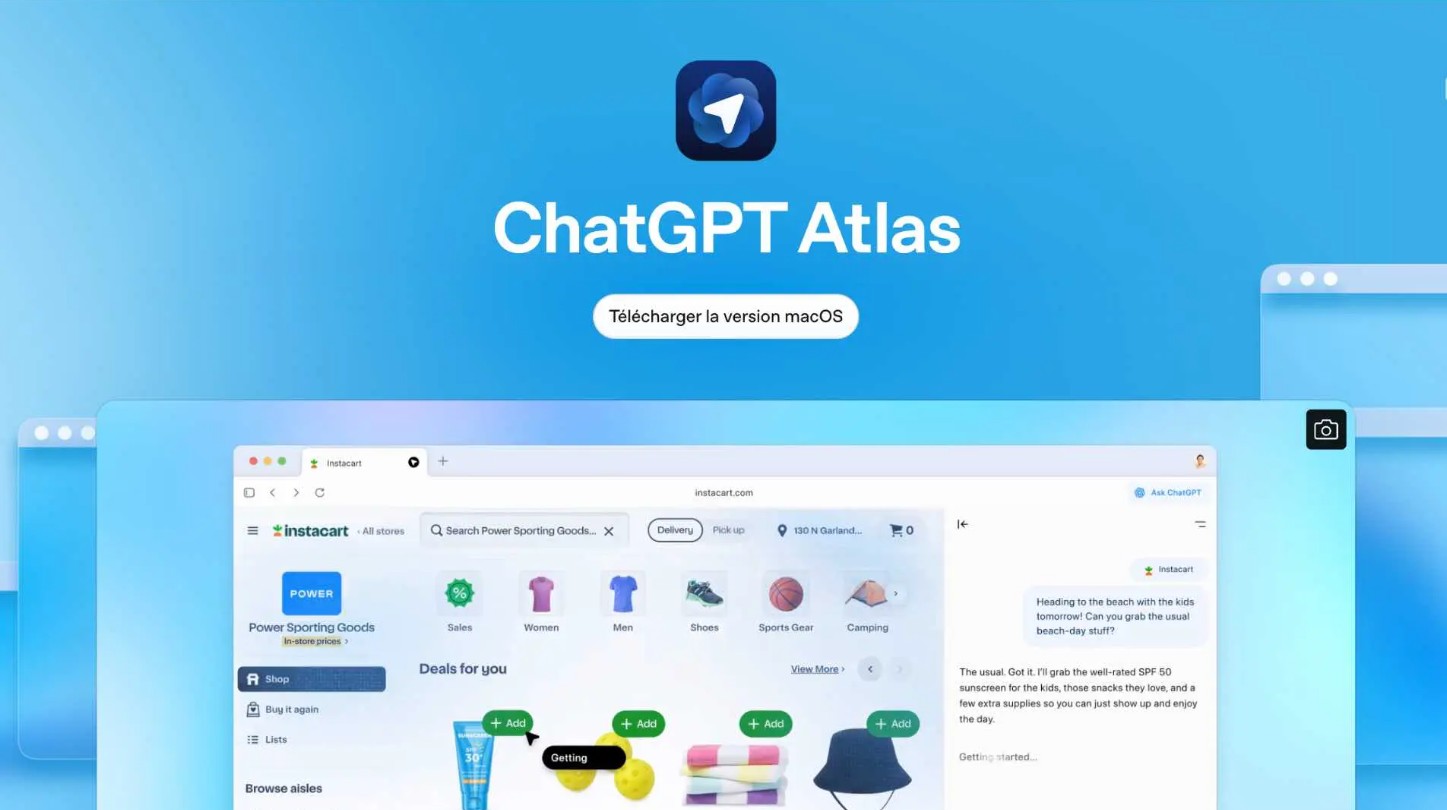
When combined with GPT-5.1, Atlas becomes a much more powerful tool. Instant enables quick operation on simple tasks such as searching or extracting information, while Thinking helps handle more demanding tasks such as analyzing reports, comparing multi-page data, or planning.
GPT-5.1 is not just a fix for GPT-5, but a major leap toward a more natural and approachable AI experience. With two models, Instant and Thinking, the ability to automatically select the appropriate model, and a powerful expansion of tone and personalization, ChatGPT is now more sophisticated, friendly, and helpful than ever before





















VIP Products








Best Selling Products
Copyright Adobe Lightroom Account
59 USD
Adobe Premiere Pro Account
99 USD
Genuine Cheap Canva Pro
39 USD
Upgrade Genuine Office 365
49 USD
Upgrade genuine Capture One account
120 USD
MidJourney Account
29 USD
ChatGPT Plus Account (GPT-4)
16 USD
Plugin Retouch4me
69 USD
Windows 10 & 11 Pro Key
36 USD
Freepik Premium Account
59 USD
Autodesk All App Account Copyright
120 USD
Capcut Pro 1 Year
39 USD
Upgrade Duolingo Super
29 USD
Adobe Photoshop Copyright - Full App
120 USD
Genuine Adobe Illustrator account
99 USD