Best Selling Products

Adobe Premiere Pro Account
99 USD

Genuine Adobe Illustrator account
99 USD
ChatGPT Plus Account (GPT-4)
16 USD
Autodesk All App Account Copyright
120 USD

Genuine Cheap Canva Pro
39 USD

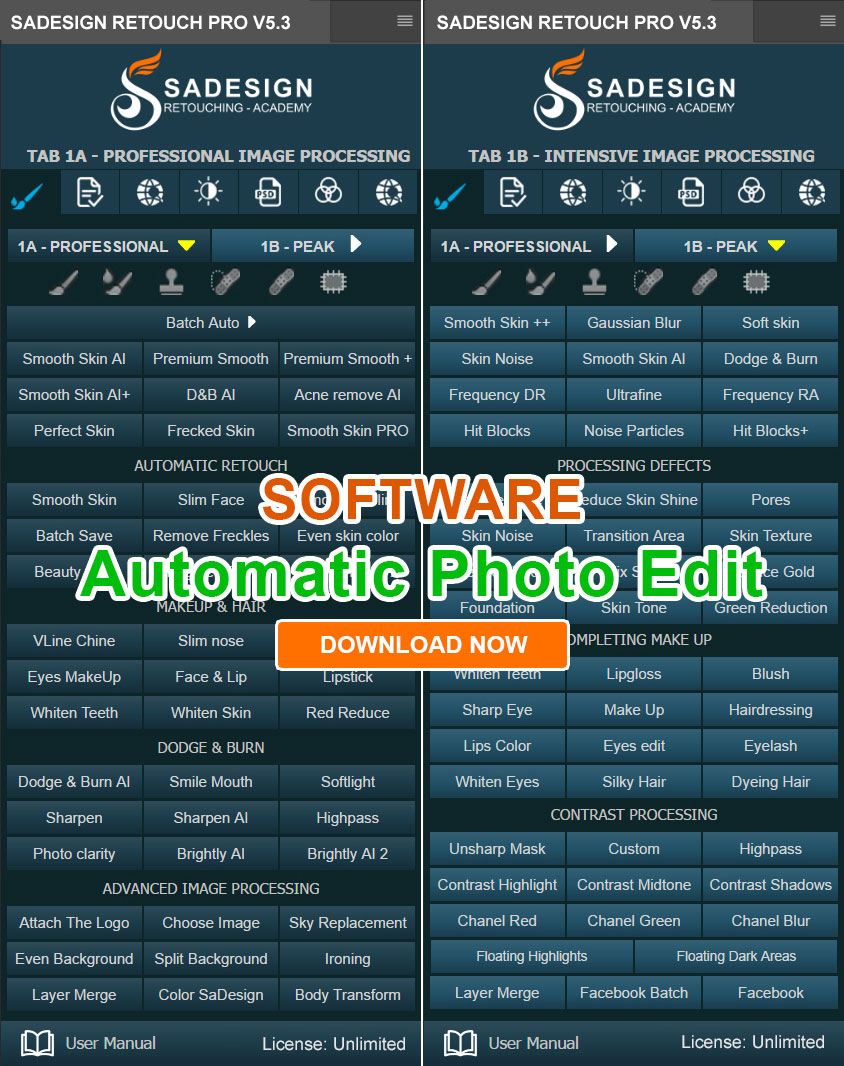
Plugin Retouch4me
69 USD

Upgrade Duolingo Super
29 USD

Adobe Photoshop Copyright - Full App
120 USD

Copyright Adobe Lightroom Account
59 USD

Capcut Pro 1 Year
39 USD

MidJourney Account
29 USD
Upgrade genuine Capture One account
120 USD

Freepik Premium Account
59 USD

Upgrade Genuine Office 365
49 USD

Windows 10 & 11 Pro Key
36 USD
OpenAI Introduces GPT-5.5: When Artificial Intelligence Begins Operating Work on Its Own
Nội dung
GPT-5.5 not only responds but also independently coordinates how problems are solved. It can connect tools, verify results, and self-correct. This marks a major step forward in autonomous AI.
1. Autonomy
One of the most remarkable aspects of GPT-5.5 is its ability to operate independently at a high level, marking a fundamental shift in how humans interact with artificial intelligence. In previous versions, users had to act as “problem decomposers,” breaking tasks down into specific steps. GPT-5.5, however, accepts overarching objectives and manages the entire process itself.
This means users no longer need to describe every individual action. Simply providing a goal-oriented request, such as “analyze this quarter’s business data and propose strategies to improve revenue,” allows GPT-5.5 to understand the context, determine the necessary steps, and execute the entire process logically.
What is particularly notable is that the model does not operate only in a linear fashion. It is capable of branching reasoning, generating multiple approaches simultaneously, evaluating the strengths and weaknesses of each option, and selecting the most effective path. This represents a major difference from earlier models that processed tasks through a single workflow.
This autonomy is further demonstrated through self-evaluation and self-correction mechanisms. During task execution, if GPT-5.5 detects inconsistencies or results that fail to meet expectations, it can revisit previous steps and adjust its strategy. This process closely resembles how experienced professionals work in complex environments, where no single predefined roadmap guarantees success.
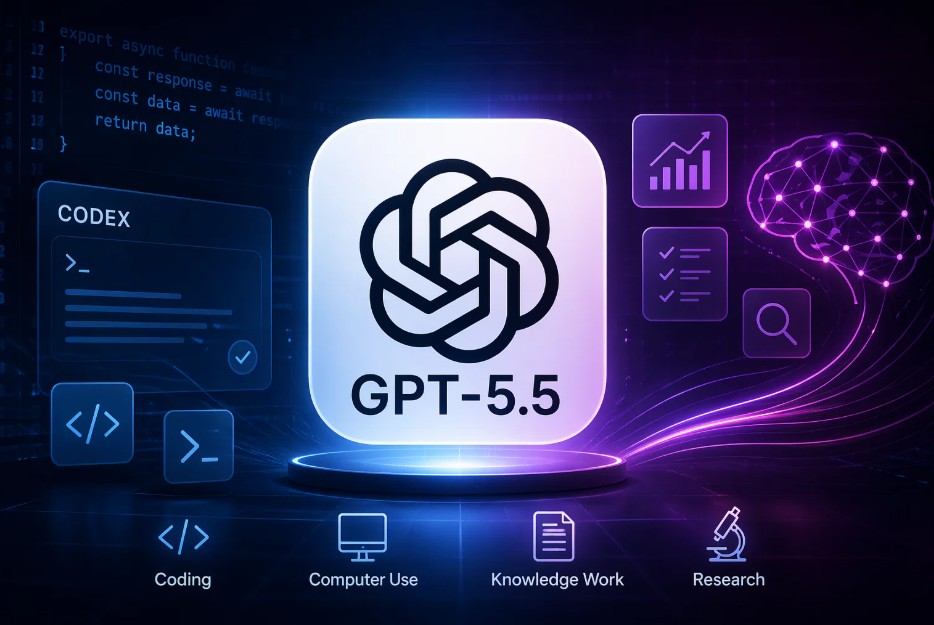
In addition, GPT-5.5 can coordinate multiple tools within a single workflow. It can independently determine when information retrieval is required, when data analysis is necessary, and when results should be synthesized. This significantly reduces dependence on users and transforms AI from a question-answering system into a comprehensive task execution platform.
2. Breakthroughs in Programming and Software Development
In software development, GPT-5.5 represents a revolutionary advancement by significantly improving its understanding of systems and software architecture. Beyond generating accurate code, the model can comprehend an entire project structure, from business logic to interactions between components.
This capability is especially valuable in large-scale projects, where source code is not merely a collection of isolated functions but a highly interconnected system. GPT-5.5 can analyze these relationships and propose holistic optimization strategies rather than simply fixing individual bugs.
Another major improvement is its ability to identify the root cause of problems. Instead of merely reacting to error messages, GPT-5.5 can trace logical workflows to pinpoint the exact source of an issue. This dramatically reduces debugging time, traditionally one of the most labor-intensive aspects of software development.
In practice, many complex problems require dozens of hours of manual analysis by developers. With GPT-5.5, this process can be significantly shortened through its ability to simulate systems thinking and recommend solutions from the analysis stage onward.
When integrated with tools such as Codex, GPT-5.5 goes beyond being a coding assistant and becomes a genuine member of the development team. It can read repositories, recommend architectural improvements, generate automated test cases, and even simulate system behavior for testing purposes.
Another noteworthy capability is source code optimization. GPT-5.5 can identify inefficient code segments and suggest alternatives that reduce computational complexity or improve execution speed. This helps improve software quality during development rather than relying solely on post-deployment fixes.
.jpg)
3. Expanding Capabilities Across Multiple Fields
In data analytics, the model can manage the entire processing lifecycle. From collecting raw data and cleaning datasets to identifying trends and visualizing results, everything can be performed within a unified workflow. This significantly reduces workload for data analysts while improving consistency in outcomes.
Beyond data processing, GPT-5.5 can interpret information within a business context. Rather than merely presenting numbers or charts, the model can explain what the data means for specific organizational objectives, supporting more informed decision-making.
In scientific research, GPT-5.5 functions as a comprehensive research assistant. It can help with literature searches, summarize previous studies, propose hypotheses, and analyze experimental results. More importantly, the model can connect fragmented information to generate new perspectives and expand research directions.
This capability is especially valuable in information-intensive fields such as medicine, physics, and data science, where synthesizing and analyzing knowledge from multiple sources is critical.
.jpg)
In addition, GPT-5.5 can be applied to document processing and office automation. It can transform data into professional reports, create complex spreadsheets, and generate detailed analytical documents based on broad requests. This significantly reduces administrative workloads that consume substantial time in business environments.
4. Performance, Cost, and Deployment Potential
One of GPT-5.5’s most important strengths is its ability to balance performance and cost. Despite major improvements in reasoning, analysis, and complex task execution, the model maintains response speeds comparable to previous versions while using system resources more efficiently.
Thanks to its improved architecture, GPT-5.5 can allocate computational power dynamically according to task complexity, minimizing resource waste on simple tasks while maintaining high accuracy for challenging problems. This is particularly important in enterprise environments where AI operating costs are a key consideration.
Notably, programming-related task costs have been significantly reduced, reaching approximately half the cost of many competing models. This makes AI technology more accessible to both large organizations and smaller development teams.
Currently, GPT-5.5 is being gradually deployed across ChatGPT through the Plus, Pro, Business, and Enterprise plans. In addition, GPT-5.5 Pro has been introduced to support advanced analytical workloads requiring higher accuracy. Future API expansion will further simplify integration into a wide range of software systems.
.jpg)
5. Impact on How Humans Work in the Future
GPT-5.5 is not only a technological advancement but also a force that may reshape how humans work. As AI becomes capable of independently completing complex tasks, human roles gradually shift from direct execution toward supervision, strategic guidance, and decision-making.
In practice, GPT-5.5 can handle activities such as data analysis, report writing, document processing, and programming assistance. This significantly reduces repetitive workloads, allowing people to focus more on creativity, strategy, and high-value responsibilities.
However, this transformation also requires adaptation from the workforce. Skills related to collaborating with AI, crafting effective instructions, and evaluating AI-generated results are becoming increasingly important. Organizations must also adjust their workflows to maximize the benefits of AI-driven operations.
In the long term, GPT-5.5 may become a common tool across industries such as business, education, and research. It will not only improve productivity but also introduce new working models where humans and AI collaborate closely to achieve superior outcomes.
In summary, GPT-5.5 represents an important milestone in the evolution of artificial intelligence. With its autonomy, strong performance, and broad range of applications, this model not only improves efficiency but also transforms how humans interact with technology. In an increasingly digital world, tools like GPT-5.5 will play a crucial role in shaping the future of work and innovation.

















VIP Products







Best Selling Products
Adobe Premiere Pro Account
99 USD
Genuine Adobe Illustrator account
99 USD
ChatGPT Plus Account (GPT-4)
16 USD
Autodesk All App Account Copyright
120 USD
Genuine Cheap Canva Pro
39 USD
Plugin Retouch4me
69 USD
Upgrade Duolingo Super
29 USD
Adobe Photoshop Copyright - Full App
120 USD
Copyright Adobe Lightroom Account
59 USD
Capcut Pro 1 Year
39 USD
MidJourney Account
29 USD
Upgrade genuine Capture One account
120 USD
Freepik Premium Account
59 USD
Upgrade Genuine Office 365
49 USD
Windows 10 & 11 Pro Key
36 USD