
Best Selling Products
Adobe Premiere Pro Account
99 USD

Freepik Premium Account
59 USD

Capcut Pro 1 Year
39 USD

Upgrade Duolingo Super
29 USD

Genuine Adobe Illustrator account
99 USD
Autodesk All App Account Copyright
120 USD
Copyright Adobe Lightroom Account
59 USD

Windows 10 & 11 Pro Key
36 USD

Plugin Retouch4me
69 USD

Upgrade genuine Capture One account
120 USD
Adobe Photoshop Copyright - Full App
120 USD

MidJourney Account
29 USD

ChatGPT Plus Account (GPT-4)
16 USD
Genuine Cheap Canva Pro
39 USD

Upgrade Genuine Office 365
49 USD
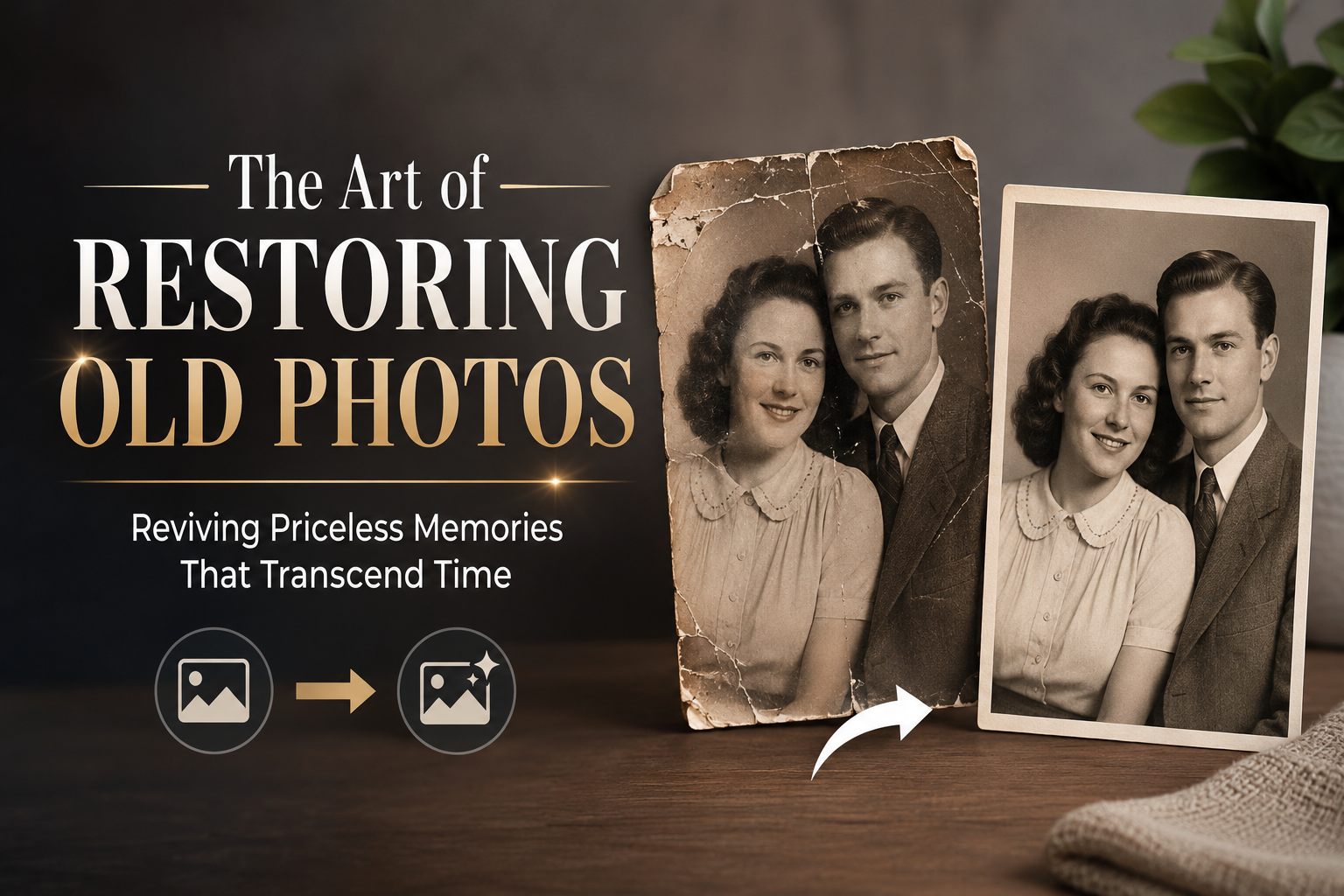
The Art of Restoring Old Photos: Reviving Priceless Memories That Transcend Time
Nội dung
- 1. The importance of restoring old photos in life.
- Preserving the spiritual values of the family.
- Preserving important historical documents.
- 2. Common defects and damage found in old photos and their causes.
- The photos are yellowed and faded.
- The image is moldy, cracked, and the emulsion layer is peeling off.
- Tears and loss of detail caused by insect infestation.
- 3. Professional old photo restoration process
- Step 1: Digitize the image using a specialized scanner.
- Step 2: Rough processing and cleaning of the digital surface
- Step 3: Restructure the missing parts
- Step 4: Adjust contrast and brightness
- 4. Application of AI technology in modern photo restoration.
- Resolution Upscaling feature
- Noise reduction and grain smoothing (Denoising)
- Automatic color restoration (Colorization)
- 5. Techniques for restoring color to black and white photos
- Choose the right skin tone.
- Recreating the colors of the costumes and the setting.
- 6. Things to consider when choosing a service to restore old photos.
- 7. Experience and skill of the artisan
- Commitment to print quality
- Protecting customer information and images.
- 8. How to preserve photos after restoration
- Use appropriate glass frames and hanging locations.
- Store digital files on cloud platforms.
- Avoid using old adhesive albums.
- 9. Restore photos at home: Simple tools
- Mobile phone applications
- Using specialized software on a computer.
- 10. The humanistic significance behind the revived photographs
- A priceless gift for one's parents.
- Preserving traditions for the younger generation.
- 11. Breakthrough online old photo restoration solution at Appvip.ai
- Why choose photo restoration through Appvip.ai ?
- Instructions on how to automatically restore photos using Appvip.ai
- 12. A trusted address for in-depth old photo restoration and technology consulting.
- Contact information and customer support at Appvip.ai
- Quality and security are guaranteed at Appvip.ai.
- 13. Conclusion
Discover the art of restoring old photos from A-Z. Learn how to refresh old, moldy, torn, and yellowed photos using professional AI and Photoshop technology to preserve family memories.
1. The importance of restoring old photos in life.
Each old photograph is a piece of personal and family history. As time passes, physical factors such as humidity, light, and temperature will severely degrade the quality of the photographic paper. Timely restoration helps prevent the permanent loss of these valuable documentary images.
Preserving the spiritual values of the family.
Photographs of grandparents and parents from their youth are often the only remaining mementos. Restoring a tattered photograph to its sharpness allows descendants to have a clearer view of the appearance and lives of their ancestors. This creates an invisible but strong bond between generations, fostering pride in their heritage.
Preserving important historical documents.
Beyond the family sphere, photo restoration plays a crucial role in preserving cultural heritage. Photographs of landscapes, costumes, or historical events from decades ago are a vital source of information for researchers. Digitizing and restoring them allows the public closer access to the glorious history of the nation.
2. Common defects and damage found in old photos and their causes.
Understanding the condition of the photograph is the first step in determining the appropriate restoration method. Often, old photographs, some decades old, will encounter many complex problems due to less than ideal storage conditions.
The photos are yellowed and faded.
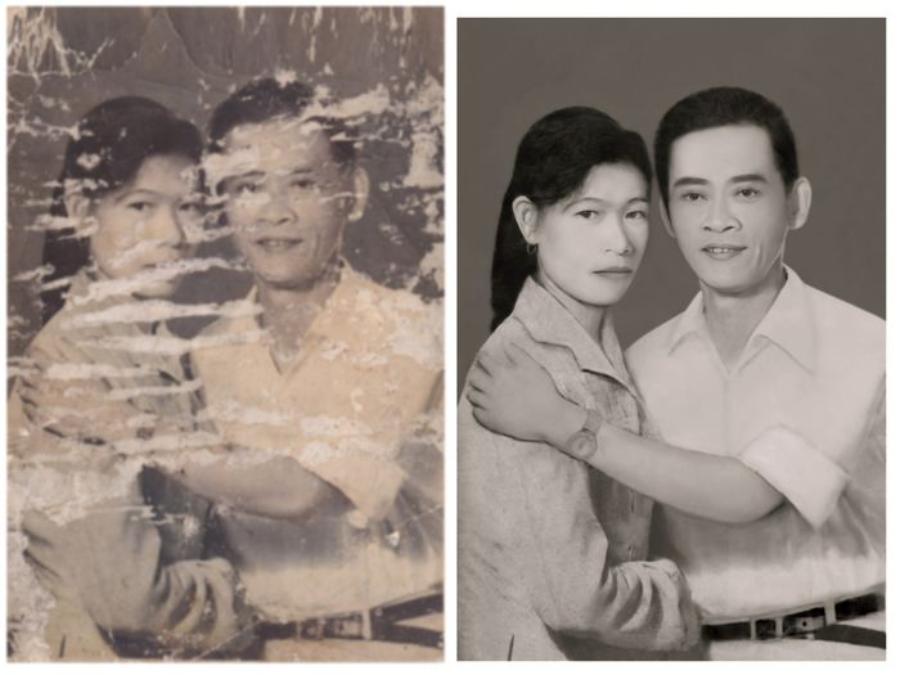
This phenomenon usually occurs due to a chemical reaction between the components in photographic paper and the surrounding environment. Direct sunlight is the primary factor causing the silver particles in the photographic emulsion to change, resulting in a loss of contrast and a faded, yellowish or dark brown tint to the image.
The image is moldy, cracked, and the emulsion layer is peeling off.
Vietnam has high humidity, which is ideal for mold growth on photo surfaces. Initially, mold appears as small spots, but over time it penetrates deep into the paper, completely ruining the details of faces or landscapes. In addition, sudden temperature changes cause uneven expansion and contraction of the photo surface, resulting in numerous hairline cracks.
Tears and loss of detail caused by insect infestation.
Cockroaches, termites, and woodworms are particularly fond of the paper and glue on the back of photographs. In many cases, photographs retrieved from old albums have a corner completely missing or are riddled with small holes. This type of damage is the most difficult to repair because it requires technicians with artistic skills to "recreate" the missing parts based on the remaining parts of the photograph.
3. Professional old photo restoration process
To achieve the best results, the restoration process needs to be carried out systematically and meticulously through many different stages.
Step 1: Digitize the image using a specialized scanner.
The first step is to convert the physical image into digital data. Using a high-resolution scanner (at least 600-1200 DPI) will ensure that as much detail as possible is captured. Note that you should avoid taking photos with your phone if possible, as light reflections and lens distortion will reduce the quality of the original file.
Step 2: Rough processing and cleaning of the digital surface
Technicians will use tools like the Clone Stamp or Healing Brush in professional software to remove debris, dust, and small scratches. This stage requires immense patience to avoid distorting the natural features of the subject in the photo.
Step 3: Restructure the missing parts
For photographs that are torn or have parts of the face missing, the photographer must apply knowledge of anatomy and lighting. They can use symmetry from the remaining part of the face or piece together images from other photographs taken at the same time to recreate the most realistic appearance.
Step 4: Adjust contrast and brightness
After achieving a clean background, balancing the brightness and contrast is necessary. This step helps to give the image more depth, clearly distinguish between light and dark areas, and eliminate the faded look of time.
4. Application of AI technology in modern photo restoration.
In recent years, artificial intelligence (AI) has revolutionized the field of image restoration, significantly saving time and effort.
Resolution Upscaling feature
AI algorithms can "guess" missing pixels to increase image size without pixelation. This is extremely useful for old, small photos like 3x4 size or photos that have become blurry. AI helps to naturally restore the sharpness of eyebrows, eyeliner, and hair strands.
Noise reduction and grain smoothing (Denoising)
Photographs taken with older film cameras often have significant grain. Deep learning technology can distinguish between image detail and noise for processing. The result is a smooth image that still retains the characteristic features of old film.
Automatic color restoration (Colorization)
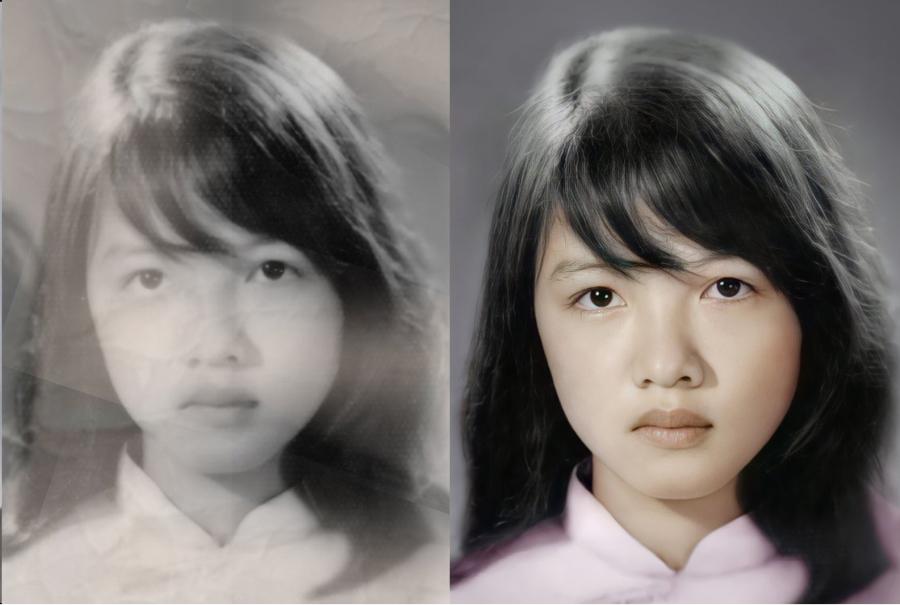
Modern AI can identify objects in photos such as the sky, trees, skin tones, or clothing to automatically apply accurate color filters. However, the colors generated by AI are often only for reference. To achieve the most realistic colors, photographers still need to manually adjust the tones to match the historical context of the photograph.
5. Techniques for restoring color to black and white photos
Transforming a black-and-white photograph into a color one is an art form that requires an understanding of art and history.
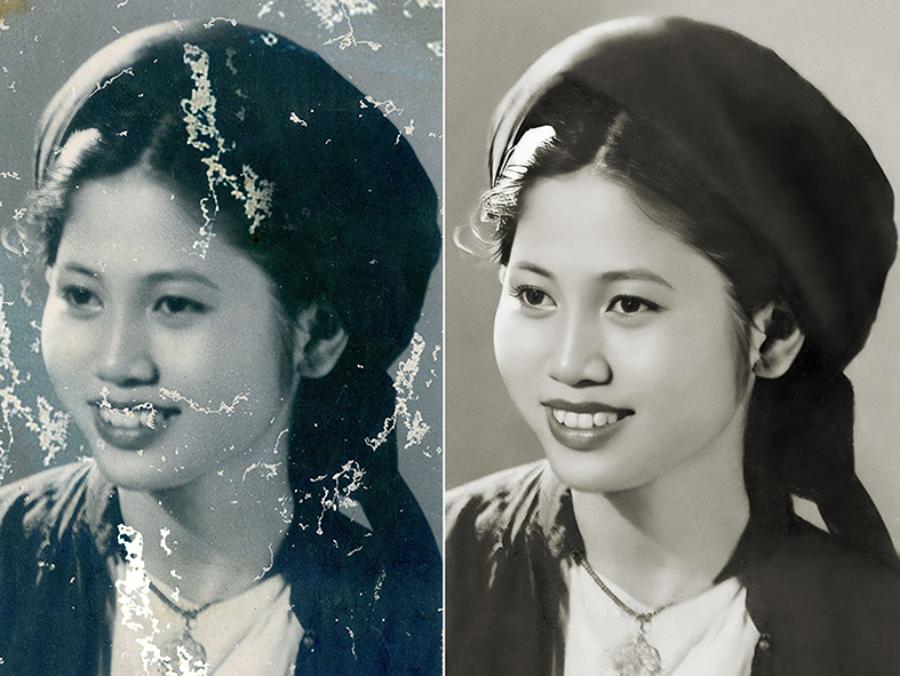
Choose the right skin tone.
Skin tone is the most important factor in determining whether a photograph looks "real" or not. Depending on ethnicity and lighting conditions during shooting (indoors or outdoors), the restorer must combine multiple layers of color, from orange and pink to earthy browns, to create a vibrant complexion and avoid the skin looking like wax figures.
Recreating the colors of the costumes and the setting.
Studying the history of clothing from different periods is crucial. For example, military uniforms, traditional Vietnamese dresses (áo dài), and headwear from the 1950s and 1960s had distinctive color palettes. Accurately coloring not only enhances the image but also respects its documentary value.
6. Things to consider when choosing a service to restore old photos.
Currently, many establishments offer this service, but not all of them can guarantee the aesthetic appeal and durability of the artwork.
7. Experience and skill of the artisan
Photo restoration isn't just about knowing how to use Photoshop. A good professional needs a good sense of aesthetics and empathy for their clients. Look at their before-and-after work to assess their ability to handle complex details like eyes, noses, and mouth corners.
Commitment to print quality
After restoring the digital file, printing it onto high-quality photo paper is the final step. You should request the use of specialized photo paper and genuine ink to ensure the photo doesn't fade after several years of use. High-quality silk or art paper is often preferred for restored works.
Protecting customer information and images.
Family photos are often highly private. A reputable agency will commit to protecting your images and will not use them for advertising purposes without your consent.
8. How to preserve photos after restoration
After the considerable effort put into restoration, proper preservation will help the photograph endure over time.
Use appropriate glass frames and hanging locations.
It's best to frame photos with protective glass to prevent dust and insects. Avoid hanging photos in direct sunlight or on damp or moldy walls. Soft LED lighting is the best option for displaying photos indoors.
Store digital files on cloud platforms.
This is the best way to preserve your memories. You should store the restored image files (in high resolution) on Google Drive, iCloud, or external hard drives. If the physical photo is damaged, you can still print a perfect copy from the original file.
Avoid using old adhesive albums.
Albums with a plastic film layer directly attached to the photo surface often contain acid that damages the paper over time. Instead, use acid-free albums with inner pockets for better photo protection.
9. Restore photos at home: Simple tools
If you have passion and some computer skills, you can definitely try your hand at restoring photos that aren't too damaged.
Mobile phone applications
Currently, there are many AI-integrated applications such as Remini, PhotoScan (from Google), or Adobe Lightroom Mobile that help you quickly handle sharpness and color issues. These applications are suitable for quick restoration for sharing on social media.
Using specialized software on a computer.
Adobe Photoshop remains the "king" in this field with its vast set of tools. In addition, software like Topaz Photo AI or VanceAI are also powerful tools for enhancing detail and removing noise from old photos without requiring overly complex skills.
10. The humanistic significance behind the revived photographs
The culmination of a long restoration process is marked by the smiles or tears of joy from clients as they see their deceased loved ones clearly again. That's when the craftspeople feel their work is most valuable.
A priceless gift for one's parents.
Giving parents a beautifully restored photograph from their youth often evokes more emotion than any material gift. It shows the care and filial piety of children towards their parents' memories.
Preserving traditions for the younger generation.
When young children look at clearly restored old photographs, the story of their family history becomes more vivid and easier to understand. This is the most effective and visual way to educate about tradition, helping the younger generation appreciate the past and confidently move towards the future.
11. Breakthrough online old photo restoration solution at Appvip.ai
In this era of rapid digital technology development, photo restoration is no longer the exclusive privilege of professional studios with exorbitant costs. Appvip.ai emerged as a revolution, offering a solution to revive memories at home with just a few simple steps a web browser mobile application.
Why choose photo restoration through Appvip.ai ?
Appvip.ai 's system is built on the latest generation of artificial intelligence (AI), possessing the ability to analyze image data at a deep level. Unlike typical editing applications, the AI here is trained through millions of pairs of old and new photos to understand how to restore skin texture, environmental colors, and the sharpness of even the smallest details. Users do not need graphic design knowledge to create works of art.
Instructions on how to automatically restore photos using Appvip.ai
The processing procedures at Appvip.ai are optimized to ensure convenience and speed for all customers:
-
Step 1: Go to the Appvip.ai homepage and upload the photo you want to restore.
-
Step 2: Select the appropriate feature, such as "Restore old photos".
-
Step 3: Wait a few seconds for the AI system to process the data and view the results directly on the screen.
-
Step 4: Download high-quality images for printing or long-term storage.
12. A trusted address for in-depth old photo restoration and technology consulting.
If you have severely damaged photos that require a combination of AI and skilled artistry, or need detailed guidance on using modern restoration technology, please connect with our team of experts.
Contact information and customer support at Appvip.ai
We are committed to accompanying you on your journey to rediscover your most precious memories. At Appvip.ai , every photo is cherished and processed with the utmost respect.
-
Official website: https://www.google.com/search?q=https://appvip.ai https://appvip.ai
-
Support services include: AI photo restoration, image resolution enhancement, automatic color restoration, and consultation on digitizing family heritage.
-
Operating hours: Our online system operates 24/7, always ready to meet your image recovery needs anytime, anywhere.
Quality and security are guaranteed at Appvip.ai.
Data security is always our top priority. When using Appvip.ai 's services , all uploaded images are encrypted and completely secure. We are committed to not sharing our customers' personal images with third parties, and we provide output quality with optimal resolution, ready for large-format printing without worrying about image loss. Let Appvip.ai be the gatekeeper of your own personal memory museum.
13. Conclusion
Restoring old photographs is the perfect blend of modern technology and human emotion. While time may fade photographic paper, advancements in restoration techniques ensure that precious moments are preserved intact. Restoring a photograph is not just repairing a damaged object; it's reviving a soul, a story, and an irreplaceable part of history. Begin your journey to rediscover your family memories today, before time erases the last details of the past.














VIP Products




Best Selling Products
Adobe Premiere Pro Account
99 USD
Freepik Premium Account
59 USD
Capcut Pro 1 Year
39 USD
Upgrade Duolingo Super
29 USD
Genuine Adobe Illustrator account
99 USD
Autodesk All App Account Copyright
120 USD
Copyright Adobe Lightroom Account
59 USD
Windows 10 & 11 Pro Key
36 USD
Plugin Retouch4me
69 USD
Upgrade genuine Capture One account
120 USD
Adobe Photoshop Copyright - Full App
120 USD
MidJourney Account
29 USD
ChatGPT Plus Account (GPT-4)
16 USD
Genuine Cheap Canva Pro
39 USD
Upgrade Genuine Office 365
49 USD