Best Selling Products

Adobe Premiere Pro Account
99 USD

Copyright Adobe Lightroom Account
59 USD

Autodesk All App Account Copyright
120 USD

Upgrade Duolingo Super
29 USD

Upgrade Genuine Office 365
49 USD

MidJourney Account
29 USD

Upgrade genuine Capture One account
120 USD

ChatGPT Plus Account (GPT-4)
16 USD

Genuine Adobe Illustrator account
99 USD

Capcut Pro 1 Year
39 USD

Windows 10 & 11 Pro Key
36 USD

Freepik Premium Account
59 USD

Adobe Photoshop Copyright - Full App
120 USD

Genuine Cheap Canva Pro
39 USD

Plugin Retouch4me
69 USD
Tinder Teams Up with OpenAI but Still Hasn’t Found the “Formula for Love”
Nội dung
The collaboration between Tinder and OpenAI raises major questions about the role of technology in love. This article analyzes AI’s ability to improve communication skills and the emotional limitations it has yet to overcome.
1. Dating Becomes a “Simulation Game”
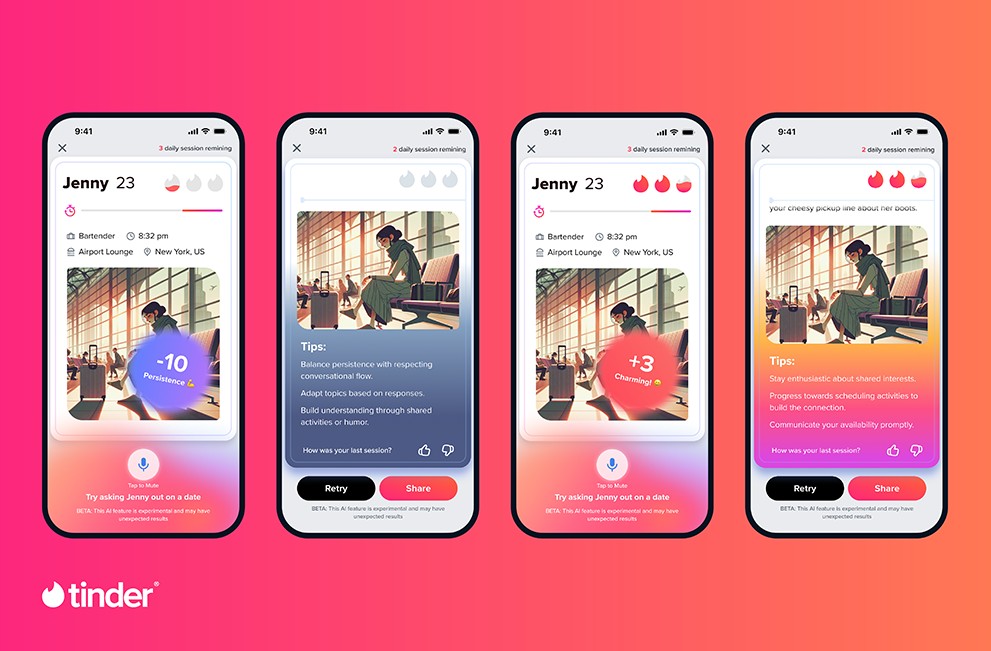
The launch of “The Game Game” demonstrates how Tinder is expanding its role from a matchmaking platform into a skill-development tool. Instead of merely helping users find potential matches, the app now creates simulated environments where they can practice starting and maintaining conversations.
In this model, users are placed in familiar settings such as cafés, elevators, or airports—contexts often associated with real-life opportunities for meeting people. They interact directly with AI characters using voice communication, attempting to make a good impression, ask meaningful questions, and keep conversations engaging enough to earn a high score. Each interaction functions like a “quick test” of communication skills, requiring users to balance natural behavior with strategic thinking.
This approach clearly reflects a modern trend: dating is no longer viewed solely as instinctive but increasingly as a skill that can be learned. The pressure to make a strong first impression, fear of rejection, and competition in the digital environment lead many people to seek “practice tools” such as AI. In this context, AI serves as a safe space where users can experiment with different approaches without worrying about negative reactions.
.jpg)
However, the “gamification” of dating also creates a paradox. When every interaction can be scored and optimized, users may gradually focus on “saying the right things” rather than “feeling the right emotions.” This raises concerns that dating could become a technical process in which sincerity is replaced by strategies and formulas.
2. The AI Technology Behind the Experience
At the core of “The Game Game” is advanced AI technology developed by OpenAI, particularly its real-time voice processing capabilities. This is a key factor that makes the experience smoother and closer to real-life communication compared to traditional chatbots.
Rather than going through multiple steps such as converting speech into text before processing it, the system can understand and respond almost instantly. This creates a continuous flow of conversation in which users can naturally use tone, speaking speed, and emotional expression. As a result, the experience feels less “mechanical” than text-based interactions and becomes far more dynamic and engaging.
In addition, the AI is designed to analyze communication behavior. It not only pays attention to what users say but also evaluates how they interact: whether they ask questions, maintain the flow of conversation, and demonstrate interest in the other person. Based on this data, the system provides feedback and scores, helping users identify both their strengths and weaknesses in communication.
.jpg)
However, despite significant technological progress, AI still cannot fully replicate the emotional depth of human beings. Its responses, while logical and fluent, are ultimately based on algorithms and data, lacking genuine spontaneity and authentic emotions. Furthermore, scoring based on measurable criteria may unintentionally encourage users to adapt their behavior according to the system’s standards, leading to greater uniformity in communication styles.
This demonstrates that AI is both a support tool and a force capable of shaping behavior. How it is used will determine whether it helps people become more natural communicators or makes them increasingly dependent on “optimized scripts” suggested by technology.
3. Real-World Experience: Between Engaging and Unnatural
In practice, many users find that “The Game Game” is both entertaining and… not entirely convincing. The AI can maintain smooth conversations, understand context, and respond quickly. Yet this very smoothness can sometimes make the experience feel unnatural.
One major issue is that the AI often reacts too positively. In real life, people are not always easily impressed or predictable in their responses. In the simulated environment, however, responses are frequently optimized to keep the conversation going, making users feel as though they are interacting with a “script” rather than a real person.
Additionally, AI responses can sometimes feel repetitive or lack personality. While it may offer advice, these suggestions are often generic and do not necessarily help users improve their skills in a truly meaningful way.
This creates a paradox: AI helps users practice, but the practice environment does not fully reflect reality. As a result, the skills learned may not transfer easily to real-world situations, where interactions are far more complex and unpredictable.
4. The Real Goal: Reducing Psychological Pressure
Despite its limitations, the primary objective of Tinder features supported by OpenAI is not to replace human interaction but to reduce the psychological pressure associated with dating.
Fear of rejection has long been a major obstacle that prevents many people from initiating conversations. AI eliminates this factor by creating a “risk-free” environment where users can experiment with different approaches without fear of judgment or emotional hurt. This is particularly beneficial for individuals who lack confidence, have limited experience, or have had negative dating experiences in the past.
Moreover, instant feedback helps users better understand their communication habits. Even though the system’s feedback is largely technical, it can still help users recognize ineffective patterns such as a lack of initiative, unengaging questions, or difficulty maintaining conversation flow. This allows them to improve in a more structured way rather than relying solely on intuition.
.jpg)
However, a completely “safe” environment also comes with a clear limitation. Once users become accustomed to interacting in a risk-free space, they may become less adaptable to real-world pressure. In real life, human reactions are often complex, unpredictable, and not always as positive as those found in simulations. This means that the gap between practice and reality remains, and AI has yet to bridge it completely.
5. Can AI Truly Improve Dating Skills?
The question remains: can tools like those on Tinder, powered by OpenAI technology, actually help users become better at dating?
At a basic level, AI does provide value by helping users improve communication skills such as starting conversations, asking appropriate questions, and maintaining dialogue. Through instant feedback, users can quickly identify ineffective interaction patterns and adjust them in more productive ways.
However, dating is not just about technique. It also involves emotions, chemistry, and subtle communication signals that AI struggles to replicate. A conversation conducted “the right way” does not necessarily create a genuine connection, because the most important factors remain sincerity and natural interaction between two people.
Furthermore, practicing with AI may create unrealistic expectations. After becoming accustomed to predictable and positive responses from the system, users may feel confused or disappointed when entering real-world situations where human reactions are far more complex and difficult to control.
Therefore, AI should be viewed as a support tool that helps users gain confidence when getting started, rather than as a complete replacement for real-world experience. It may help you “break the ice” more effectively, but building a genuine relationship still depends on authentic experiences and real emotions.
The collaboration between Tinder and OpenAI in “The Game Game” is an intriguing experiment that reflects the dating industry's efforts to innovate in the age of AI.





















VIP Products








Best Selling Products
Adobe Premiere Pro Account
99 USD
Copyright Adobe Lightroom Account
59 USD
Autodesk All App Account Copyright
120 USD
Upgrade Duolingo Super
29 USD
Upgrade Genuine Office 365
49 USD
MidJourney Account
29 USD
Upgrade genuine Capture One account
120 USD
ChatGPT Plus Account (GPT-4)
16 USD
Genuine Adobe Illustrator account
99 USD
Capcut Pro 1 Year
39 USD
Windows 10 & 11 Pro Key
36 USD
Freepik Premium Account
59 USD
Adobe Photoshop Copyright - Full App
120 USD
Genuine Cheap Canva Pro
39 USD
Plugin Retouch4me
69 USD