Best Selling Products

Autodesk All App Account Copyright
120 USD
Adobe Photoshop Copyright - Full App
120 USD
Copyright Adobe Lightroom Account
59 USD

Plugin Retouch4me
69 USD

Adobe Premiere Pro Account
99 USD

Genuine Cheap Canva Pro
39 USD
Upgrade genuine Capture One account
120 USD

ChatGPT Plus Account (GPT-4)
16 USD

Upgrade Genuine Office 365
49 USD

Capcut Pro 1 Year
39 USD

Upgrade Duolingo Super
29 USD

Freepik Premium Account
59 USD

Windows 10 & 11 Pro Key
36 USD

Genuine Adobe Illustrator account
99 USD

MidJourney Account
29 USD
Decoding the numbers and symbols on camera lenses
Nội dung
- 1. The f-number and maximum aperture of the lens
- 2. Lens mount symbols indicate compatibility.
- 3. Symbol Ø and thread diameter for filter mounting
- 4. Focal length in millimeters and angle of view of the lens
- 5. Macro lenses and magnification ratios
- 6. Minimum focusing distance in meters and feet
- 7. Abbreviations for autofocus systems
- 8. Optical image stabilization symbol
- 9. High-end lens lines
- 10. Buttons, dials, and switches on the lens body.
- Conclusion
If you''ve ever picked up a lens and looked at the series of numbers and letters printed around the barrel or on the front ring, you''ve probably wondered what they mean. These aren''t just decorative symbols. Manufacturers use them to tell you about the aperture, focal length, mount, focusing system, image stabilization, and even the lens''s optical grade. Understanding this "language" helps you choose the right lens when buying, avoid wasting money on incompatible equipment, and fully utilize what your lens can do. Let''s go through ten of the most common groups of symbols.
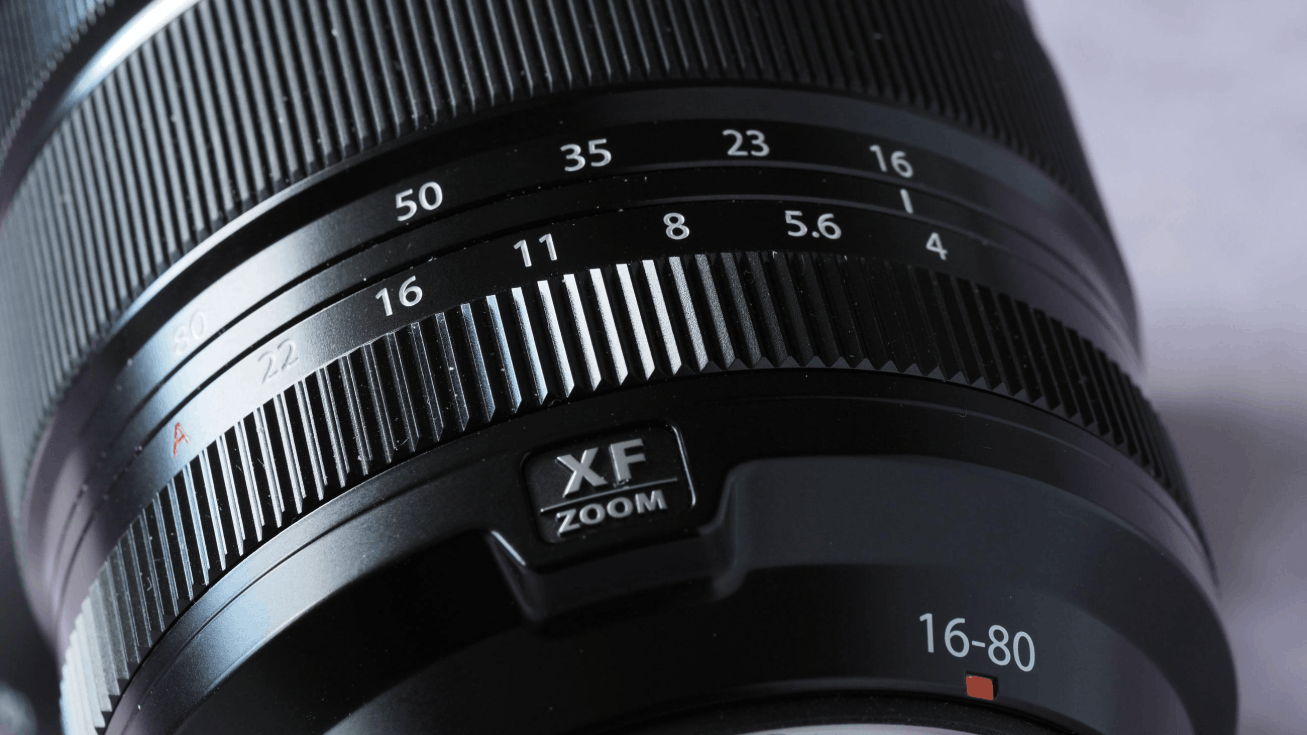
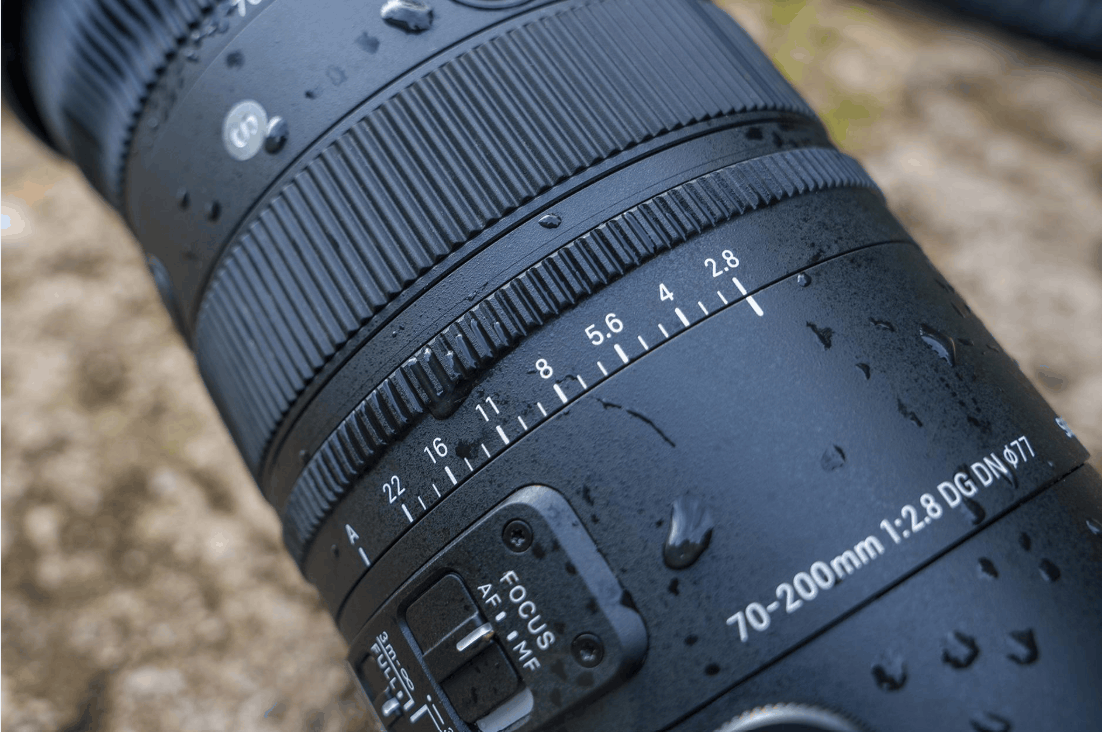
1. The f-number and maximum aperture of the lens
The letter 'f' stands for f-stop, also known as the f-number, indicating the aperture opening. The symbol is usually f/4.5, which consists of the letter 'f', a slash, and a number. It's easy to be confused: the smaller the number, the wider the aperture, while the larger the number, the narrower the aperture. For example, f/2 is a wide aperture, while f/2.2 is a very narrow aperture. Each step on the standard scale, such as from f/2 to f/2.8 or from f/2.8 to f/4, corresponds to a 50% reduction in the amount of light entering the sensor.
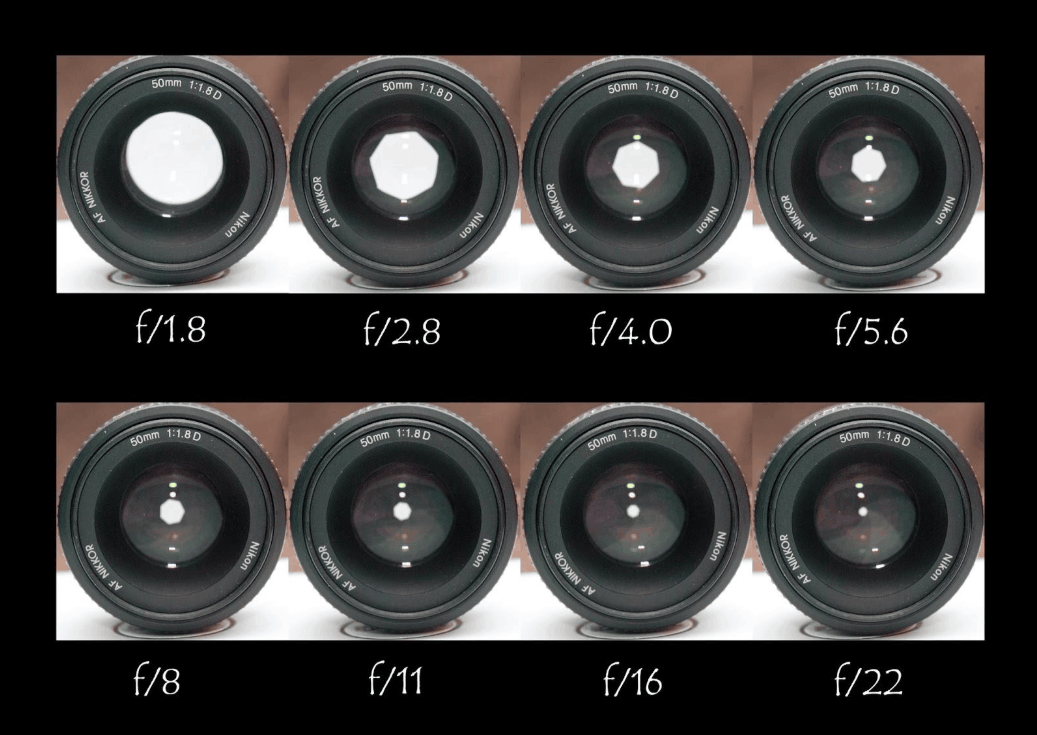
On the lens barrel, you'll always see the maximum aperture, which is the widest opening the lens can achieve. This number indicates whether the lens is "fast" or "slow." Fast lenses have a wide maximum aperture, capturing more light, allowing for shooting in low-light conditions with higher shutter speeds and better control over depth of field to create a smooth, blurred background. In return, these lenses are usually more expensive, heavier, and bulkier.
The way apertures are indicated also varies between manufacturers. Sometimes you see the letter 'f', sometimes just two numbers separated by a slash, with the first number being the aperture. Some manufacturers indicate it as a ratio, such as 1:1.8, meaning the maximum aperture is f/1.8. With zoom lenses, you might encounter two apertures; for example, a 70-300mm f/4.5 to f/6.3 lens might have a maximum aperture of f/4.5 at the 70mm end, but only f/6.3 when zoomed all the way to 300mm. This is called variable maximum aperture. Conversely, if you only see a single number like f/2.8, the maximum aperture remains constant throughout the zoom range, and you don't lose any light when getting closer to the subject.
2. Lens mount symbols indicate compatibility.
The letter F on a lens doesn't always indicate the aperture. On many Canon, Nikon, Fujifilm, and Sony lenses, these letters indicate the lens mount system. Each manufacturer uses a mount designation, usually consisting of one to three letters.
Canon uses the EF mount for full-frame DSLRs and the EF S mount for APS-C lenses. Mirrorless cameras use RF and RF S mounts, while the EF M mount is for older, compact mirrorless cameras. Nikon uses the F mount for DSLRs, while mirrorless cameras use the Z mount, and lenses for APS-C sensors are designated Z DX. Sony uses FE for full-frame lenses and E for APS-C lenses, both belonging to the E mount, alongside the older A mount. Fujifilm uses XF and XC for its APS-C mirrorless system. Olympus, now OM Systems, and Panasonic Lumix share the Micro Four Thirds system, designated as M.Zuiko, Micro 4/3, or G. Panasonic also uses the letter L for its full-frame L mount.
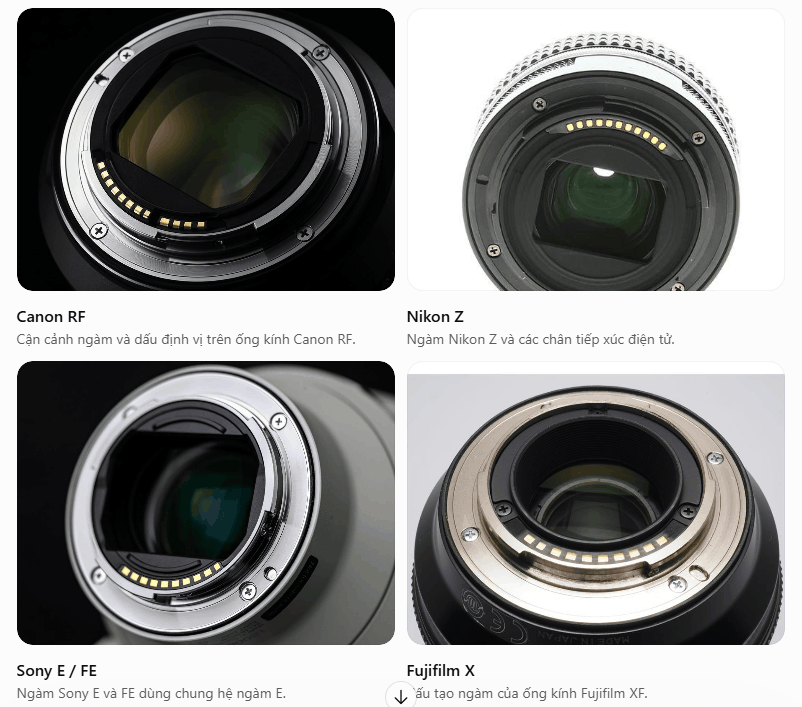
Reading the correct mount designation is especially important when considering third-party lenses from brands like Sigma, Tamron, or Tokina, which produce the same model for multiple mounts. A Sigma 24-70mm f/2.8 lens might have the letters EF, meaning it's for Canon DSLRs, or Z, meaning it's for Nikon mirrorless cameras. It's also worth noting that lenses designed for smaller sensors, such as EF S or RF S, can be mounted on full-frame cameras of the same type, but the image will be cropped, losing some of the advantages of a larger sensor.
3. Symbol Ø and thread diameter for filter mounting
The symbol resembling a circle with a diagonal line through it, Ø, indicates the diameter of the filter thread in millimeters located on the front of the lens. Therefore, Ø67 means the lens accepts 67mm threaded filters. Although often referred to simply as the lens diameter, this number is not the size of the lens barrel, but rather the size of the thread on the front.
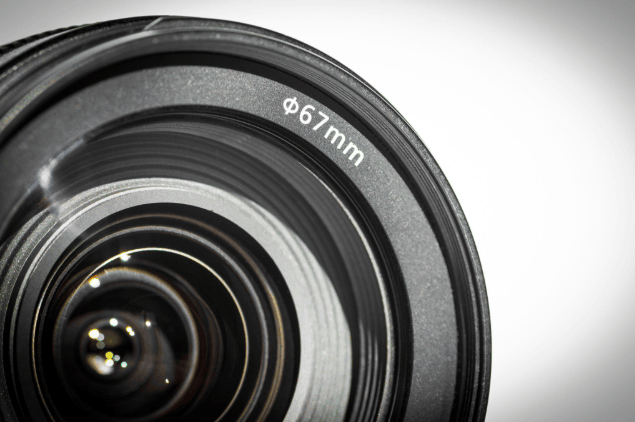
This information is more practical than you think. When buying lens caps, you need to know this exact number to ensure a proper fit. When buying filters, from protective filters and polarizing filters (CPL) to ND filters, the filter size must match the thread diameter of the lens. If you own several lenses with different thread sizes, you can buy the largest filter and use an adapter ring to share it with the smaller lenses, saving you considerable costs. Some lenses, especially ultra-wide-angle lenses or those with a domed front, don't have standard filter threads, and you'll need a specialized filter mount.
4. Focal length in millimeters and angle of view of the lens
Focal length is indicated in millimeters, usually a number next to the aperture number. On a lens marked 1.8/50, you read the maximum aperture of f/1.8 and a focal length of 50mm. Focal length determines the lens's field of view, and the simple principle is that the smaller the number, the wider the field of view. A 20mm lens provides a wide angle, suitable for landscapes and architecture. A 50mm lens is considered the standard focal length, close to how the human eye sees. Lenses of 100mm and above create a narrower field of view, bringing objects closer, ideal for portraits and long-distance shots.
A fixed-focal-length or prime lens has only one focal length and cannot zoom, so it's marked with a number like 50 or 50mm. A zoom lens has a variable focal length, and you'll see two numbers indicating the zoom range, for example, 70 to 200, meaning the shortest focal length is 70mm and the longest is 200mm, allowing you to rotate the zoom ring to select any value in between.
One important point to remember is that this number is tied to sensor size. On an APS-C camera, the field of view is narrowed by approximately 1.5 or 1.6 times, while on a Micro Four Thirds camera it's doubled. Therefore, a 50mm lens on an APS-C camera has a field of view nearly the same as a 75 to 80mm lens on a full-frame camera.
5. Macro lenses and magnification ratios
Macro lenses are designed to photograph very small subjects or capture extremely fine detail. Their most important parameter is the magnification ratio, which indicates the size of the image on the sensor relative to the actual size of the object. A 1:1 ratio means the object appears on the sensor at its real-life size, also known as true macro. A 2:1 ratio results in an image twice the size of the object, and a 1:2 ratio means the image is only half the size of the object.
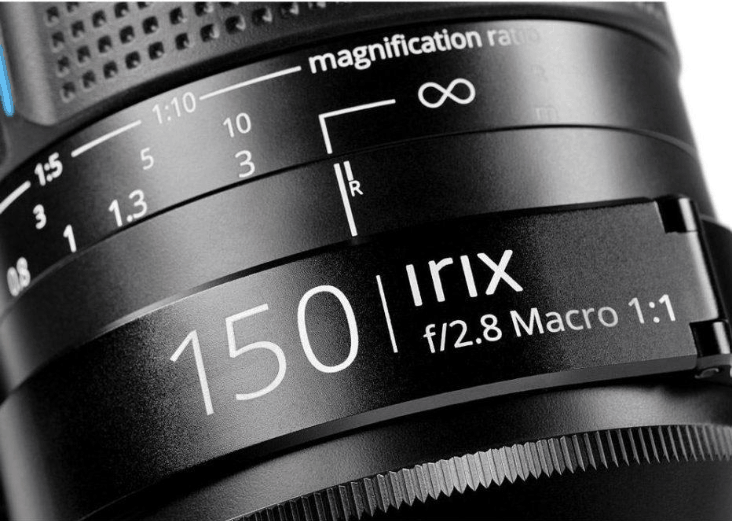
This is important to note because the word "macro" on a lens doesn't always mean 1:1. Many zoom lenses labeled "macro" only achieve a ratio of 1:4 or 1:3, enough for closer-than-normal shots but not true macro. If you plan on photographing insects, flowers, or jewelry with high detail, carefully check the maximum magnification ratio instead of relying solely on the "macro" label. Some lenses even have a switch to toggle the magnification range to suit different situations, and this is also where you should check the working distance—the distance between the front of the lens and the subject—as too short a distance can scare insects or block out light.
6. Minimum focusing distance in meters and feet
On many lenses, you'll see a series of numbers in meters and feet, such as 0.9m / 2.96ft. This is the minimum focusing distance, meaning the lens cannot focus on a subject closer than this distance. The two numbers have the same value; they only differ in the system of measurement, as each country uses either the metric or the imperial system.
A common mistake is that this distance is usually measured from the sensor plane, which the camera body marks with a circle and a horizontal line, not from the front glass. Therefore, the actual distance between the front of the lens and the subject will be shorter than the number printed on the camera body.
With zoom lenses, you can find a range of values, for example, 0.5m / 1.64ft to 0.8m / 2.63ft. This means that at the shortest focal length, the minimum focusing distance is 0.5 meters, and when zoomed to the longest focal length, that number increases to 0.8 meters. This parameter is especially important for product photographers, detail photographers, flower photographers, or anyone who likes to get close to their subjects. This is also why a telephoto lens can hardly function as a close-up lens, even with a long focal length.
7. Abbreviations for autofocus systems
Besides aperture and focal length, lenses also have abbreviations indicating the type of autofocus motor. Each manufacturer has its own naming convention, and some manufacturers use multiple types of motors for different lens models.
Most Canon lenses today use either STM or USM. STM stands for Stepping Motor, a stepper motor that uses rotating gears to move the lens elements. It's quiet and smooth, very suitable for video recording, and is often found in entry-level models. USM stands for Ultra Sonic Motor, which uses ultrasonic vibrations to move the lens group. It's faster than STM and is usually found in high-end lenses, alongside the Nano USM variant which combines the advantages of both. Nikon uses AF S for Silent Wave Motor, AF P for Stepping Motor, and AF I for older models with integrated motors. Lenses labeled purely AF don't have their own motors and rely on the motor in the compatible camera body. Fujifilm uses LM, short for Linear Motor. Sigma uses HSM, or Hyper Sonic Motor, the company's high-end motor line. With Sony's A-mount lenses, you'll find SSM or SAM.
When buying used or third-party lenses, be sure to check this symbol carefully, as some camera bodies do not support autofocus with lenses that lack a built-in motor.
8. Optical image stabilization symbol
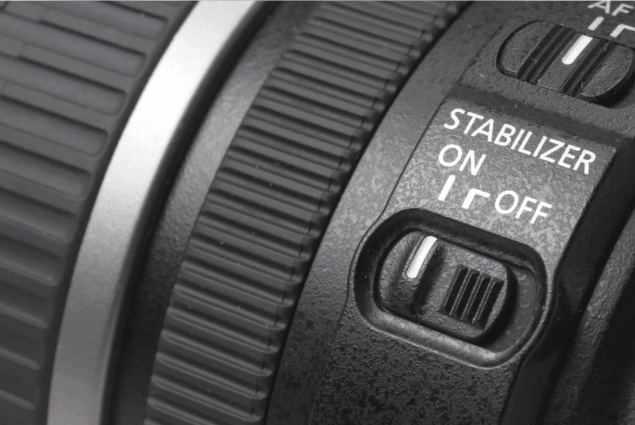
Lenses with built-in image stabilization will clearly state this in their name and on the lens body, but each manufacturer uses a different abbreviation. Canon uses IS, Nikon uses VR, short for Vibration Reduction. Sony uses OSS, which stands for Optical SteadyShot, Fujifilm uses OIS, Sigma uses OS, and Olympus uses IS. Despite the different names, they are essentially the same technology, using a group of moving lenses to compensate for hand shake, allowing you to shoot handheld at slower shutter speeds while maintaining sharp images. Some other manufacturers, such as Tamron, use VC, and Panasonic uses the OIS designation.
You'll often see a small switch on the side of the lens to turn this feature on or off, labeled IS On/Off. If the lens has multiple modes, the switch will be labeled Off, 1, and 2, with the second mode usually optimized for tracking horizontally moving subjects or panning. Image stabilization is mainly found on telephoto lenses and high-end models, as hand shake has the most significant impact at long focal lengths. If you don't see this symbol, your lens doesn't have image stabilization. Also, remember that many newer camera bodies have built-in image stabilization, and many manufacturers allow combining both for a stronger effect. When shooting with a stable tripod, you should consider turning off image stabilization on older lenses to avoid in-body shake.
9. High-end lens lines
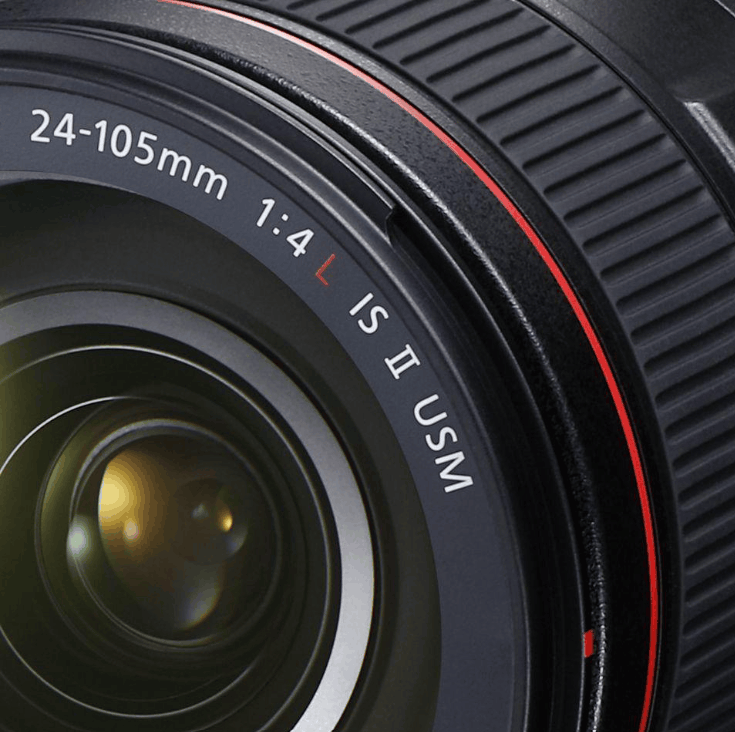
Some manufacturers use letters to designate their highest-end lens lines. Canon has the L series, short for Luxury, applicable to both EF and RF mounts, known for the red ring on the front of the lens barrel. A prime example is the Canon RF 70-200mm f/2.8 L IS USM lens. The L series stands out for its superior optical quality, high durability, and often dust and moisture resistance. Nikon uses the letter S for high-quality Z-mount lenses, positioned as the company's professional line. Sony has the G series for high-end lenses, and the G Master series, designated GM, represents the pinnacle of quality, with excellent resolution and beautiful background blur effects.
Fujifilm doesn't have a high-end line with its own name, but uses the letters WR to indicate weather-resistant lenses. Sigma also divides its lenses into Art, Contemporary, and Sports lines, with Art focusing on maximum image quality.
When comparing prices, understand that the difference between high-end models is often not just in the name. It reflects lens quality, anti-glare coatings, mechanical construction, weather resistance, and consistency across products. A single letter on a lens can sometimes result in a price difference of hundreds of dollars, so carefully reading the markings before making a decision is highly recommended.
10. Buttons, dials, and switches on the lens body.
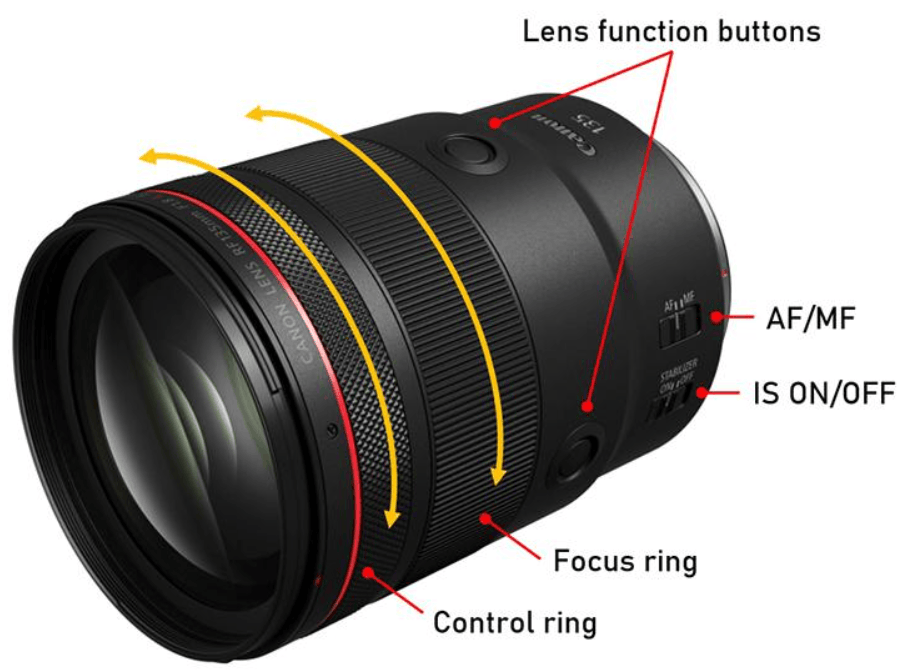
In addition to the markings printed on the body, lenses have several physical controls you need to be aware of. Every lens has a focus ring for manual focusing. Zoom lenses have an additional zoom ring to change the focal length, and many newer lenses have a third control ring, a customizable ring that you can assign to aperture, ISO, exposure compensation, or other settings.
Most lenses have a switch to toggle between autofocus and manual focus, labeled A/M or AF/MF. As mentioned earlier, many lenses have an on/off switch for image stabilization, and some have a customizable function button, often labeled L Fn, allowing you to assign a preferred setting. Telephoto and macro lenses often have a focus limit switch, labeled Full and ∞ up to 3m, with the specific distance varying by model. When the limit switch is activated, the lens only focuses within the selected range, resulting in faster focusing, especially when shooting wildlife or sports. Some lenses, particularly those from Fujifilm, also have a separate aperture ring, providing a familiar mechanical control feel.
Conclusion
Each manufacturer has its own way of labeling, but you can always find the maximum aperture and focal length on every lens, along with the mount designation and other information depending on the model. Understanding these numbers and letters helps you quickly read the lens's capabilities, from low-light performance, angle of view, focusing distance to durability and quality. Next time you're buying a lens, take a few minutes to carefully read the markings on the body. Those small details often make the difference between a smart investment and something unsuitable for your needs.

















VIP Products






Best Selling Products
Autodesk All App Account Copyright
120 USD
Adobe Photoshop Copyright - Full App
120 USD
Copyright Adobe Lightroom Account
59 USD
Plugin Retouch4me
69 USD
Adobe Premiere Pro Account
99 USD
Genuine Cheap Canva Pro
39 USD
Upgrade genuine Capture One account
120 USD
ChatGPT Plus Account (GPT-4)
16 USD
Upgrade Genuine Office 365
49 USD
Capcut Pro 1 Year
39 USD
Upgrade Duolingo Super
29 USD
Freepik Premium Account
59 USD
Windows 10 & 11 Pro Key
36 USD
Genuine Adobe Illustrator account
99 USD
MidJourney Account
29 USD