Best Selling Products

Upgrade genuine Capture One account
120 USD

Copyright Adobe Lightroom Account
59 USD

Adobe Photoshop Copyright - Full App
120 USD

MidJourney Account
29 USD

Upgrade Genuine Office 365
49 USD

Freepik Premium Account
59 USD

Windows 10 & 11 Pro Key
36 USD

Genuine Cheap Canva Pro
39 USD

Upgrade Duolingo Super
29 USD

Genuine Adobe Illustrator account
99 USD

Autodesk All App Account Copyright
120 USD

Adobe Premiere Pro Account
99 USD

ChatGPT Plus Account (GPT-4)
16 USD

Plugin Retouch4me
69 USD

Capcut Pro 1 Year
39 USD
Gemini 3.7 Flash: Google Takes AI Programming to the Next Level at Half the Price
Nội dung
- 1. Key Points to Remember
- 2. Google Launches Gemini 3.7 Flash, a New Artificial Intelligence Model for Programmers and Agents
- 2.1 Additional Updates Following Gemini 3.6 Flash
- 2.2 Focus on Programming, Intellectual Work, and Web Development Improvements
- 3. Improved Performance and Benchmarks Compared to Gemini 3.6 Flash
- 3.1 Higher First-Try Code Accuracy on FrontierCode 1.1 Main and DeepSWE v1.1
- 3.2 Outstanding Web Development Results at Arena.ai 's WebDev Arena
- 3.3 Improving Reasoning Ability and Accuracy on GDP.pdf and AutomationBench
- 4. Enhanced Developer Experience and Cost Savings
- 4.1 Improving the Ability to Handle Complex Processes and Instructions
- 4.2 Launch Offer: Half the Price of the Previous Version
- 5. Integration with Gemini Spark and Wider Platform Accessibility
- 5.1 Gemini Spark Uses Flash 3.7 to Power Individual AI Agents
- 5.2 Access Through Google AI Studio, Android Studio, Gemini API, and Enterprise Platforms
- 6. Improved Safety Features for Responsible AI Deployment
- 7. Frequently Asked Questions
Google DeepMind has officially launched Gemini 3.7 Flash, the latest artificial intelligence model in the Flash product line, specifically designed for programming and automated agent operation tasks. Perhaps the most noteworthy aspect is not only the technical improvements, but also the incredible speed of its release, as this version appeared just three weeks after Gemini 3.6 Flash was made available to developers.
1. Key Points to Remember
Before delving into specific aspects, here is some key information to help you quickly grasp the overall picture of Gemini 3.7 Flash.
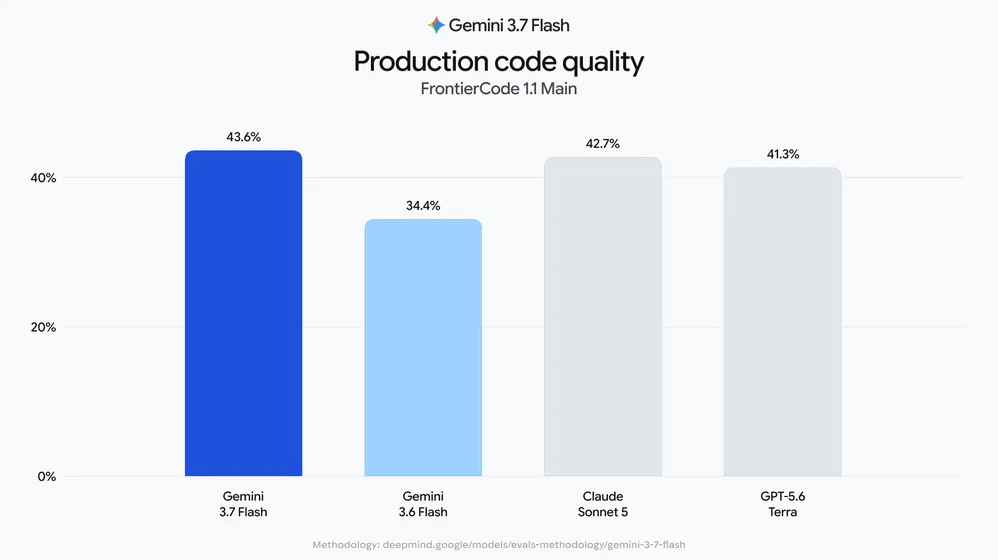
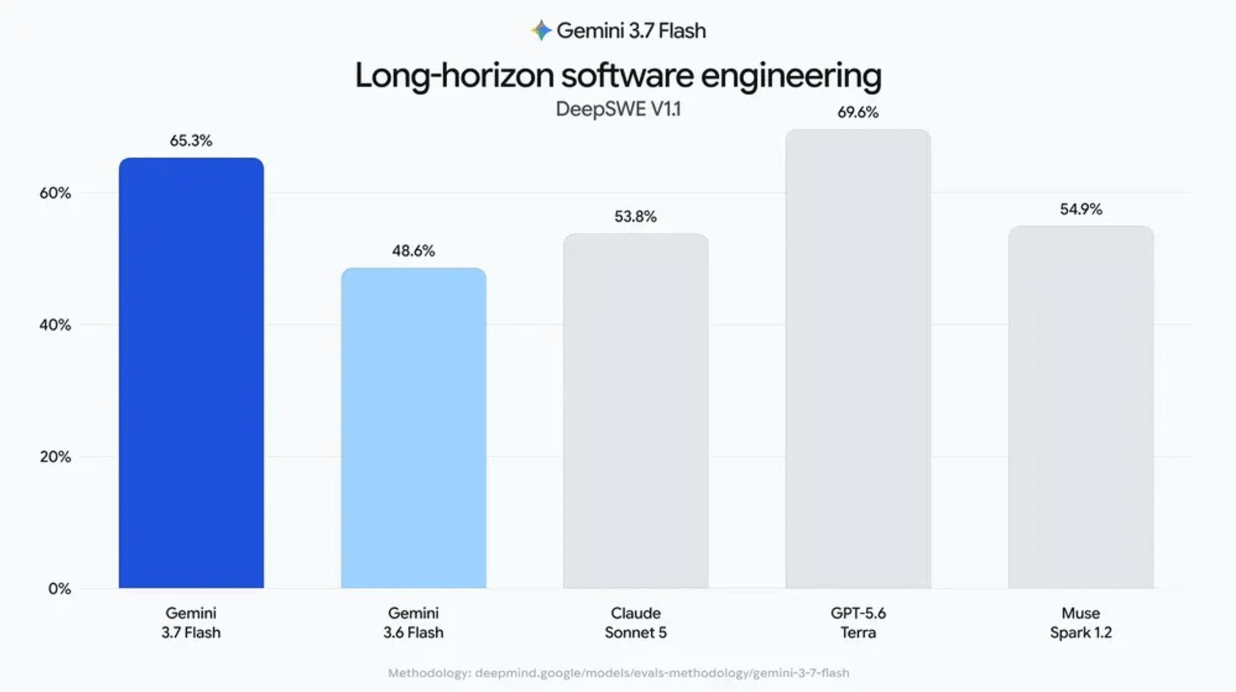
This model was released just about three weeks after Gemini 3.6 Flash, positioned as Google's most powerful Flash version to date for programming and automated agents. In terms of performance, Gemini 3.7 Flash significantly outperformed its predecessor in several benchmark tests, including FrontierCode 1.1 Main with results of 43.6% versus 34.4%, and DeepSWE v1.1 with results of 65.3% versus 49%.
Regarding pricing, the introductory price is set at $0.75 per million tokens invested and $3.75 per million tokens exported, which is only half the previous cost, and this price is valid until the end of the year. In addition, Gemini Spark, the personal AI assistant for Google AI Pro and Ultra users in over 160 countries, has switched to this new model since its launch. Finally, this version is equipped with updated security measures to address the risk of abuse in the chemical, biological, radiological, and nuclear fields, as well as cyberattacks.
2. Google Launches Gemini 3.7 Flash, a New Artificial Intelligence Model for Programmers and Agents
Google describes Gemini 3.7 Flash as the most intelligent core model ever for programming and automated agents, and its timing is highly significant. The fact that it took only three weeks since Gemini 3.6 Flash was released is a speed that Google says stems directly from developer community feedback and internal algorithmic improvements the company plans to continue applying to future models.
Such a rapid rollout carries its own signal. Tech companies don't typically release model updates in quick succession within weeks unless they're racing to catch up with competitors or responding to real-world usage patterns from paying customers. Google positions this as an incremental but substantial step forward, not a complete revolution in model generation, but powerful enough across programming, artificial intelligence, and web development to warrant a separate launch event rather than just a quiet update note.
2.1 Additional Updates Following Gemini 3.6 Flash
Instead of positioning Gemini 3.7 Flash as a completely rebuilt model from scratch, Google views it as a refinement cycle, a type of rapid update that has become increasingly common throughout the artificial intelligence industry as labs compete to keep their cheaper and faster models sharp without reaching the price point of higher-end flagship models.
2.2 Focus on Programming, Intellectual Work, and Web Development Improvements
The focus areas announced by Google are quite narrow and clearly defined, including software engineering, specialized work requiring extensive knowledge, and user-side web interface development. Google states that these are the workflows where developers have reported the most difficulties when using Gemini 3.6 Flash, and also where the new model demonstrates the most significant improvements.
3. Improved Performance and Benchmarks Compared to Gemini 3.6 Flash
In almost every benchmark test published by Google, Gemini 3.7 Flash significantly outperformed its direct predecessor, particularly in debug capabilities, the accuracy of the first-generation code, and the quality of output ready for production.
3.1 Higher First-Try Code Accuracy on FrontierCode 1.1 Main and DeepSWE v1.1
In the FrontierCode 1.1 Main test, Gemini 3.7 Flash achieved 43.6% while version 3.6 Flash only reached 34.4%. In the DeepSWE v1.1 test, the gap widened even further with results of 65.3% compared to 49%. Google stated that the new model also shows stronger progress in addressing programming-related issues, as well as creating source code that is closer to deployment-ready without requiring extensive manual cleanup.
3.2 Outstanding Web Development Results at Arena.ai 's WebDev Arena
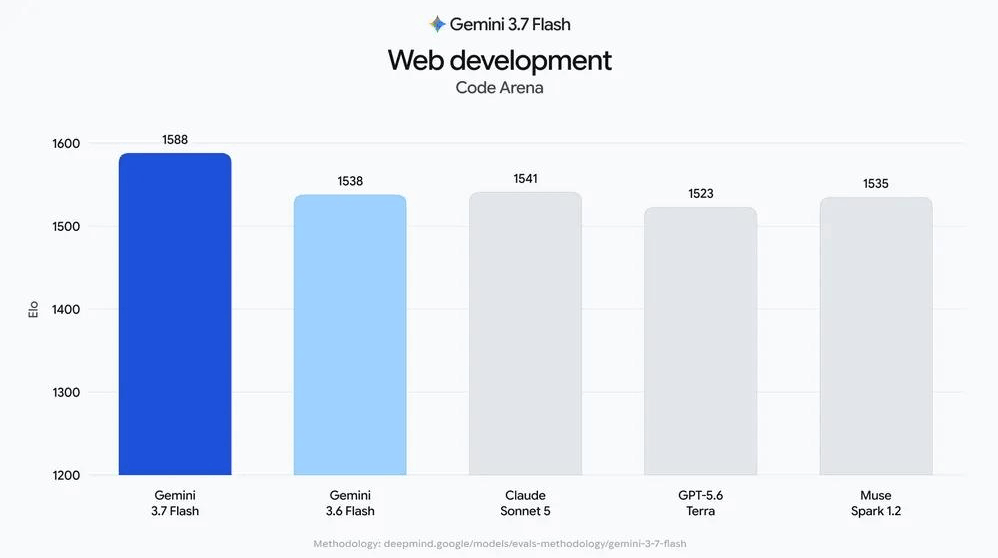
Specifically for web development, Gemini 3.7 Flash creates better-functioning layouts and fully functional applications with fewer commands. This model also demonstrates better adherence to reference designs, whether it's a screenshot, a specific image, or an entire complete design system. On the Arena.ai WebDev platform , this model achieved an Elo score of 1588, higher than the 1538 of Flash version 3.6.
3.3 Improving Reasoning Ability and Accuracy on GDP.pdf and AutomationBench
In fields requiring in-depth knowledge such as finance, law, and bioscience, the new model demonstrates significantly sharper reasoning capabilities. On the GDP.pdf test, designed to assess the model's ability to handle complex documents, Gemini 3.7 Flash scored 34%, compared to its predecessor's 22%. On AutomationBench, a test measuring the ability to complete real-world business workflows, the new model achieved 30.4% compared to 17% for the previous version.
These numbers aren't just minor improvements. The near-double increase in benchmarks like DeepSWE v1.1 and AutomationBench shows that Google isn't just refining the model in the finer details, but is actually bridging the gap between a code-suggesting assistant and a reliable agent capable of completing tasks. For developers and businesses considering a programmable AI model to standardize processes, this difference has significant practical implications.
4. Enhanced Developer Experience and Cost Savings
Beyond pure benchmark scores, Google says Gemini 3.7 Flash also demonstrates a significant difference in real-world use. The new model adapts better to obstacles, proactively asks for clarification when user intent isn't entirely clear, and follows instructions more faithfully. It also invests more effort in multi-step planning and calling support tools, which Google says means less manual oversight and fewer retries in engineering processes.
4.1 Improving the Ability to Handle Complex Processes and Instructions
This more thoughtful approach is the dividing line between a model that needs constant monitoring and one that can be trusted to run lengthy agent tasks without close supervision—a top priority for any team trying to scale automation rather than simply speed up individual commands.
4.2 Launch Offer: Half the Price of the Previous Version
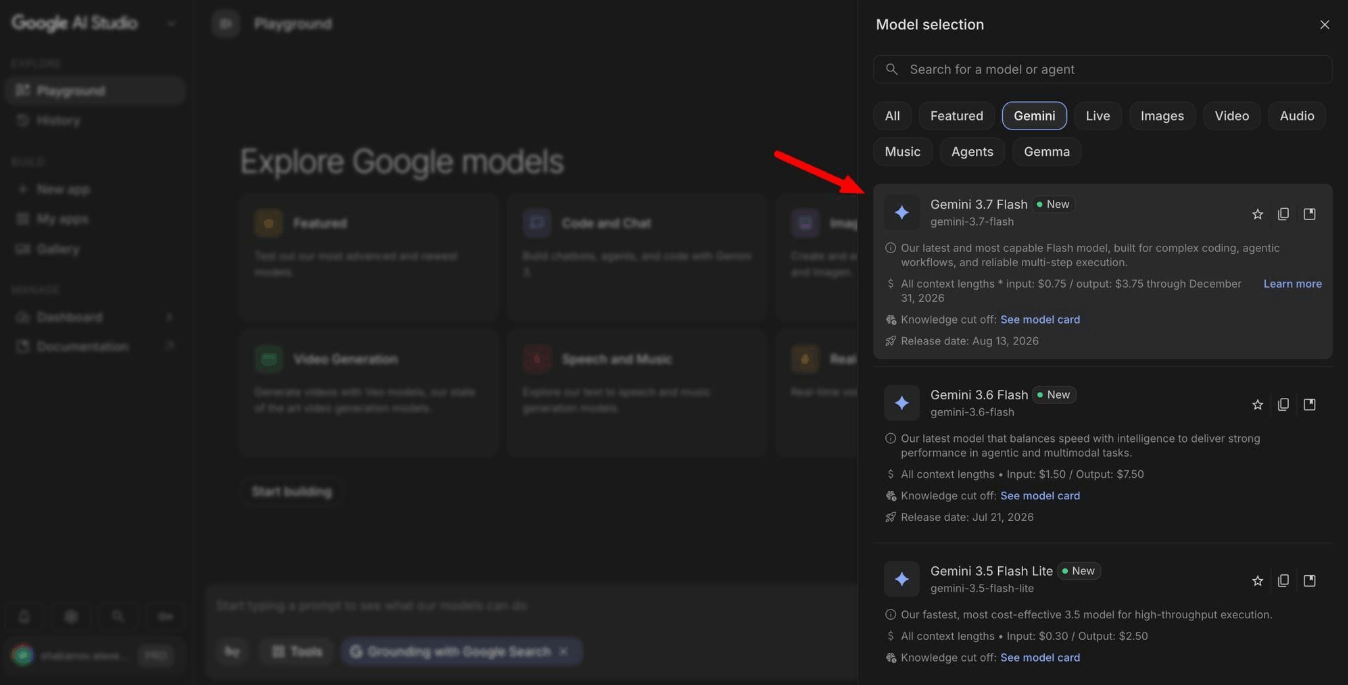
In terms of cost, Google is offering Gemini 3.7 at an introductory price of $0.75 per million tokens input and $3.75 per million tokens output, valid until the end of this year, half the price that Flash version 3.6 charged per million tokens. Combined with performance improvements, Google positions this as a way for developers and customers to scale their production-ready agents without incurring proportionally increased costs. According to Google, initial customer feedback has highlighted significant improvements in accuracy and performance at this lower cost.
5. Integration with Gemini Spark and Wider Platform Accessibility
Since its launch, Gemini Spark, Google's personal AI assistant for Google AI Pro and Ultra users in over 160 countries, has officially migrated to run on the Gemini 3.7 Flash platform. Spark, originally launched at Google I/O as a continuously active agent capable of performing actions on behalf of users, now benefits from improved tool utilization across Google Workspace applications, along with greater accuracy and output quality for complex tasks requiring multiple skills simultaneously.
5.1 Gemini Spark Uses Flash 3.7 to Power Individual AI Agents
In practical terms, this means Spark can more efficiently aggregate files, compose emails, and update work status documents, helping to translate ideas into actionable actions with fewer obstacles than before.
5.2 Access Through Google AI Studio, Android Studio, Gemini API, and Enterprise Platforms
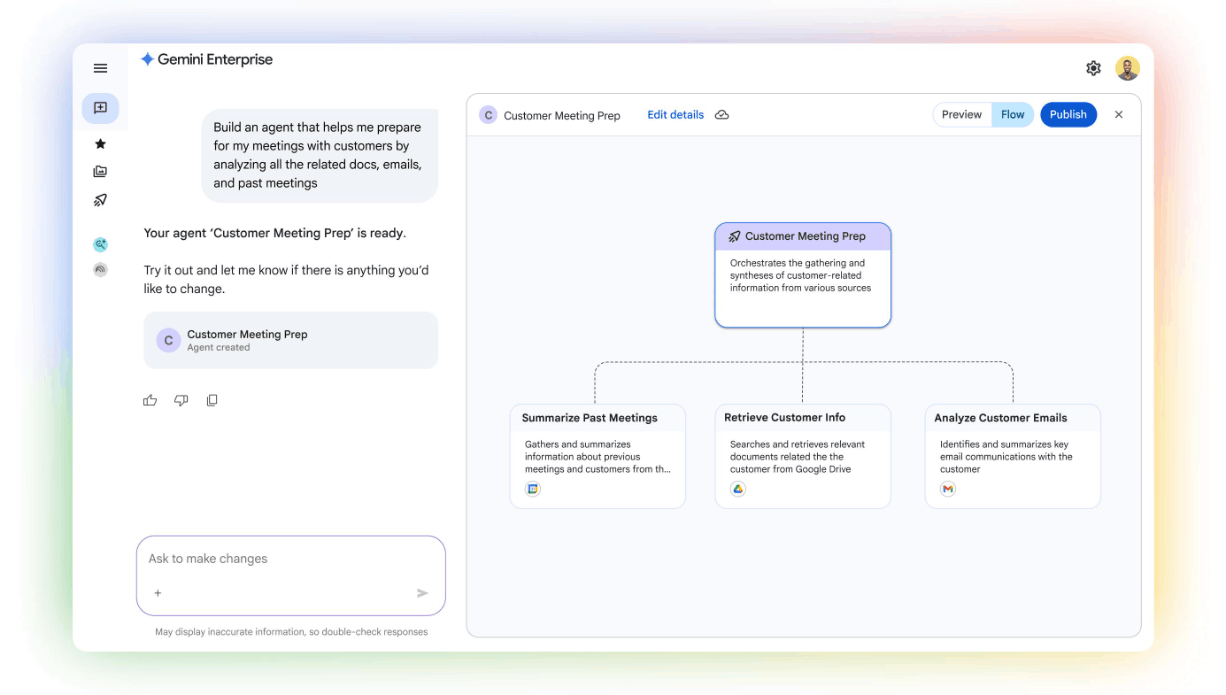
Developers can access this model through the Gemini API on the Google AI Studio and Android Studio platforms, or explore agent-prioritized workflows on Google Antigravity. Businesses access it through the Gemini Enterprise Agent Platform and the Gemini Enterprise app. For individual users, the model will automatically appear through Spark within the Gemini app, provided they are using the Google AI Pro or Ultra plan in a supported country.
6. Improved Safety Features for Responsible AI Deployment
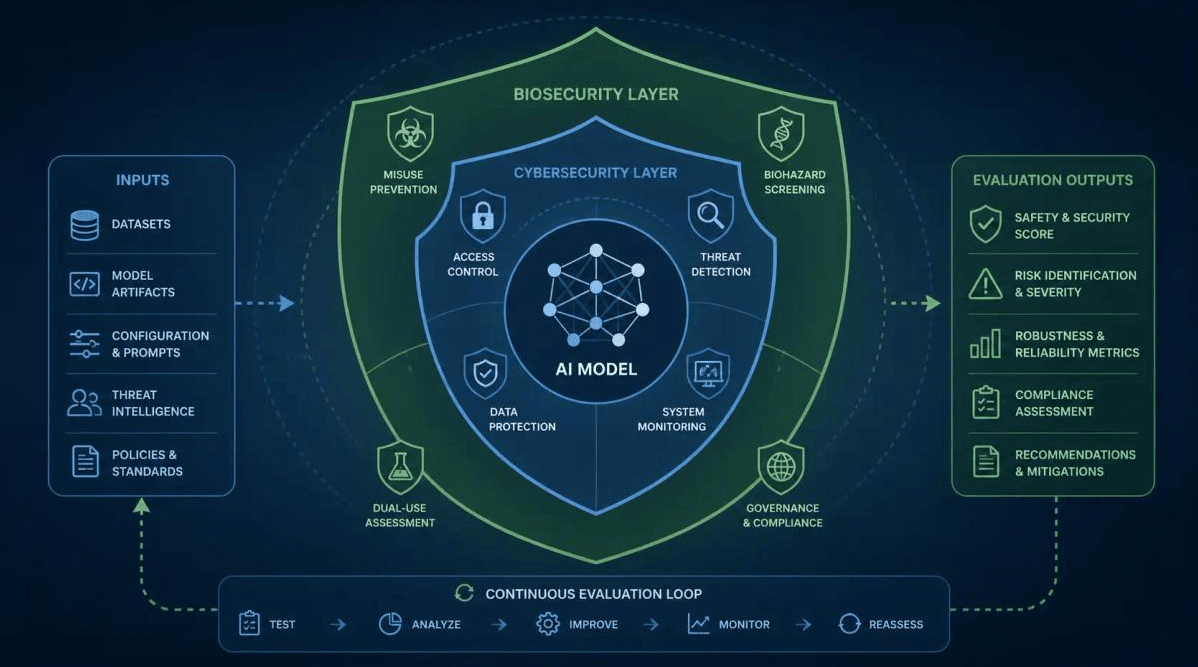
Google states that Gemini 3.7 Flash is equipped with updated protections against misuse in the chemical, biological, radiological, and nuclear fields, commonly known as CBRN, as well as in cyberattacks, while ensuring that legitimate use cases within these fields remain intact.
Updated safeguards to combat abuse in the CBRN field and cybercrime.
These safeguards align with Google's broader approach to bioresilience and its cybersecurity program, as part of an ongoing effort to expand the coverage and robustness of what the company calls pioneering safety safeguards. More detailed technical information is released in the model card that Google is releasing alongside this launch.
As Flash-based AI models become cheaper and more powerful in agent tasks, the very qualities that make them useful for legitimate automation—such as the ability to reason through complex documents, execute multi-step plans, and write code quickly—are also the capabilities that managers and security teams fear could fall into the wrong hands. Integrating protections into a mid-range, low-cost model, rather than reserving them for high-end, flagship versions, shows that Google views fast and inexpensive AI as a broader, more critical area to secure.
7. Frequently Asked Questions
What improvements does Gemini 3.7 Flash offer compared to the previous 3.6 Flash version?
Gemini 3.7 Flash demonstrates improved performance in areas such as programming, debugging, brainstorming, and web development, delivering higher code accuracy and enhanced business workflow capabilities, according to benchmark tests published by Google.
How does the price of the Gemini 3.7 Flash compare to the Gemini 3.6 Flash?
Gemini 3.7 Flash is offered at a special launch price that is only half the cost per million tokens compared to version 3.6 Flash, specifically $0.75 for input tokens and $3.75 for output tokens, valid until the end of this year.
Which platforms and products support Gemini 3.7 Flash?
Developers can access this model through Google AI Studio, Android Studio, and the Gemini API. Businesses use it through the Gemini Enterprise Agent Platform and the Gemini Enterprise app. The Gemini Spark AI assistant has also migrated to run on Gemini 3.7 Flash for Google AI Pro and Ultra users.
What safety features does the Gemini 3.7 Flash have?
This model includes updated safeguards against the risk of abuse in the chemical, biological, radiological, and nuclear fields, as well as in the area of cyberattacks, in line with Google's bioresilience approach and cybersecurity program.





















VIP Products








Best Selling Products
Upgrade genuine Capture One account
120 USD
Copyright Adobe Lightroom Account
59 USD
Adobe Photoshop Copyright - Full App
120 USD
MidJourney Account
29 USD
Upgrade Genuine Office 365
49 USD
Freepik Premium Account
59 USD
Windows 10 & 11 Pro Key
36 USD
Genuine Cheap Canva Pro
39 USD
Upgrade Duolingo Super
29 USD
Genuine Adobe Illustrator account
99 USD
Autodesk All App Account Copyright
120 USD
Adobe Premiere Pro Account
99 USD
ChatGPT Plus Account (GPT-4)
16 USD
Plugin Retouch4me
69 USD
Capcut Pro 1 Year
39 USD