Best Selling Products
Autodesk All App Account Copyright
120 USD

Freepik Premium Account
59 USD
Adobe Photoshop Copyright - Full App
120 USD

MidJourney Account
29 USD
Adobe Premiere Pro Account
99 USD
Genuine Cheap Canva Pro
39 USD

Capcut Pro 1 Year
39 USD
Plugin Retouch4me
69 USD

Windows 10 & 11 Pro Key
36 USD
ChatGPT Plus Account (GPT-4)
16 USD
Upgrade Genuine Office 365
49 USD

Copyright Adobe Lightroom Account
59 USD
Genuine Adobe Illustrator account
99 USD

Upgrade genuine Capture One account
120 USD
Upgrade Duolingo Super
29 USD
Google launches a series of new AI tools to support more comprehensive learning for students.
Nội dung
- 1. Google is turning Gemini into a learning companion.
- 2. Gemini's New Student Center Integrates Learning Tools
- 3. Study Handbooks Can Help You Build a Personalized Study Plan
- 4. Gemini Can Create Interactive 3D Learning Experiences
- 5. Google Search is also equipped with AI-powered learning features.
- 6. Google Lens Will Help Students Solve Math Problems Step-by-Step
- 7. Gemini Notebook is integrated into AI Mode.
- 8. Search can turn uploaded documents into review materials.
- 9. Gemini Live Expands the Capabilities for In-Depth Research
- 10. Google Offers Students One Year of Free AI Access
- 11. Why Does Google Focus So Much on Students?
- 12. What does this mean for students?
Google has just announced a series of major updates for the education sector, making Gemini and Google Search more comprehensive learning tools than ever before. These aren''t just a few minor additions, but a deliberate strategy to transform Gemini from a simple question-answering chatbot into a complete learning ecosystem that engages students throughout the school year.
1. Google is turning Gemini into a learning companion.
For many years, students have been accustomed to using AI tools to explain homework assignments, summarize book chapters, or suggest ideas for essays. However, this approach has often been fragmented, meaning users ask a question, receive an answer, and then end the session without any connection between the interactions. With this update, Google aims to completely change that approach.

Gemini's new experience includes a dedicated student learning center, study notebook features, the ability to create interactive visualizations, practice tests, and in-depth research capabilities through Gemini Live. Instead of simply asking a question and leaving, students can now use Gemini as part of a longer learning process, from organizing materials and identifying knowledge gaps to self-testing before exams. Google also emphasizes that its educational tools are designed to support personalized learning while maintaining the teacher's role throughout the teaching and learning process, rather than completely replacing human instruction.
2. Gemini's New Student Center Integrates Learning Tools
One of the most noticeable changes is the introduction of a brand-new student center within the Gemini app, accessible at gemini.google.com/students. Previously, to use various learning features, users often had to search and navigate through numerous individual sections within the app. Now, this center acts as a centralized access point, making it easy for students to start a new study notebook, create flashcards, or take practice tests in just a few simple steps.
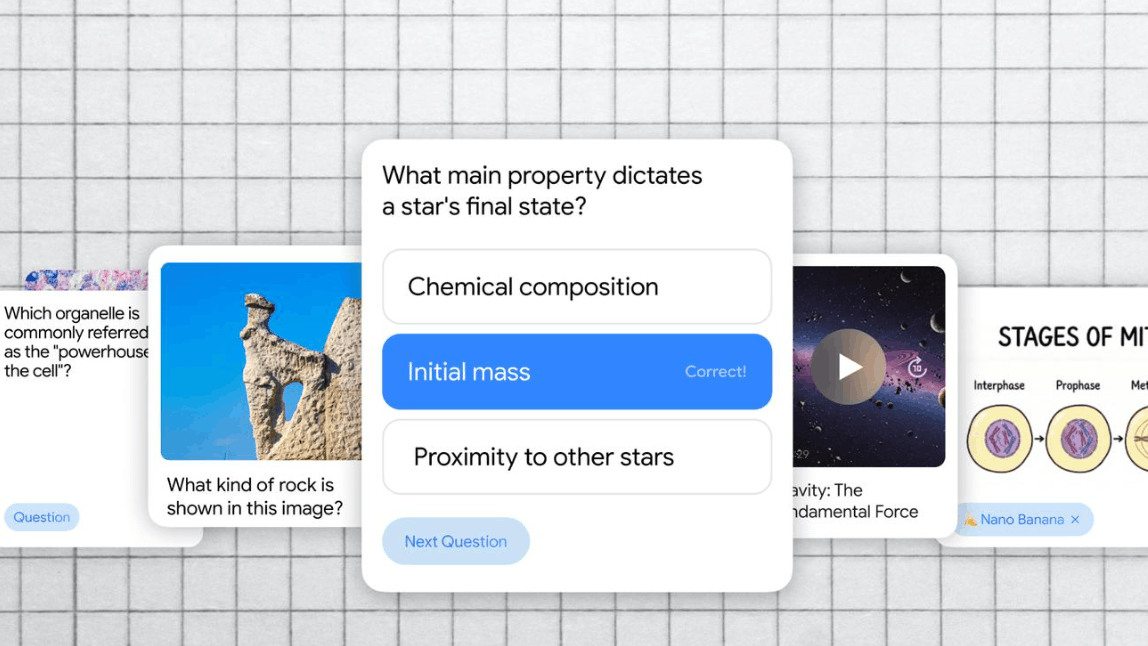
This change has significant practical implications for students who want a structured learning process, rather than simply using AI as a tool to answer random questions. According to Google, the student center is currently being rolled out on both mobile and web platforms for logged-in personal accounts, with all languages supported by the Gemini app. Support for school-issued Google accounts and for younger users who meet Google's age requirements is expected to be added in the coming weeks.
3. Study Handbooks Can Help You Build a Personalized Study Plan
Gemini's study notebook feature is perhaps the most noteworthy highlight of this entire update, as it clearly demonstrates Google's ambition for personalization. Students can upload their own study materials, such as lecture notes, course outlines, or other class-related resources. Gemini then helps organize all of this material into a clearly structured learning process.
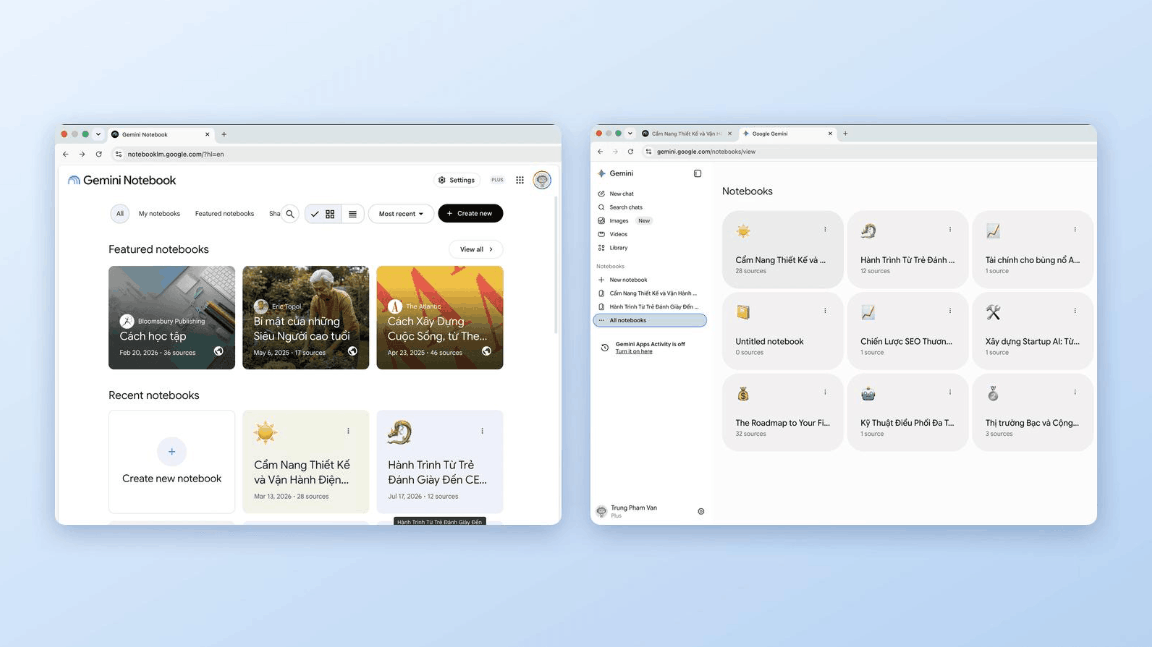
The system can use diagnostic tests to identify areas where students are weak, and then build smaller lessons and tests focused on those specific gaps. Google also says students can use this feature to track their learning progress, and if granted permission, the system can automatically schedule important milestones such as exam dates or assignment deadlines on Google Calendar. Interestingly, the AI isn't simply providing answers; it's trying to understand what students already know and where they need further practice—an approach closer to that of a real tutor than an automated answering machine.
4. Gemini Can Create Interactive 3D Learning Experiences
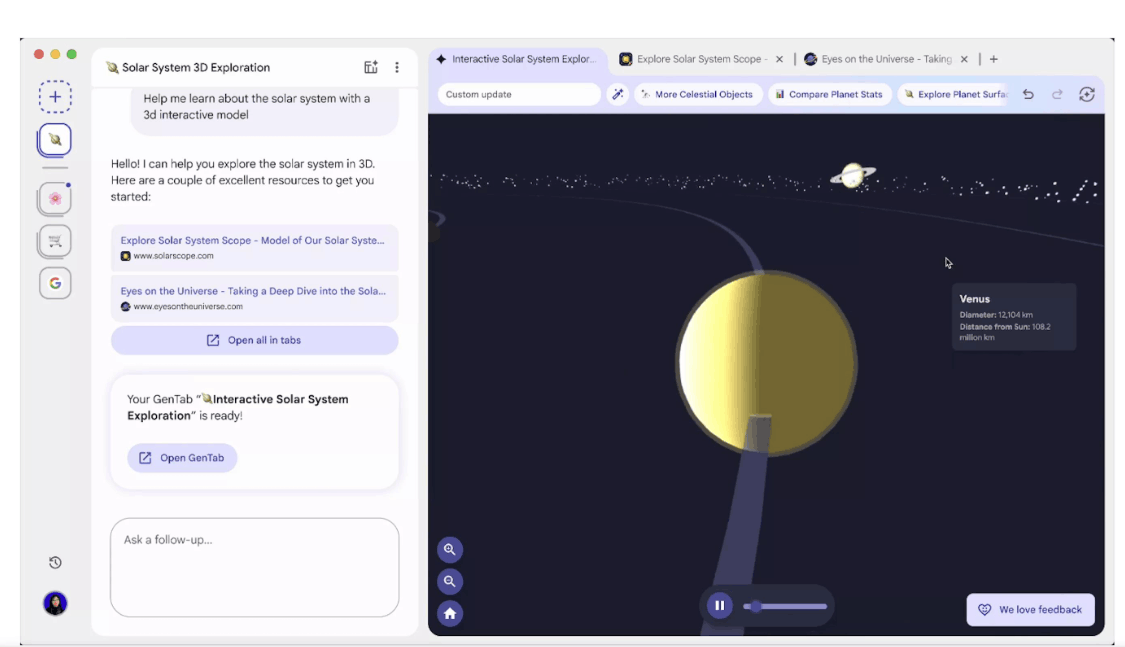
In addition to organizing documents, Google also places a strong emphasis on visual learning. Gemini's interactive visualization feature can build real-world, functional three-dimensional models for certain topics. For example, a student might ask Gemini to explain the structure of a DNA molecule in three dimensions, then interact directly with the model by rotating or zooming in and out to observe more detail.
The same idea can be applied to many other subjects, in cases where visually observing a process is far easier to understand than simply reading a descriptive text. Google provides several specific examples, such as the structure of DNA, the motion of a pendulum, and interactive representations of financial concepts. For students studying science and engineering, this could be one of the most useful additions, as it helps transform abstract concepts that are difficult to visualize into models that can be seen and manipulated directly.
5. Google Search is also equipped with AI-powered learning features.
These changes aren't limited to the Gemini app; they extend to Google Search as well. The search engine is now adding AI-powered learning experiences, capable of generating interactive visuals, on-demand practice tests, and customized learning materials.
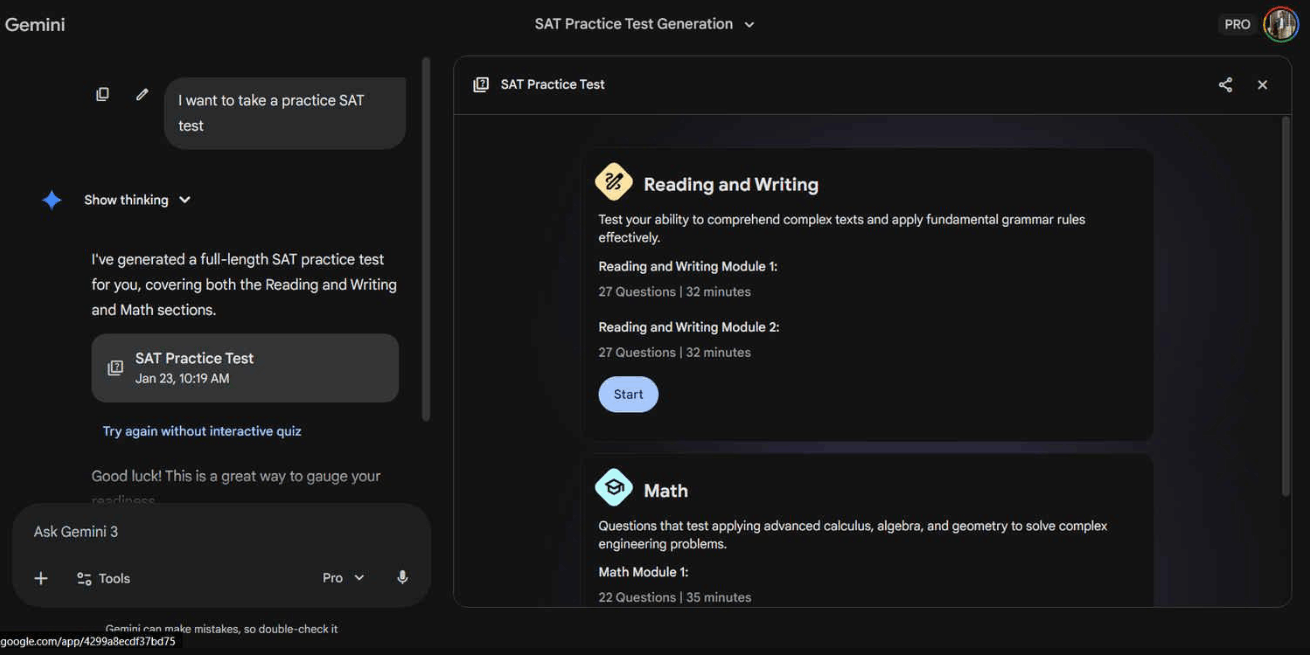
For example, a student learning about pH scales could ask Search to create an interactive visual representation, then continue exploring related questions. Google says AI Mode can also create more specialized visual experiences based on specific user requests. Additionally, Search can generate customized practice tests across a wide range of fields such as science, mathematics, humanities, and foreign languages. Notably, Google says this test experience is currently offered for free in English and can also be used to prepare for several important standardized tests, including JEE, NEET, SAT, GRE, and MCAT. This is particularly interesting because the feature extends beyond typical academic subjects to include preparation for highly competitive exams.
6. Google Lens Will Help Students Solve Math Problems Step-by-Step
Google is also bringing a more interactive learning experience to Lens, its familiar image recognition tool. With the new update, students can directly take photos of the math problems or assignments they are struggling with using Lens's camera option. From there, Google's AI will provide explanations, point out potential errors in their approach, and guide students through that specific difficult step.
The company says this new learning experience on Lens will be rolled out globally in English in the coming weeks. The key is that this approach focuses on providing precise support where students are stuck, rather than requiring them to re-explain an entire chapter because of a small calculation error. This saves significant time and keeps the learning process focused on the problem at hand.
7. Gemini Notebook is integrated into AI Mode.
Google is also connecting its notebook experience more closely with Search. Gemini Notebook, the new name for the tool previously known as NotebookLM, is now available in AI Mode. This allows students to create individual notebooks for each subject or project, and add materials such as lecture slides, course outlines, and relevant reference websites.
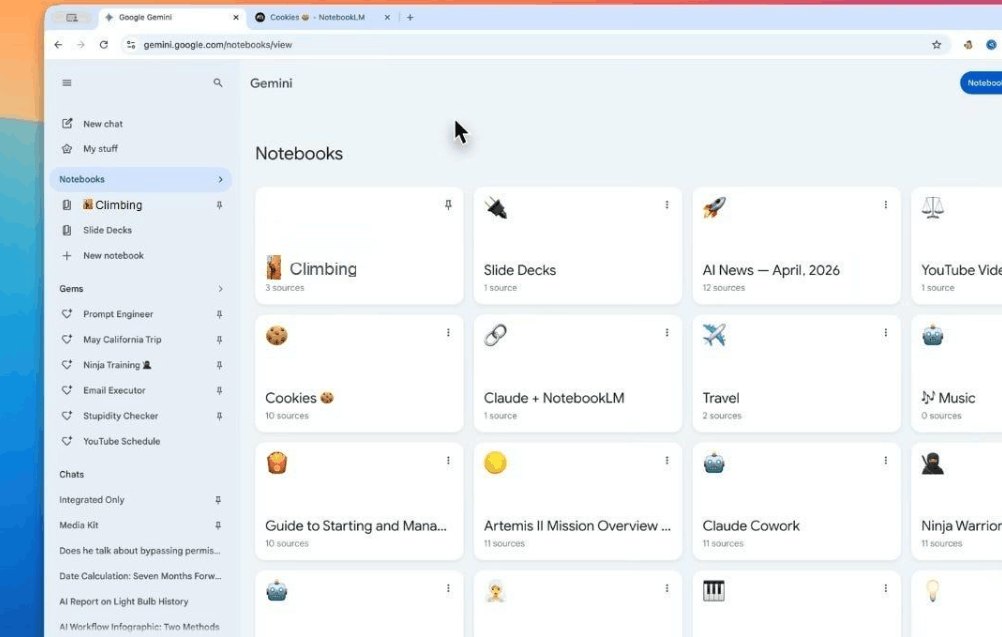
The idea behind this feature is to give students a personalized AI workspace, built on their own reference materials, rather than relying entirely on a general chatbot conversation. Google says the notebook feature is currently rolled out in English in over 180 countries, and support for local languages is expected to be added later. This is a logical step, as it helps connect learning more closely to each student's actual source materials, rather than relying on generic answers that are not directly related to the lesson being studied.
8. Search can turn uploaded documents into review materials.
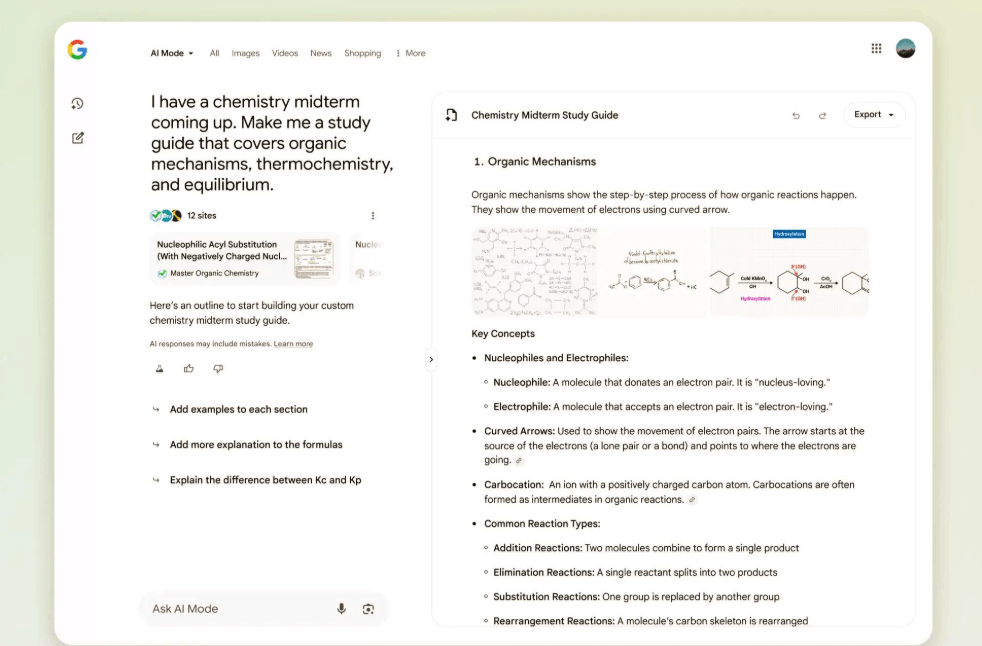
Another helpful addition is the ability to create review materials using AI. Students can provide files such as notes, lecture slides, text documents, or other supported document formats, and then ask Search to generate a concise review document based on that content.
Google provides a specific example: combining a photo of handwritten notes with lecture slides to create a concise, one-page summary of the most important concepts. For students dealing with a large amount of material before an exam, this feature can significantly save time in compiling and reviewing, especially useful in the final stretch before important tests when the amount of material to review is often large and fragmented.
9. Gemini Live Expands the Capabilities for In-Depth Research
Google is also expanding the research capabilities within Gemini Live. Students can request Gemini to conduct multi-step research on a specific topic, while continuing to use their device for other tasks as the AI processes the work in the background. When the research report is ready, Gemini will notify the user so they can return to the conversation, ask further questions, and explore the results via voice.
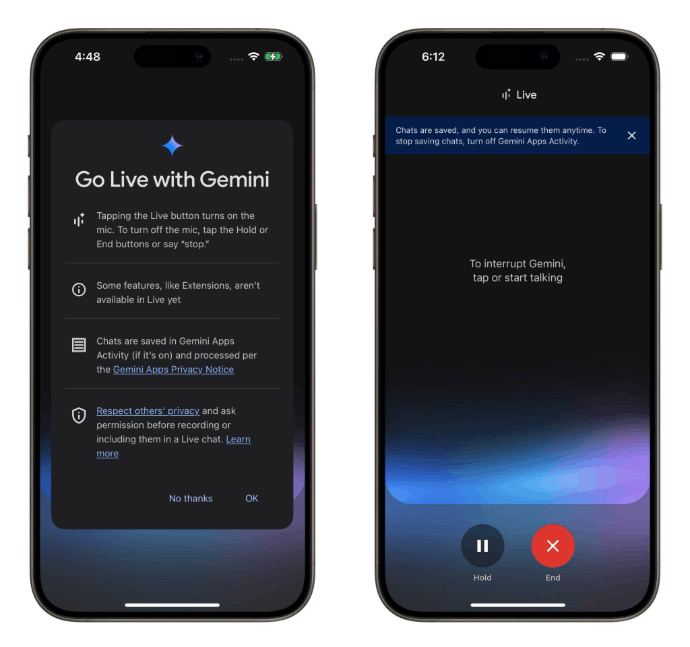
This approach makes Gemini Live more than just a typical voice assistant. It's gradually becoming a conversational interface for longer and more complex research tasks, allowing students to continue other activities while receiving quality research results when needed—a flexibility that traditional research tools could hardly offer.
10. Google Offers Students One Year of Free AI Access
Alongside the new learning features, Google also announced a notable promotion for students. Eligible university students in the United States can receive a year of Google AI Pro completely free. Google says this package includes four times the Gemini usage limit, Gemini Spark, access to Gemini within other Google apps, and 5 TB of storage.
Students outside the United States may be eligible for a free year of Google AI Plus in the markets where the plan is offered. Google says this international offer covers more than 140 markets, subject to eligibility and availability in specific regions. To receive the offer, students need to verify their enrollment status through the SheerID platform and provide a valid payment method upon registration. These offers are currently scheduled to be redeemable until December 31, 2026, subject to eligibility and applicable regional terms and conditions. It's important to note that after the free period ends, the plan will automatically revert to the standard price unless the user actively cancels before that date.
11. Why Does Google Focus So Much on Students?
Behind these updates lies a clear long-term strategy. Students are becoming a crucial user group for AI companies in general. Once students become familiar with using a particular AI assistant for learning, research, and organizing work, that habit tends to continue into college, internships, and even their professional careers.

Therefore, Google isn't simply adding a few isolated chatbot features. The company is building an entire ecosystem around Gemini, tightly connecting Search, notebooks, research, documents, and learning tools into a unified whole. Competition in this field is also becoming more intense than ever, as OpenAI, Google, and an increasing number of AI education startups are all striving to become an integral part of users' daily learning experiences. The company that can make AI truly useful, rather than simply impressing with superficial features, will likely have the biggest advantage in this race.
12. What does this mean for students?
For students, the biggest benefit probably lies in convenience. Previously, a student might have had to use a separate tool for note-taking, another for practice tests, yet another for research, and a separate website just for finding visual aids. Google's new approach attempts to consolidate most of these activities into a single ecosystem, reducing fragmentation and saving time switching between different platforms.
However, it's important to note that AI shouldn't become a complete replacement for real learning. If students simply ask Gemini to solve every math problem, summarize every chapter, and write every essay for them, they might get the work done faster, but they won't truly understand the lesson. A more sensible approach is to use AI as a companion tutor, asking it to explain a difficult concept, check their understanding, point out mistakes, and provide additional practice exercises. This approach transforms AI from a mere answer-generating machine into a true learning assistant, contributing to knowledge consolidation rather than hindering independent thinking skills.
More broadly, this trend reflects a larger shift across the entire education industry. AI assistants are moving from simple question-and-answer systems to more fully interactive learning environments. Instead of just generating text, today's AI tools can create visuals, analyze uploaded documents, build tests, conduct research, and maintain context throughout a long-term learning project. This could gradually change how students prepare for exams and approach complex subjects in the future. However, the real measure isn't the number of features Google releases, but whether students actually learn more effectively thanks to these tools.













VIP Products



Best Selling Products
Autodesk All App Account Copyright
120 USD
Freepik Premium Account
59 USD
Adobe Photoshop Copyright - Full App
120 USD
MidJourney Account
29 USD
Adobe Premiere Pro Account
99 USD
Genuine Cheap Canva Pro
39 USD
Capcut Pro 1 Year
39 USD
Plugin Retouch4me
69 USD
Windows 10 & 11 Pro Key
36 USD
ChatGPT Plus Account (GPT-4)
16 USD
Upgrade Genuine Office 365
49 USD
Copyright Adobe Lightroom Account
59 USD
Genuine Adobe Illustrator account
99 USD
Upgrade genuine Capture One account
120 USD
Upgrade Duolingo Super
29 USD