Best Selling Products
Adobe Premiere Pro Account
99 USD
Upgrade genuine Capture One account
120 USD

Freepik Premium Account
59 USD
Adobe Photoshop Copyright - Full App
120 USD
Upgrade Genuine Office 365
49 USD
ChatGPT Plus Account (GPT-4)
16 USD
Autodesk All App Account Copyright
120 USD
Genuine Cheap Canva Pro
39 USD
Windows 10 & 11 Pro Key
36 USD
Plugin Retouch4me
69 USD
Capcut Pro 1 Year
39 USD
Upgrade Duolingo Super
29 USD

MidJourney Account
29 USD
Copyright Adobe Lightroom Account
59 USD
Genuine Adobe Illustrator account
99 USD
OpenAI unveils GPT 6.1 Terra, a noteworthy mid-range AI option for the cost-effective era.
Nội dung
On October 26, 2026, OpenAI officially introduced GPT 6.1 Terra, the successor to GPT 5.6 Terra. The model is positioned as a fast and efficient choice for everyday work. Users of Plus, Pro, Enterprise, and Edu packages can access it via ChatGPT Work and the Codex, while developers can access it via API. This upgrade focuses on four key areas: visual visualization and computer manipulation capabilities, real-world accuracy, programming capabilities, and API pricing. This article will analyze each point based on data published by OpenAI and results from the independent assessment organization Artificial Analysis. Note that the model name is written as "GPT 6.1 Terra," without hyphens.
1. Visualization abilities and computer skills are significantly improved.
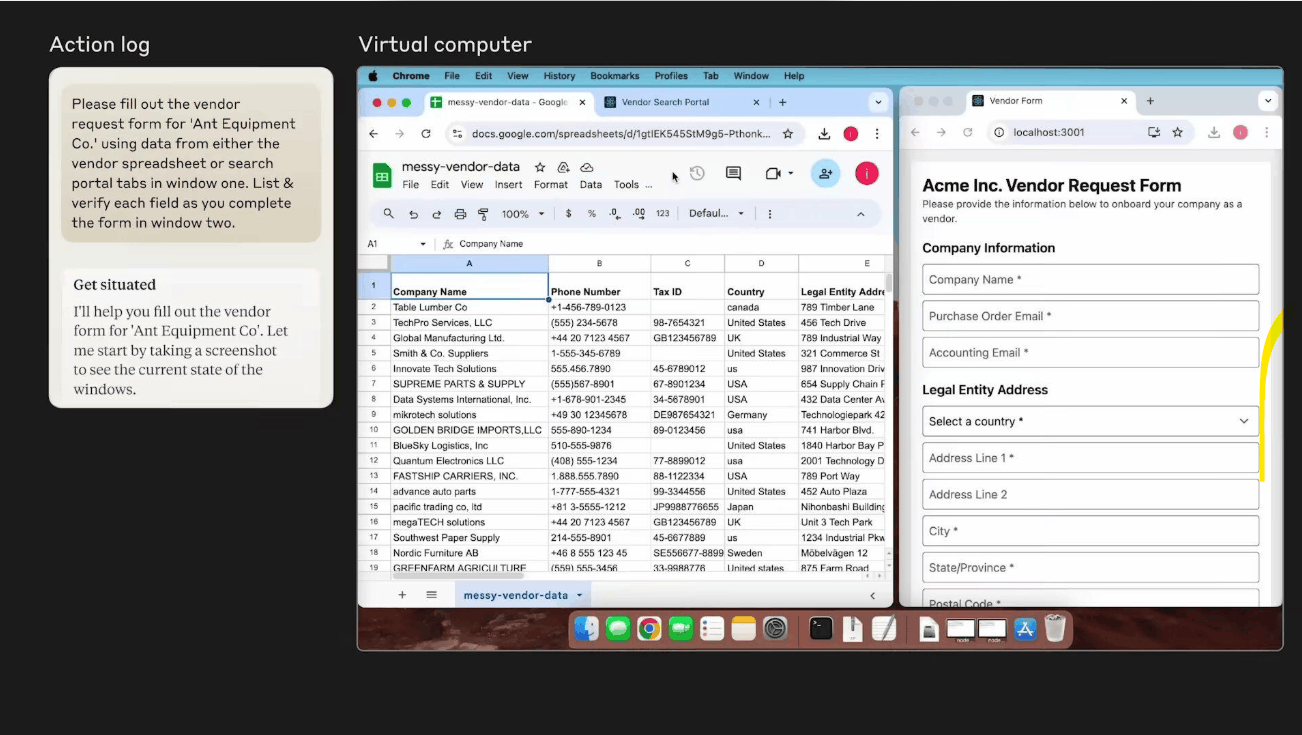
The first improvement is the ability to understand what is displayed on the screen and automatically manipulate the software on behalf of the user. OpenAI used three tests to demonstrate this, including OSWorld 2.1, Agents' Last Exam v1, and MMMU Pro.
OSWorld 2.1 requires AI to run real desktop software, often involving multiple steps to complete, such as building a 3D model in the software based on technical drawings. Even at the Medium inference level, GPT 6.1 Terra's score surpassed the best results of GPT 5.6 Terra at all inference levels. When Max was enabled, the model achieved 74.2%, quite close to GPT 6.1 Sol's Xhigh score of 75.9%. A mid-range model approaching the level of higher-end models is a remarkable leap.
Agents' Last Exam v1 is closer to real-world professional work, for example, converting architectural drawings into 3D models, or watching an animated film scene by scene and creating a time-coded recording for the restoration team. At the Medium level, GPT 6.1 Terra achieved 57.6%, 6.9 points higher than the 50.7% of GPT 5.6 Terra Max, while costing only about one-third. This result is comparable to GPT 6 Astra Medium, the strongest model, but the price per token is only one-tenth.
Compared to Claude Opus 5.5, Terra Max GPT 6.1 is 3.2 points lower, but token utilization is more than three times higher, and the cost per token is only a quarter. Multiplying these two factors, the cost per task is approximately nine times cheaper. This comparison is published by OpenAI, so users should verify it themselves on their workloads.
MMMU Pro measures visual reasoning ability, with questions mixing charts, diagrams, photographs, and text. The model must correctly understand the image content before inferring. GPT 6.1 Terra outperforms GPT 5.6 Terra at all reasoning levels, and scores nearly match GPT 6 Astra and GPT 6.1 Sol. For real-world users, this allows the model to support proposal creation, technical drawing reading, form filling, or video editing with greater reliability.
2. Practical errors have been significantly reduced.
OpenAI stated that this year they invested significant resources in reducing illusions and real-world errors. The results were quite evident in tests using trick questions. At the Low reasoning level, GPT 5.6 Terra had an error rate of 53.6%, meaning more than half of the answers contained errors. GPT 6.1 Terra reduced this number to 16.7%, meaning only about one-sixth of the answers were incorrect, a reduction of nearly 37 percentage points. When Max was enabled, the error rate decreased by another 18 percentage points, to 4.3%, approaching the level of GPT 6 Astra Max and GPT 6.1 Sol Max.
Third-party results show a similar trend. AA Omniscience from Artificial Analysis, a separate test of knowledge and hallucination, recorded the percentage of models that guessed blindly when the answer was unknown. The hallucination rate of GPT 5.6 Terra Max was 88%, while GPT 6.1 Terra Max dropped to 38%, and accuracy increased by 2 points.
This is important for those who use AI for work requiring accuracy, such as research, document creation, or data analysis. However, the 38% figure still shows that the model hasn't completely eliminated guesswork when information is lacking, so for important content, a verification step is still necessary.
3. Software development capacity has more than doubled.
Terminal Bench 4.0 tests the ability of AI programming agents to solve problems in a command-line environment, for example, fixing a webpage with a garbled layout when loading. At the Max level, GPT 6.1 Terra solved 50.3% of the tasks, while GPT 5.6 Terra only achieved 21.5%. This is more than double the previous performance and the biggest numerical improvement in the entire upgrade.
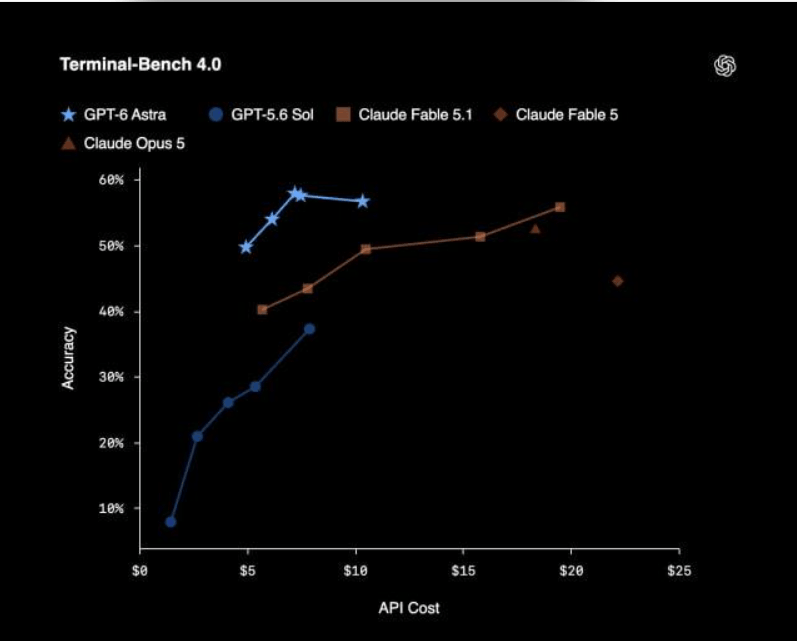
However, the picture needs to be viewed objectively. Compared to the GPT 6.1 Sol series, Terra Max's performance falls between Sol's Low and Medium levels, while Terra Max costs more than Sol Medium. Therefore, considering programming alone, GPT 6.1 Sol still offers a better price-to-performance ratio. OpenAI also acknowledges that for the most complex programming tasks, GPT 6.1 Sol and GPT 6 Astra remain the more suitable choices.
In terms of overall ability, the Artificial Analysis Intelligence Index combines multiple tests of work, programming, agents, knowledge, illusion, visual comprehension, and reasoning into a single score.
• GPT 5.6 Terra Max scored 42 points, with an average cost per task of $1.40.
• GPT 6.1 Terra Max scored 48 points, with an average cost per task of $0.40.
• GPT 6.1 Sol Medium scored 48 points, with an average cost per task of $0.21.
Terra Max and Sol Medium have similar overall scores, but that doesn't mean the two models are equally strong on every test. One might excel in programming, while the other is more stable in knowledge or documentation comprehension. Notably, the cost per task for Terra Max is nearly double that of Sol Medium, so careful consideration is needed when choosing a model based on the specific needs of your work.
4. Standard API prices are 50% cheaper than GPT 5.6 Terra and GPT 6.1 Sol.
This is the most noteworthy point for developers and businesses. According to OpenAI, the standard API price of GPT 6.1 Terra is 50% lower than both GPT 5.6 Terra and GPT 6.1 Sol, making the automation of large workloads more economical. The price per million tokens is as follows.
• GPT 6.1 Terra, input $1, input buffered $0.05, output $5.
• GPT 5.6 Terra, input $2, input buffered $0.20, output $12.
• GPT 6.1 Sol, input $2, input buffered $0.10, output $10.
• GPT 6 Astra, input $10, input buffered $1, output $50.
Compared to the previous generation, input costs have been halved, output costs have dropped from $12 to $5, a nearly 60% reduction, and caching input costs are only a quarter of what they were before. Caching write fees have also been halved, to $1.25 per million tokens. Compared to GPT 6.1 Sol, Terra's input and output unit costs are exactly half, and compared to GPT 6 Astra, they are only one-tenth.
It's important to distinguish between unit price and actual cost. The 50% discount applies to the price per token, while the cost per task depends on the number of tokens the model consumes during inference. Therefore, in the example above, Terra Max is still more expensive than Sol Medium when calculated per task, even though the unit price is lower. For applications that need to handle a large number of repetitive tasks such as screen manipulation, form filling, or document analysis, this price still opens up many new possibilities.
5. Conclusion
GPT 6.1 Terra isn't OpenAI's most powerful model, and neither does the company claim so. Its value lies in its balance. It offers better machine learning, deeper image understanding, fewer real-world errors, significantly better programming than its predecessor, and a much more accessible price point. For the most complex tasks, GPT 6.1 Sol and GPT 6 Astra remain safer choices, while for most everyday tasks, Terra is becoming a worthy contender. The best approach is still to experiment with your specific workflow, measuring both the quality and cost per task before deciding to switch.










VIP Products

Best Selling Products
Adobe Premiere Pro Account
99 USD
Upgrade genuine Capture One account
120 USD
Freepik Premium Account
59 USD
Adobe Photoshop Copyright - Full App
120 USD
Upgrade Genuine Office 365
49 USD
ChatGPT Plus Account (GPT-4)
16 USD
Autodesk All App Account Copyright
120 USD
Genuine Cheap Canva Pro
39 USD
Windows 10 & 11 Pro Key
36 USD
Plugin Retouch4me
69 USD
Capcut Pro 1 Year
39 USD
Upgrade Duolingo Super
29 USD
MidJourney Account
29 USD
Copyright Adobe Lightroom Account
59 USD
Genuine Adobe Illustrator account
99 USD