Best Selling Products

MidJourney Account
29 USD

Autodesk All App Account Copyright
120 USD

Freepik Premium Account
59 USD

Windows 10 & 11 Pro Key
36 USD

Upgrade Duolingo Super
29 USD
Upgrade genuine Capture One account
120 USD

Upgrade Genuine Office 365
49 USD

Adobe Premiere Pro Account
99 USD

Plugin Retouch4me
69 USD

Capcut Pro 1 Year
39 USD

ChatGPT Plus Account (GPT-4)
16 USD

Genuine Adobe Illustrator account
99 USD

Genuine Cheap Canva Pro
39 USD
Adobe Photoshop Copyright - Full App
120 USD
Copyright Adobe Lightroom Account
59 USD
Photography Terminology for Beginners
Nội dung
This is a concise yet comprehensive list of core photography terms. It's suitable for beginners who want a quick but fundamental understanding.
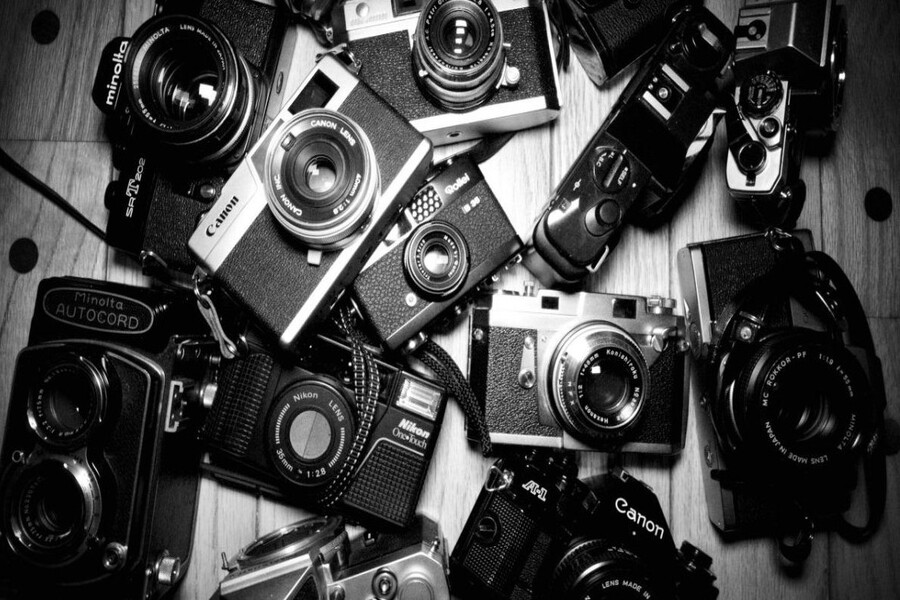
Photography is a discipline that combines technique and art, requiring the photographer not only to observe but also to thoroughly understand the equipment they are using. Many beginners often pick up a camera with countless buttons, modes, and settings without truly understanding what they mean, how they work, and how they affect the photograph. Therefore, mastering basic photographic terminology is a crucial first step in mastering your equipment and creating the images you desire.
This article serves as a "mini-dictionary," systematically organizing the most fundamental concepts, simplifying understanding while maintaining accuracy. If you're a beginner, this will be a valuable resource to help you grasp the core knowledge that any photographer should know. Even if you've been using a camera for some time, this article will still be a helpful resource for reviewing and reinforcing important concepts. Let's begin our journey exploring the fascinating world of photography through the terms below.
1. Aperture
In photography, aperture is one of the three most important elements in the "Exposure Triangle," alongside shutter speed and ISO. Aperture can be considered the "door" of the lens, determining the amount of light that enters the camera sensor.
The aperture is widened or narrowed by a mechanism of steel blades inside the lens. When the aperture is wide open, the amount of light entering the sensor increases; conversely, when the aperture is narrowed, the light is more restricted. This is why in low-light conditions, lenses with large apertures are often used to avoid dark images or having to increase the ISO.
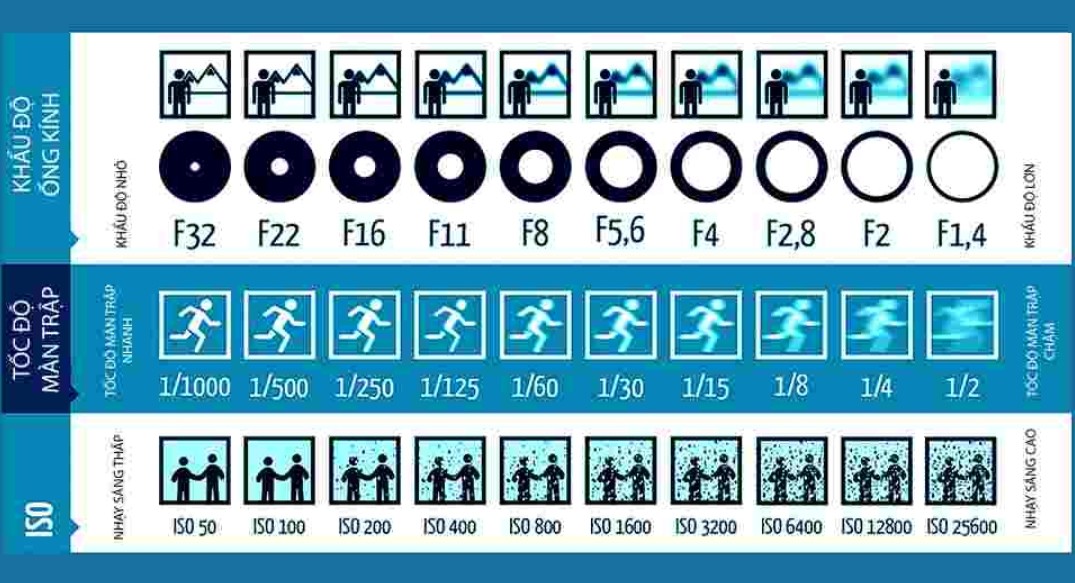
Aperture is denoted by the letter F followed by a number, for example F/1.8, F/2, F/4… This number is the “aperture value”. In photography, the smaller the F-value, the larger the aperture, meaning more light enters. For example, F/2 is larger than F/4, so F/2 allows more light to enter.
Besides affecting brightness, aperture also strongly influences depth of field, which determines whether the background is blurred or not. This is why photos with smooth, blurred backgrounds and a prominent subject are often taken with a large aperture (e.g., F/1.8 or F/2.2). Conversely, scenes such as landscapes and architecture often use smaller apertures (like F/8 or F/11) to maintain sharp detail from near to far.
2. Depth of Field
Depth of field, or DOF, is a term that describes the area of space in an image that is in sharp focus. A photograph can have the entire scene in focus, or only a small portion of it can be in focus while the rest fades into blur. DOF is what creates this effect.
When the depth of field is shallow, it means only a very small area within the focus point is clearly visible, while the background or foreground is blurred. Viewers often call this "bokeh," an effect that is very popular in portrait or food photography. Shallow DOF usually occurs when the aperture is large, meaning the F-value is less than or equal to 4.5.
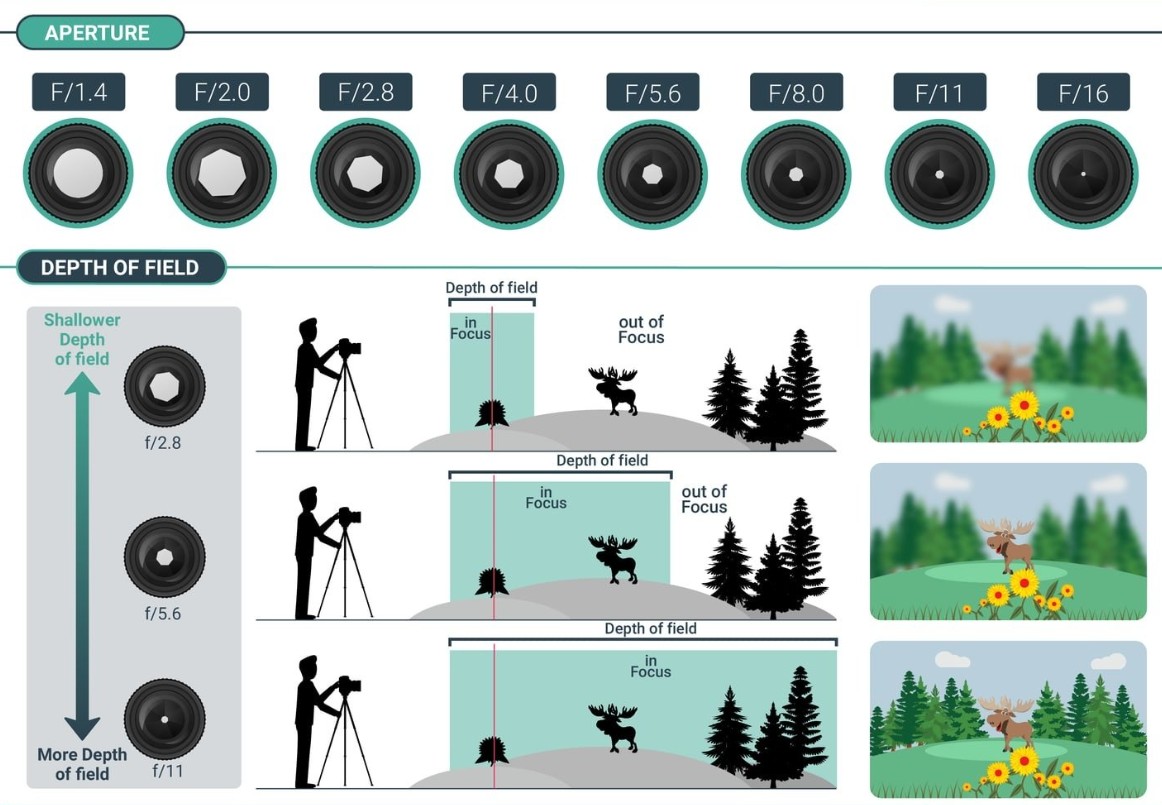
Conversely, when the depth of field is deep, the entire frame is in focus. This effect is common when shooting landscapes, architecture, or images that require a lot of detail. To create a deep DOF, smaller apertures (F/8, F/11, etc.) are often used.
The depth of field (DOF) is influenced by three main factors: aperture, lens focal length, and distance to the subject. The camera and lens don't entirely determine DOF; it's adjusted by the photographer. Therefore, understanding depth of field allows you to be more proactive in creating photos with soft or sharp backgrounds, depending on your artistic vision.
3. Shutter speed
Shutter speed is the amount of time the shutter remains open, allowing light to enter the sensor. This speed is measured in seconds or fractions of a second, for example, 1/125, 1/250, 1/1000, etc. The larger the number, the faster the shutter speed.
Shutter speed affects two main factors: brightness and the "freezing" of motion. When the shutter speed is fast, the camera captures the moving moment without blurring the subject. For example, to photograph a person jumping, a falling drop of water, or a bird in flight, you need a speed of 1/500 or faster.
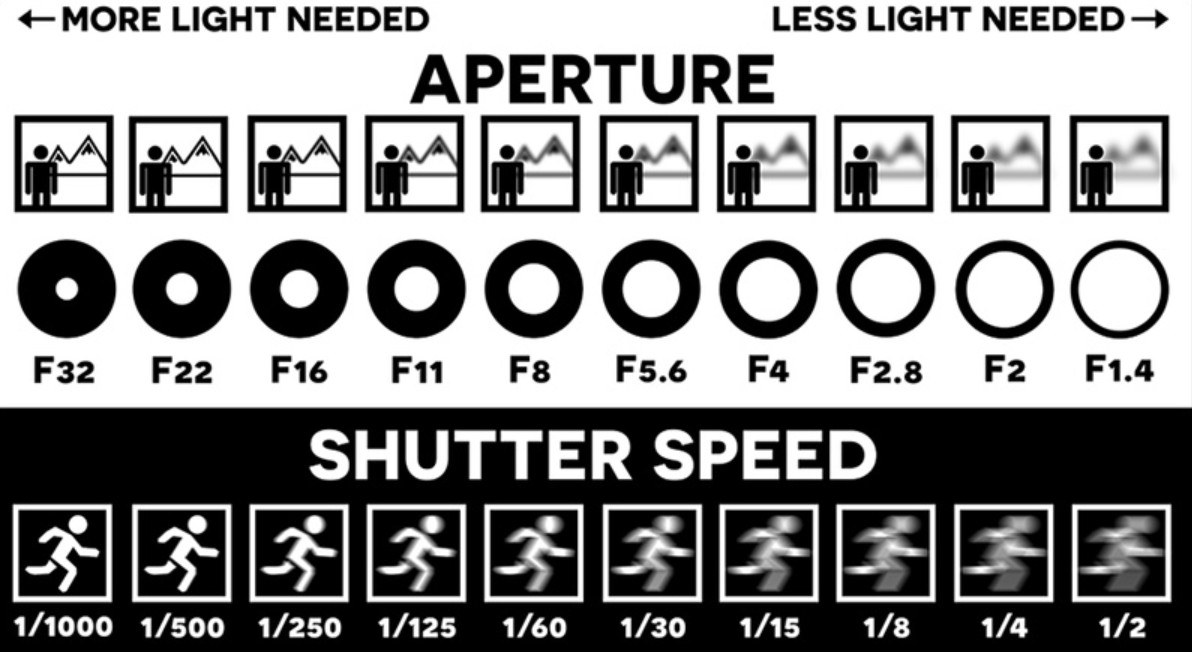
Conversely, slow shutter speeds are often used in low-light environments or to create motion blur effects. Nighttime photos of cars trailing behind a stream of light or soft, flowing waterfalls are all captured using slow shutter speeds. However, slow shutter speeds are prone to camera shake, so a tripod is necessary to ensure the image remains clear.
4. Camera's ISO sensitivity
ISO is a parameter that adjusts the light sensitivity of the sensor. The higher the ISO, the more sensitive the camera is to light, resulting in brighter photos in low-light conditions. Conversely, a low ISO is suitable for well-lit environments or when shooting outdoors.
However, ISO is a "trade-off" parameter. Increasing the ISO too much will cause noise, resulting in grainy images and reduced quality. Therefore, the principle when taking photos is to keep the ISO as low as possible, only increasing it when absolutely necessary.
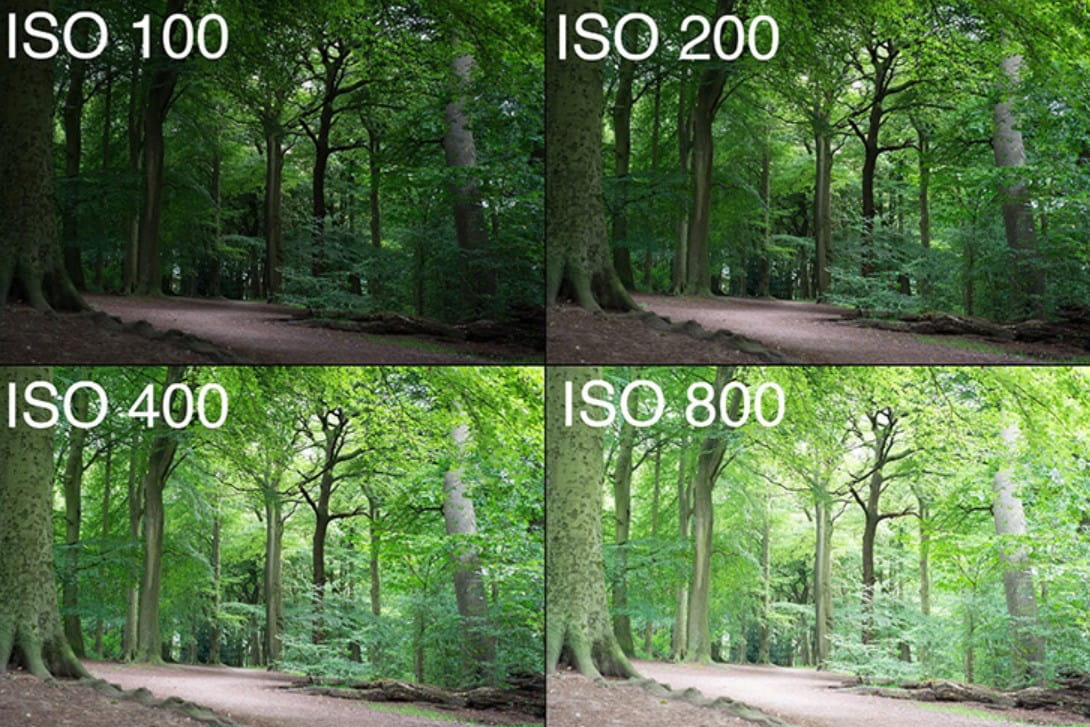
Under normal outdoor lighting conditions, ISO 200 is usually appropriate. When shooting indoors or at night, you can increase it to 400–800 depending on the situation. Some newer cameras handle ISO very well, but caution is still advised to avoid unwanted image quality degradation.
ISO helps you balance exposure in many situations, but beginners need to understand when to increase it and when to keep it low to optimize image quality.
5. Shutter
The shutter is a metal screen placed in front of the sensor that opens or closes to regulate the amount of light entering. Many people often confuse "shutter" and "shutter speed," but these two concepts are different. The shutter is a physical component, while shutter speed is the operating time of that component.
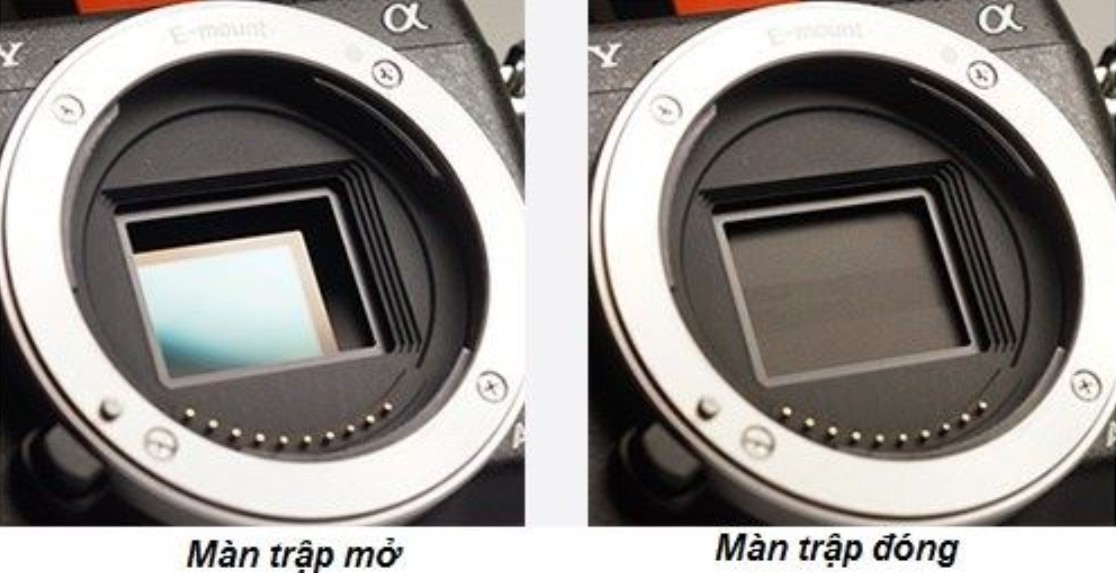
Understanding the shutter mechanism helps you understand why cameras sometimes shake, why the shutter sound is so distinctive, and why fast movements require high speed. This is also related to camera durability, as shutters have a limited lifespan, typically ranging from 100,000 to 300,000 shutter releases (depending on the model).
6. Lens focal length
Focal length is the distance between the lens and the sensor, determining the magnification and field of view. The unit of measurement for focal length is millimeters (mm). Each focal length produces different image characteristics, suitable for different genres of photography.
Short focal length lenses like 14mm and 24mm offer a wide field of view, capturing more of the scene in a single frame. These are popular lenses for shooting landscapes, architecture, or when creating a sense of spaciousness.
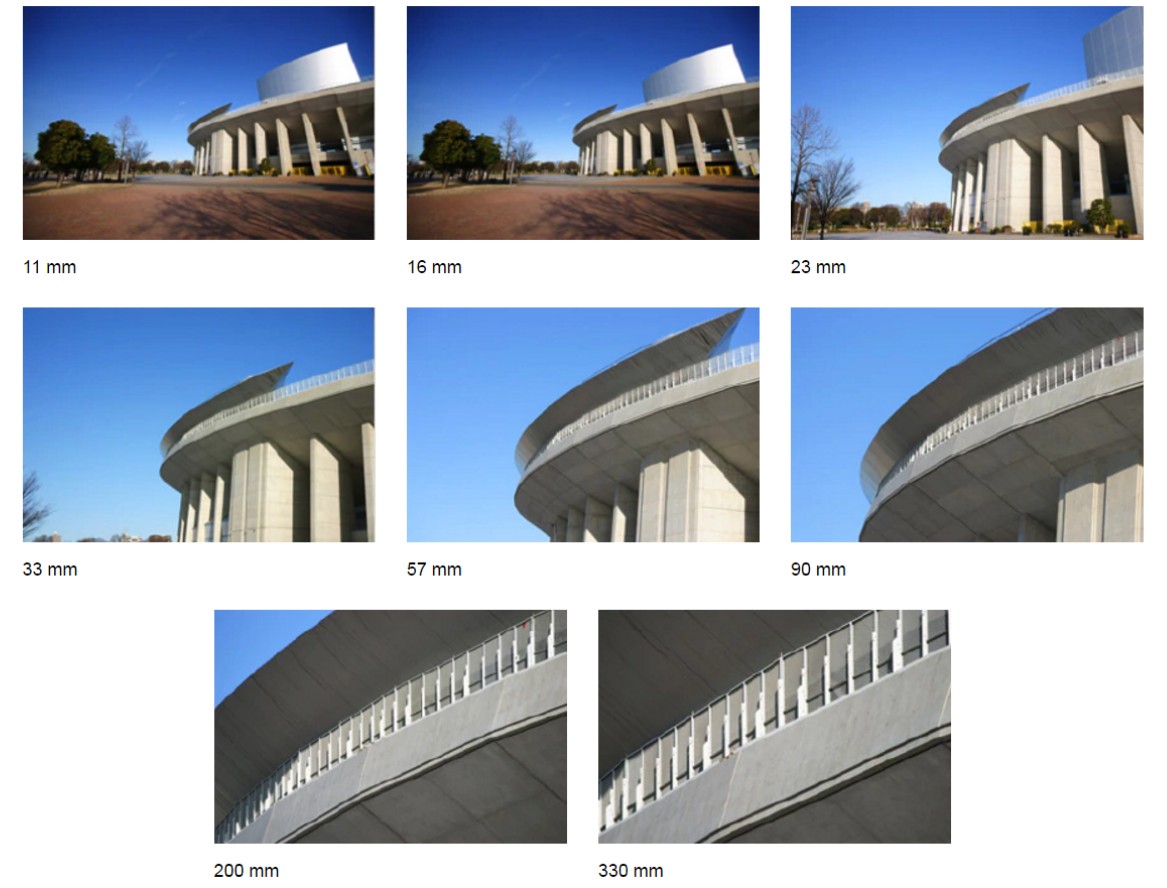
Conversely, long focal length lenses like 85mm, 135mm, or 200mm magnify the subject, making it stand out and gently separate it from the background. This type is ideal for portraits or wildlife photography.
Choosing the right focal length helps photographers create images that match their intentions and convey the appropriate space. This is why some people prefer wide-angle lenses, while others prefer portrait lenses. Each type has different expressive capabilities, and there is no "best" type, only the "most suitable" type.
7. Focusing Mode
Focusing is key to capturing a clear, sharp, and non-blurred subject. Cameras have two main focusing modes: AF (automatic focus) and MF (manual focus).
AF mode is the most widely used due to its convenience and speed. The camera automatically adjusts the focus point based on the focus sensor to ensure the subject is sharp. Thanks to technological advancements, many cameras also have face recognition, human eye recognition, and even animal recognition capabilities, making focusing extremely accurate.
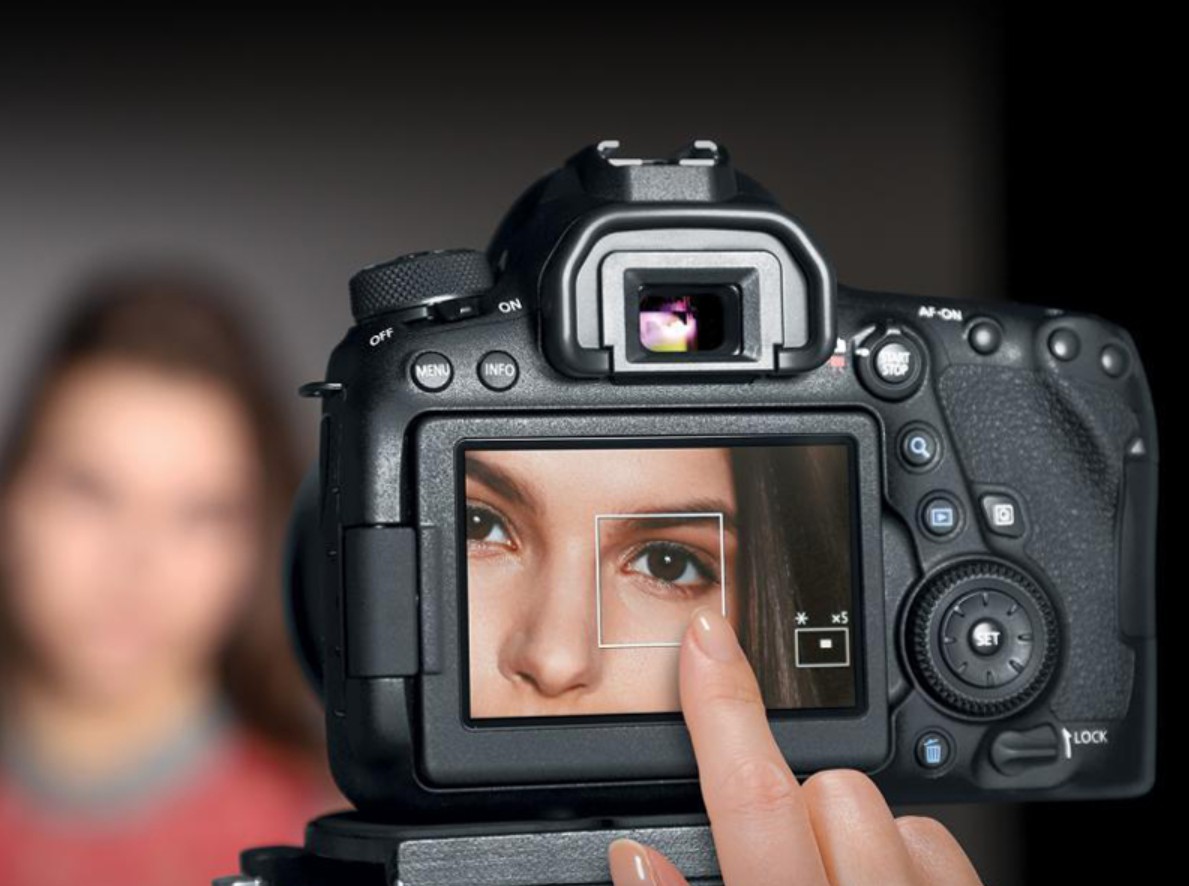
Conversely, manual focus (MF) requires the photographer to manually rotate the focus ring on the lens to adjust the focus. This mode is suitable for still photography, macro photography, or when low light makes it difficult for the AF system to function. Although slightly more time-consuming, MF provides absolute control for the photographer.
Understanding the two focusing modes will help you avoid missing important moments and create sharp images exactly as you want them.
8. Shooting modes on DSLR cameras
DSLR cameras offer various shooting modes, allowing users to control brightness at different levels. The four most common modes on the mode dial are M, A, S, and P.
Manual mode (M) is a fully manual mode. The photographer adjusts parameters such as aperture, shutter speed, and ISO themselves. This mode is suitable for those who want to learn advanced techniques or have complete control over every element in the frame.
Aperture Priority (A) mode prioritizes aperture. The photographer selects the aperture, and the camera calculates the appropriate shutter speed to ensure the image is properly exposed. This is a popular choice for portraits or landscapes, where depth of field is crucial.
Shutter Priority (S) mode prioritizes shutter speed. The photographer selects the shutter speed, while the aperture is automatically adjusted by the camera. This mode is useful when shooting sports, moving subjects, or at night when controlling subject blur is necessary.
Program mode (P) is an automatic mode where the camera automatically adjusts both aperture and shutter speed. Users only need to focus on composition and the moment. While easy to use, this mode limits creativity because it doesn't allow control over exposure.
Photography is not just about pressing a shutter button; it's a combination of technical and aesthetic elements. Mastering basic terminology like aperture, shutter speed, ISO, focal length, and shooting modes will give you a deeper understanding of how your camera works. Once you understand these, you'll be more confident in your creativity and expressing your emotions through each photograph


















VIP Products






Best Selling Products
MidJourney Account
29 USD
Autodesk All App Account Copyright
120 USD
Freepik Premium Account
59 USD
Windows 10 & 11 Pro Key
36 USD
Upgrade Duolingo Super
29 USD
Upgrade genuine Capture One account
120 USD
Upgrade Genuine Office 365
49 USD
Adobe Premiere Pro Account
99 USD
Plugin Retouch4me
69 USD
Capcut Pro 1 Year
39 USD
ChatGPT Plus Account (GPT-4)
16 USD
Genuine Adobe Illustrator account
99 USD
Genuine Cheap Canva Pro
39 USD
Adobe Photoshop Copyright - Full App
120 USD
Copyright Adobe Lightroom Account
59 USD