Best Selling Products

Capcut Pro 1 Year
39 USD

Upgrade Genuine Office 365
49 USD

Upgrade Duolingo Super
29 USD

Windows 10 & 11 Pro Key
36 USD

Copyright Adobe Lightroom Account
59 USD

ChatGPT Plus Account (GPT-4)
16 USD

MidJourney Account
29 USD

Genuine Cheap Canva Pro
39 USD

Upgrade genuine Capture One account
120 USD

Adobe Photoshop Copyright - Full App
120 USD

Plugin Retouch4me
69 USD

Freepik Premium Account
59 USD

Adobe Premiere Pro Account
99 USD

Genuine Adobe Illustrator account
99 USD

Autodesk All App Account Copyright
120 USD
What is Crop Factor? Understanding Sensor Cropping in Photography
Nội dung
- 1. What is Crop Factor?
- 1.1 Crop Factor on APS-C Sensor Cameras
- 1.2 Crop Factor on Micro Four Thirds Cameras
- 2. The Relationship Between Crop Factor and Focal Length
- 2.1 What is Focal Length?
- 2.2 Crop Factor and Equivalent Focal Length
- 2.3 How to Calculate Equivalent Focal Length
- 3. Crop Factor and Lenses
- 3.1 Full-Frame Lenses and Lenses for Crop Sensors
- 3.2 Micro Four Thirds Lens
- 4. How Does Crop Factor Affect Your Photography?
- 5. Conclusion
If you''ve ever bought a new camera or lens, you''ve probably heard the term "crop factor" at least once. It''s a seemingly complex concept, but incredibly important because it directly affects your field of view, magnification, and how you choose the right lens for your camera. This article will help you understand the nature of crop factor, how it affects focal length, how to choose lenses for different sensor types, and its practical impact on everyday photography.
1. What is Crop Factor?
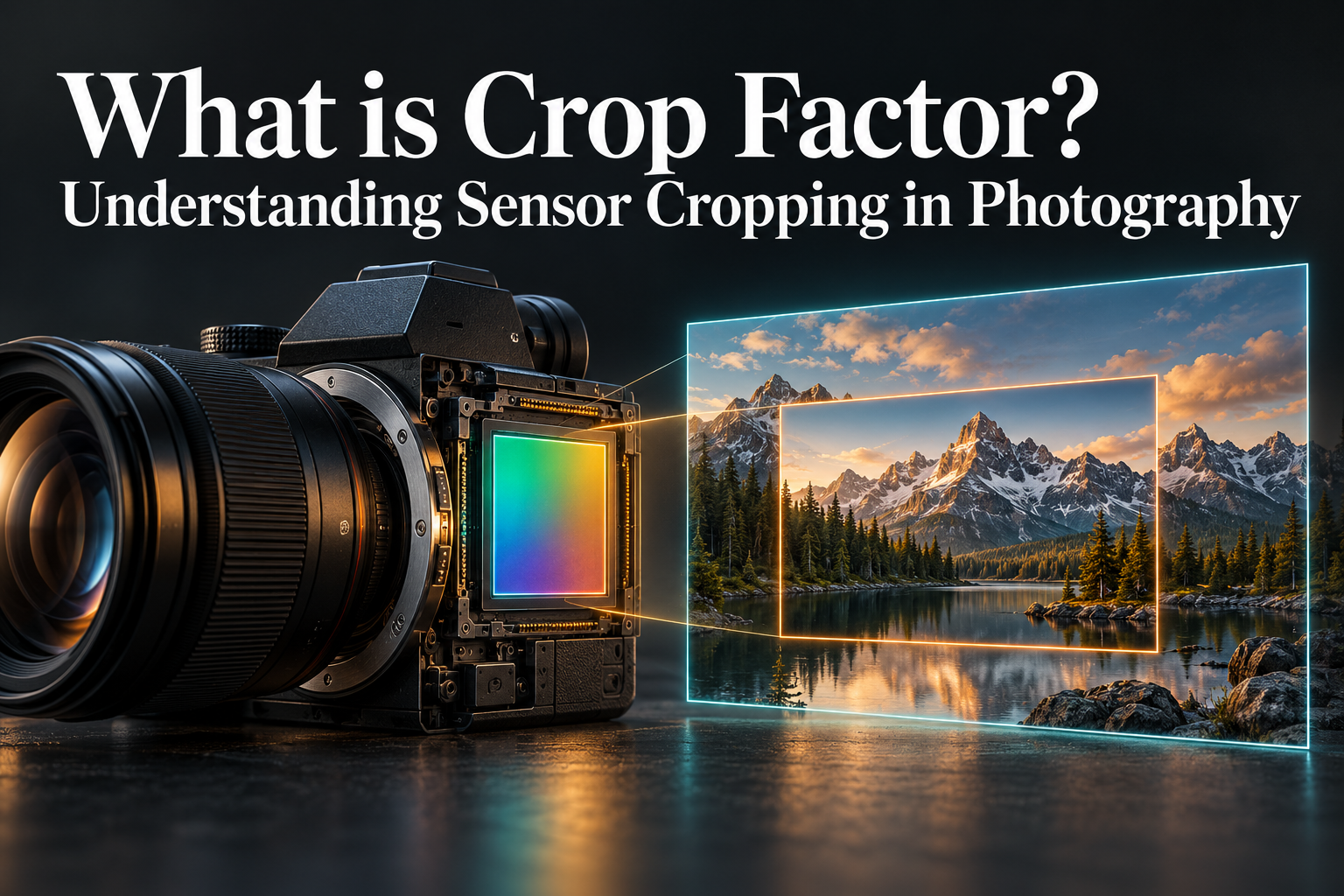
Crop factor, also known as the cropping coefficient, is the change in perspective and magnification that occurs when a lens is mounted on a camera with a sensor smaller than a standard full-frame sensor. In other words, it's a number that indicates how much the image is "cropped" compared to the full frame that the lens was originally designed to create.
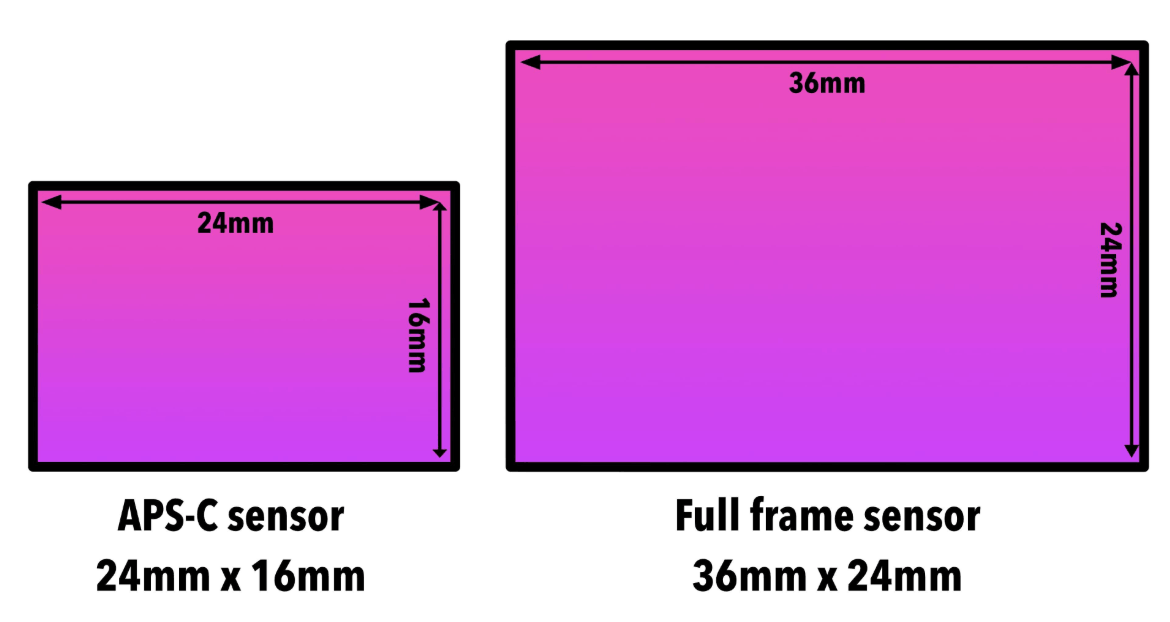
To understand this better, we need to go back to the concept of a full-frame sensor. A full-frame sensor is the same size as a 35mm film frame in traditional analog photography, and it's called "full-frame" because the image frame remains intact, without any cropping.
Optically, a camera lens always projects a circle of light. With a full-frame sensor, the four corners of the sensor reach close to the edge of that circle, so the entire frame is captured. Conversely, an APS-C sensor is smaller, meaning the four corners of the sensor cannot reach the edge of the circle of light. As a result, a large portion of the image is cropped, leading to a significantly narrower field of view compared to a lens mounted on a full-frame camera.
Any sensor smaller than full-frame is considered a crop sensor and will be affected by the crop factor, including both APS-C and Micro Four Thirds systems. The general consequence of the crop factor is a narrower but more magnified field of view. Figuratively speaking, the crop factor changes the actual focal length of the lens, creating what is called the "equivalent focal length," which significantly impacts how you use the lens and camera in practice.
1.1 Crop Factor on APS-C Sensor Cameras
APS-C sensors are smaller than full-frame sensors, which is why cameras using this type of sensor are often called crop sensor cameras, and they are always affected by the crop factor when attaching lenses.
While full-frame sensors are standardized at 36 x 24mm across all camera brands, APS-C sensor sizes vary by manufacturer. Nikon, Sony, and Fujifilm all use APS-C sensors measuring 23.6 x 15.7mm, while Canon uses a slightly smaller APS-C sensor at 22.2 x 14.8mm.
This difference in size leads to a difference in crop factor values. Specifically, Nikon, Sony, and Fujifilm APS-C cameras have a crop factor of 1.5x, while Canon APS-C cameras have a crop factor of 1.6x. These numbers are important because they form the basis for calculating the equivalent focal length, which helps you predict the actual field of view that the lens will provide when mounted on a particular crop sensor camera.
1.2 Crop Factor on Micro Four Thirds Cameras
Micro Four Thirds sensors, often abbreviated as MFT, are even smaller than APS-C sensors, measuring just 17.3 x 13mm. Because of their significantly smaller size compared to full-frame, these systems have to tolerate a considerably higher degree of cropping.
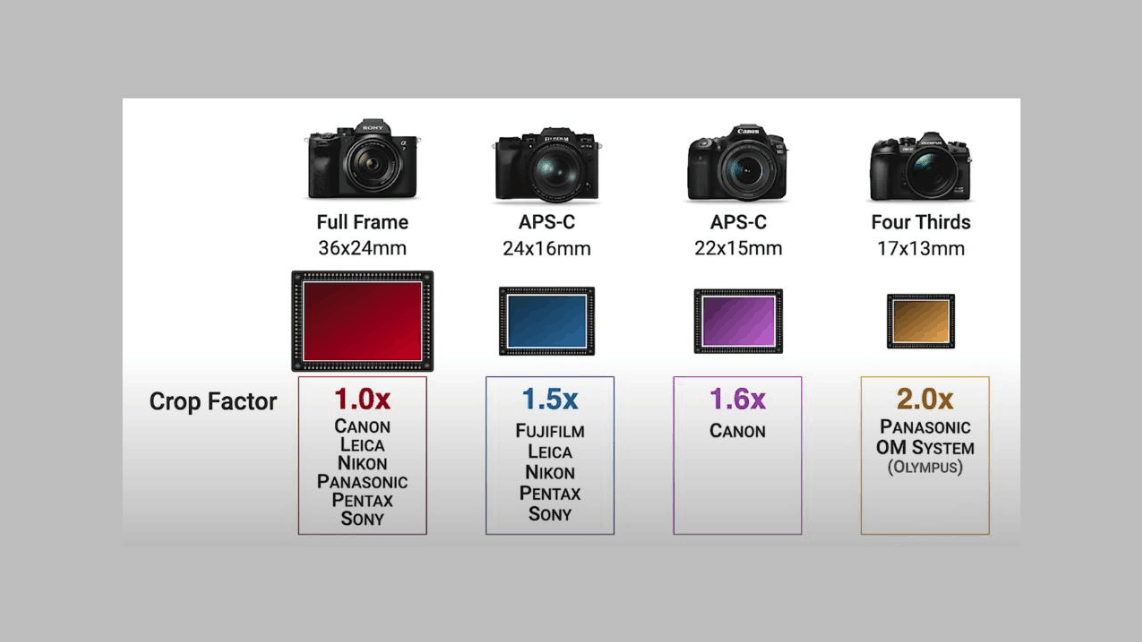
While APS-C sensors typically have crop factors ranging from 1.5 to 1.6x, Micro Four Thirds cameras boast crop factors up to 2.0x. This creates a significant difference in equivalent focal length, almost doubling the lens's original focal length. Notably, this effect persists even when using lenses specifically designed for the Micro Four Thirds system, not just full-frame lenses with adapters.
2. The Relationship Between Crop Factor and Focal Length
After grasping the basic concept of crop factor and why it exists, the next step is to understand how this factor affects photographers in practice. To do that, we need to delve into the concepts of focal length and equivalent focal length.
2.1 What is Focal Length?
Every photographic lens has a specification called focal length, usually measured in millimeters and printed on the lens body or front. Technically, focal length is the distance between the focal point inside the lens and the camera's sensor—that is, where light rays passing through the lens converge. For example, if you own a 50mm lens, the distance between the focal point and the sensor will be 50mm.
In practical terms, focal length tells us the angle of view that a lens will produce. A 50mm focal length is generally considered the standard, neither too wide nor too narrow, providing a field of view quite close to how the human eye observes the world around us.
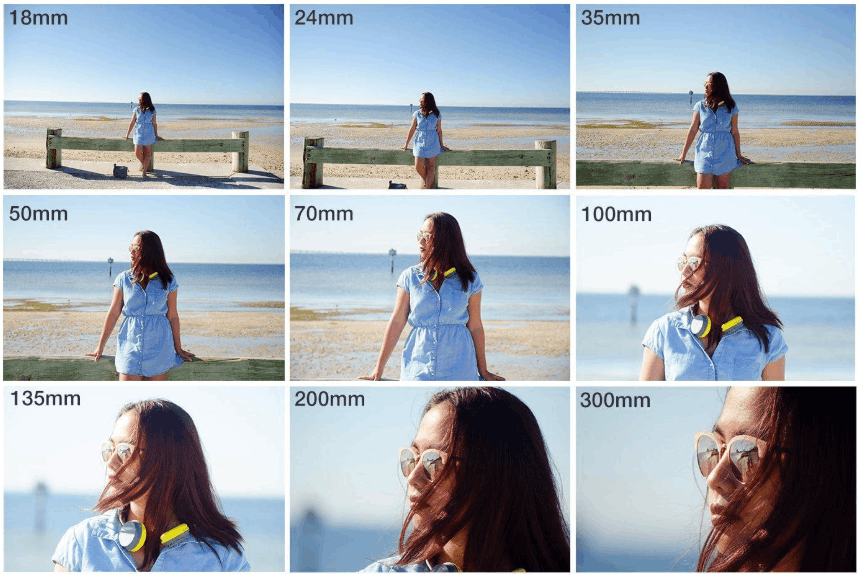
A shorter focal length, such as 24mm, will give you a wider field of view, allowing you to capture more detail of the scene in front of you, making it ideal for shooting expansive landscapes or confined spaces. Conversely, a 100mm focal length will create a telephoto field of view, meaning a narrower angle and greater magnification than a 50mm lens. The general rule is that the larger the focal length, the narrower the field of view and the greater the magnification of the subject.
2.2 Crop Factor and Equivalent Focal Length
When you attach a lens to a full-frame camera, the actual focal length remains the same as the specification written on the lens. If the lens is labeled 50mm, you will get the exact same field of view as a 50mm lens, and this applies similarly to all other focal lengths.
However, when the same lens is mounted on an APS-C or Micro Four Thirds camera, the crop factor changes the effective focal length. This new focal length is called the equivalent focal length, and it is always greater than the focal length indicated on the lens label, meaning the field of view becomes narrower.
It's called equivalent focal length because this number reflects the equivalent viewing angle of a lens with that focal length when mounted on a full-frame camera. Thanks to this concept, you can more visually compare the shooting experience between systems with different sensor sizes.
2.3 How to Calculate Equivalent Focal Length
Calculating the equivalent focal length is actually quite simple. Let's say you're using a Nikon APS-C camera with a crop factor of 1.5x. This number is the key to calculating the equivalent focal length of any lens when mounted on that camera.
The formula is very simple: multiply the focal length indicated on the lens by the crop factor. The result is the equivalent focal length. If you have a 50mm lens, the calculation would be 50 multiplied by 1.5, which gives 75, meaning the equivalent focal length is 75mm. This formula applies to all different focal lengths.
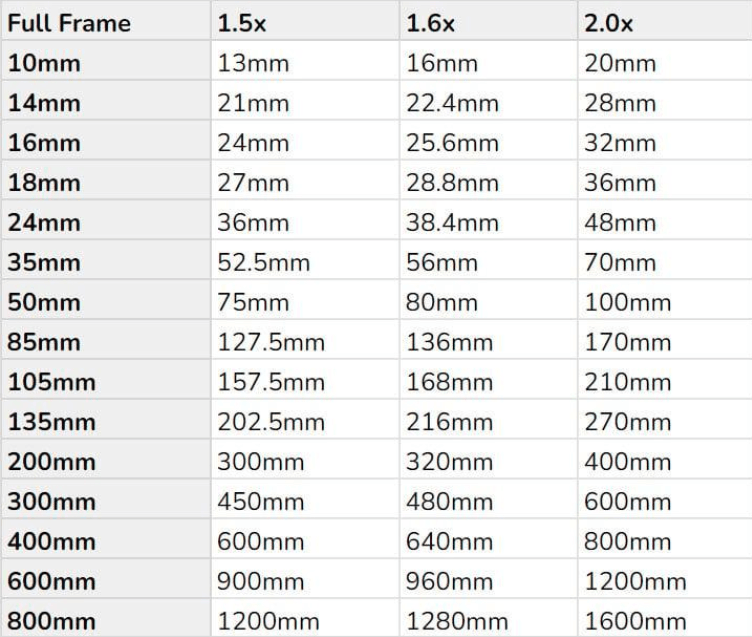
It's worth noting that Canon's APS-C cameras have a crop factor of 1.6x, so the calculation would be 50 multiplied by 1.6, which equals 80, meaning the equivalent focal length in this case is 80mm. Similarly, for a Micro Four Thirds camera with a crop factor of 2.0x, the same 50mm lens will give an equivalent focal length of 100mm, which is 50 multiplied by 2.0.
By knowing the lens's original focal length and the crop factor of your camera, you can quickly and accurately calculate the equivalent focal length.
3. Crop Factor and Lenses
Not only do cameras differ in sensor size, but lens manufacturers also produce two separate product lines: lenses for full-frame cameras and lenses specifically for crop sensor cameras.
3.1 Full-Frame Lenses and Lenses for Crop Sensors
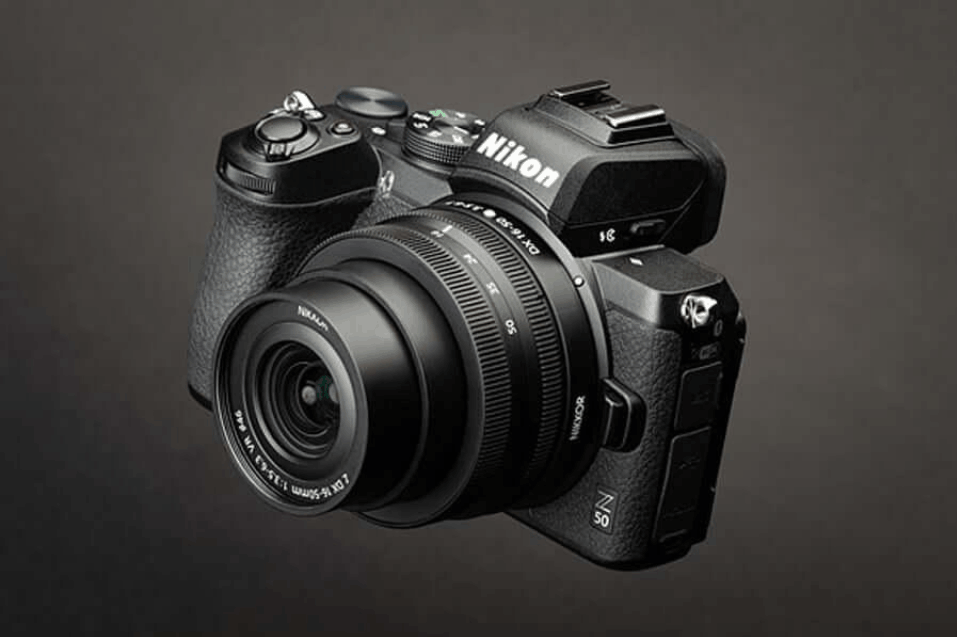
Nikon's F-mount lens lineup is one of the most diverse and longest-running lens collections on the market. The majority are full-frame lenses, but Nikon also produces some specialized lenses for crop-sensor cameras. These lenses are labeled DX, while full-frame lenses are labeled FX, and a similar classification applies to the company's Z-mount lenses for mirrorless cameras.
Canon also has its own line of lenses for APS-C sensors, labeled EF-S for DSLR cameras and RF-S for mirrorless cameras. Sony uses a similar classification system, with APS-C lenses labeled E and full-frame lenses labeled FE.
Although these lenses are designed for different sensors, they still use the same mount as the camera body, so you can attach a Nikon full-frame FX lens to an APS-C camera, or vice versa, attach a DX lens to a full-frame camera. However, if you use a crop lens on a full-frame camera, the circle of light will not be large enough to cover the entire sensor, resulting in vignetting or black edges at the corners of the frame, forcing you to crop the image after shooting.
The main issue when using full-frame lenses on crop sensor cameras is the crop factor, which alters the field of view. However, you should also note that even when using lenses specifically designed for APS-C cameras, you will still experience the effects of the crop factor as usual.
3.2 Micro Four Thirds Lens
Things become simpler with the Micro Four Thirds system. Currently, there are only two main manufacturers using this standard: Panasonic and OM System, the new name for Olympus. Both brands use the same MFT mount, also known as the 4/3 mount, meaning you can use Olympus lenses on Panasonic camera bodies and vice versa without any problems.
While Panasonic does produce full-frame cameras, these models use a completely different mount. OM Systems, on the other hand, only manufactures cameras using the Micro Four Thirds standard, so users don't need to worry about incompatible lenses.
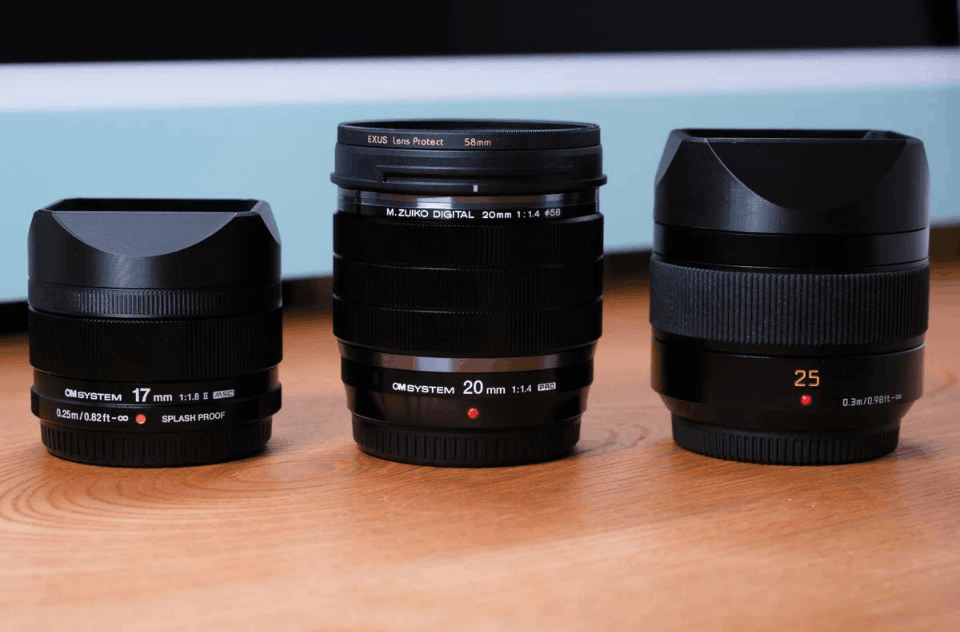
However, you should still keep in mind that Micro Four Thirds cameras have a 2x crop factor, meaning the equivalent focal length is double the focal length stated on the lens label, which can completely change the original purpose of a lens.
4. How Does Crop Factor Affect Your Photography?
The biggest impact of the crop factor on photography lies in the focal length. As analyzed above, the crop factor completely changes the effective focal length of the lens you are using, and this has very significant practical consequences in the creative process.
If you attach a 50mm lens but end up getting a 75mm equivalent field of view due to the crop factor, your lens has essentially transformed from a standard lens into a lightweight telephoto lens. While 50mm lenses are very popular in street photography, becoming a 75mm lens makes it much more difficult for photographers to work in cramped urban spaces where quick, close-up shots are required.
This problem is even more serious with Micro Four Thirds cameras, where a 50mm lens becomes a 100mm lens, resulting in a narrower telephoto field of view and significantly greater magnification than originally intended. For this reason, understanding the crop factor and how to calculate the equivalent focal length becomes crucial, as it will affect almost every photo you take with an APS-C or Micro Four Thirds camera.
Additionally, you also need to understand the difference between full-frame lenses and lenses specifically designed for crop sensors, as this has a significant practical impact on how you choose equipment and compose your shots.
5. Conclusion
Understanding crop factors is essential for anyone using an APS-C or Micro Four Thirds sensor camera, and this knowledge is useful even if you own a full-frame camera.
Crop factor changes the effective focal length of a lens, which can completely alter its original functionality. Therefore, you should thoroughly understand this concept before you start taking photos and know how to calculate the equivalent focal length for each type of lens and camera you are using.
Like many other topics in photography, crop factor may sound complicated and difficult to understand at first, but the concept is actually quite simple once you grasp its nature and how it affects images. Once you understand crop factor, you'll be able to make more informed decisions when choosing new cameras and lenses in the future.





















VIP Products








Best Selling Products
Capcut Pro 1 Year
39 USD
Upgrade Genuine Office 365
49 USD
Upgrade Duolingo Super
29 USD
Windows 10 & 11 Pro Key
36 USD
Copyright Adobe Lightroom Account
59 USD
ChatGPT Plus Account (GPT-4)
16 USD
MidJourney Account
29 USD
Genuine Cheap Canva Pro
39 USD
Upgrade genuine Capture One account
120 USD
Adobe Photoshop Copyright - Full App
120 USD
Plugin Retouch4me
69 USD
Freepik Premium Account
59 USD
Adobe Premiere Pro Account
99 USD
Genuine Adobe Illustrator account
99 USD
Autodesk All App Account Copyright
120 USD